Artwork
"He Turned Their Waters into Blood"
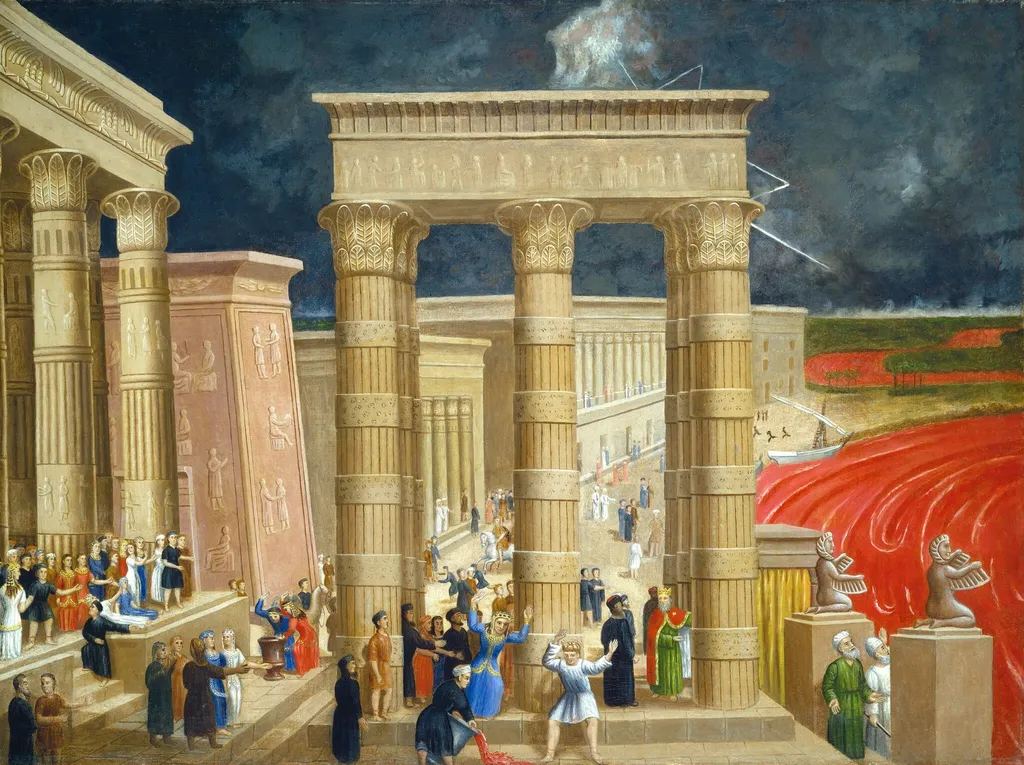
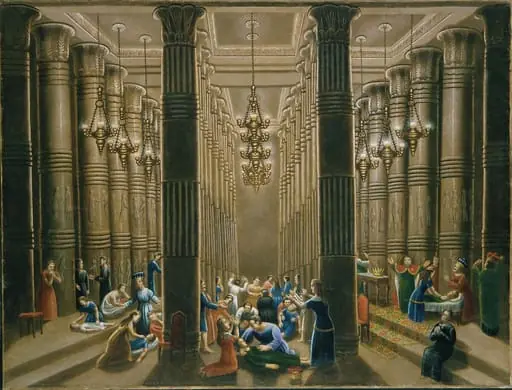
"He Turned Their Waters into Blood" is an oil painting by the American Folk Art artist Erastus Salisbury Field. It dates from 1872 and is held in the collection of the National Gallery of Art.
About this work
Technique & Style
The painting is classified as a religious work and is held in the collection of the National Gallery of Art in Washington, D.
He Turned Their Waters into Blood is an oil on canvas painting executed in 1865. The work measures 76.8 cm in height by 102.9 cm in width, giving it a horizontal orientation suited to its narrative religious subject. Its medium and support place it firmly within the traditional easel-painting practice of mid-nineteenth-century American history and biblical painters, with the canvas providing a ground for layered oil paint handling.
The painting is classified as a religious work and is held in the collection of the National Gallery of Art in Washington, D.C.
History & Provenance
Erastus Salisbury Field painted "He Turned Their Waters into Blood" in 1865. The work descended through the Cooley family of Sunderland, Massachusetts; the Cooleys were friends and neighbors of Field during his time in Plumtrees, Massachusetts, and his studio stood behind their home. The painting passed to Mrs. Esther Cooley Page, then to Robert Schuyler Tompkins of Sheffield, Massachusetts, who sold it in 1949 to Edgar William and Bernice Chrysler Garbisch. The Garbischs gave the painting to the National Gallery of Art in 1964.
The painting descended within the Cooley family of Sunderland, Massachusetts, eventually passing to Esther Cooley Page. It was subsequently acquired by Robert Schuyler Tompkins of Sheffield, Massachusetts, who sold the work in 1949 to collectors Edgar William and Bernice Chrysler Garbisch. The couple donated the piece to the National Gallery of Art in Washington, D.C., in 1964, where it remains part of the permanent collection.
Specific exhibition records for this work are not detailed in the available documentation, though its provenance establishes a clear line of ownership from the artist's neighbors to its current institutional home.
Overview
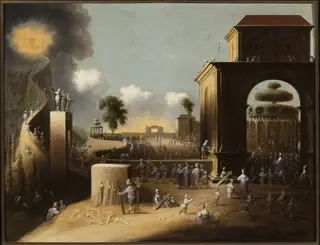
Erastus Salisbury Field’s oil on canvas, dated circa 1872, presents a biblical‑inspired scene titled “He Turned Their Waters into Blood.” The composition centers on an imposing, antiquated Egyptian‑style temple surrounded by a crowd, under a foreboding sky that hints at divine intervention.
Subject & Meaning
At the forefront, a robed figure in white lifts his arms, evoking a prophetic or pleading gesture. The surrounding onlookers appear uneasy, suggesting the painting visualizes the plague of blood described in the Exodus narrative, where water is transformed into a scarlet torrent.
Context
The painting aligns with a broader 19th‑century fascination with biblical catastrophes and exotic settings, merging Egyptian architectural motifs with a Judeo‑Christian story. This synthesis mirrors contemporary interests in archaeology and the expanding visual vocabulary of American religious art.
Own this work as a print
Artist & collection

- The Fire of Troy
 Narrow road of virtue and wide road of sin (Matthew 7:13-14)
 The Garden of Eden
 Untitled
 Gladiator fight
 The Building of the 'Argo'
 Christ in Limbo
 Grimmige Tiere und wilde Männer bedrohen das Menschenkind
 The Cathedrals of Wall Street
 Historienzyklus: Marcus Curtius opfert sich für das römische Volk
 The Healing of the cripple of Bethesda
 Triumfuri noi