Artwork
The Visit to the Nursery
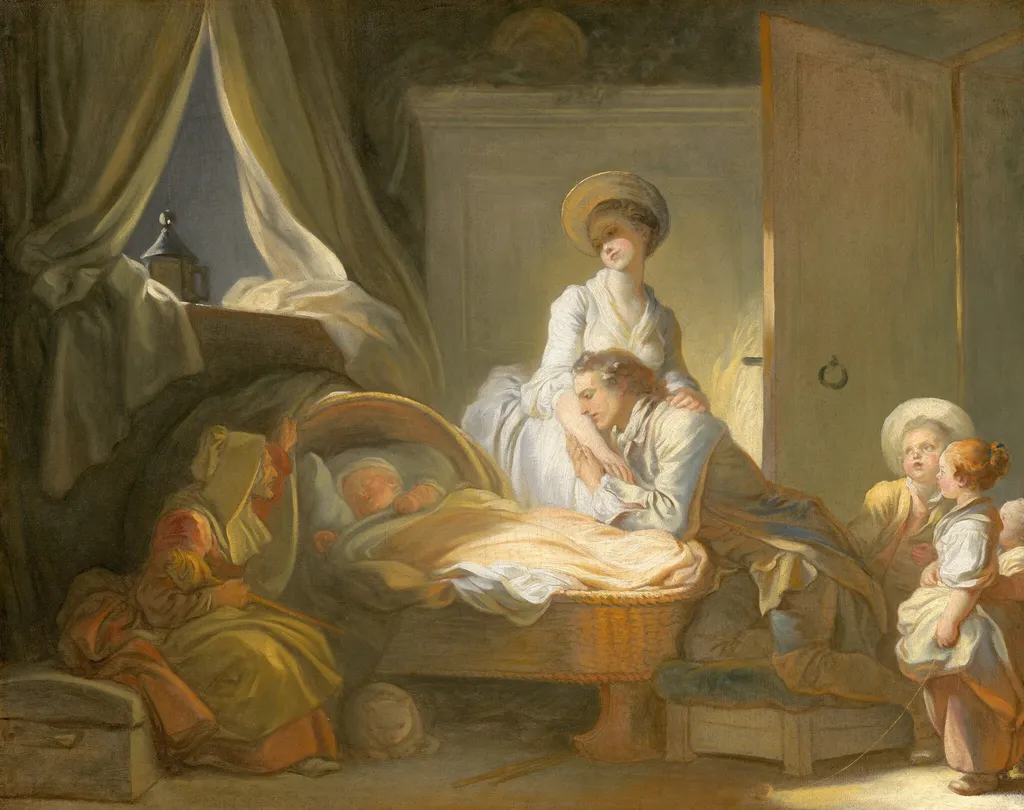
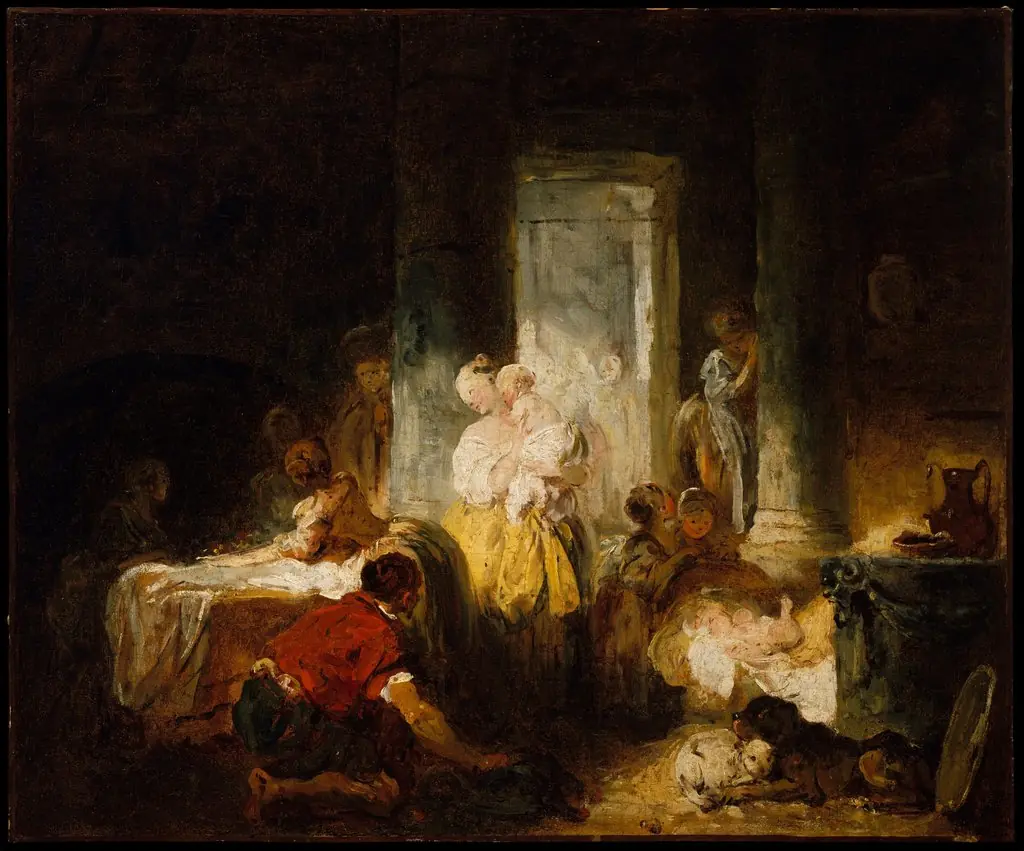
The Visit to the Nursery is an oil painting by the Rococo painting artist Jean Honoré Fragonard. It dates from 1775 and is held in the collection of the National Gallery of Art.
About this work
Subject & Meaning
The canvas shows a young couple together with their three children visiting a newborn baby who is asleep, while an elderly nurse sits beside the cot.
The canvas shows a young couple together with their three children visiting a newborn baby who is asleep, while an elderly nurse sits beside the cot. The composition is interpreted as a visual illustration of a scene from Jean-François de Saint-Lambert’s novel Sara Th. and l’Abenaki, emphasizing themes of family intimacy and innocent domesticity. The painting exemplifies the Rococo genre of genre scenes, which often celebrated everyday family moments with lightness and charm.
The presence of the nurse and the tender interaction conveys a sentimental narrative about parental care and the fragility of new life.
Technique & Style
The Visit to the Nursery is an oil painting on canvas created circa 1775. The work is executed in the Rococo style and belongs to the genre painting tradition, portraying an intimate domestic scene. Its support is a canvas ground, and the medium is oil paint, as indicated by its catalogued description and material specifications.
History & Provenance
The painting was executed circa 1775 as an oil-on-canvas genre scene. Its creation is documented in contemporary records that list the work as a genre composition by Fragonard, with the medium specified as oil on canvas.
The earliest known owner was Jean-François Leroy de Sennéville, fermier général, whose collection was dispersed in sales of April 1780 (lot 50) and April 1784 (lot 26). The work passed to Basan, then possibly to Madame Goman, and later to various dealers before entering the stock of the Samuel H. Kress Foundation in 1942, after which it was donated to the National Gallery of Art in Washington, D.C.
The painting is held in the National Gallery of Art, Washington, D.C., as part of the Samuel H. Kress Collection, with accession no. 1943.7.3.
Its exhibition history includes a display at Wildenstein & Co., New York, in 1939, before entering the Kress Foundation’s holdings, and a subsequent loan to the National Gallery of Art, marking its permanent presentation in the museum’s collection.
Context
Scholarship on Fragonard’s The Visit to the Nursery links the work to the Rococo taste for intimate, anecdotal scenes and the period’s fascination with childhood and family life. The painting’s provenance connects it to elite French collectors, including Jean François Leroy de Senneville, a fermier général, whose 1780 sale included a work later associated with this composition. Recent research has complicated this identification; a painting matching the 1780 description was rediscovered in Estonia, suggesting the Washington canvas may represent a variant or a later iteration of the subject.
Within Fragonard’s oeuvre, the work aligns with his genre scenes of the 1770s, which often idealized domestic affections and maternal themes, reflecting Enlightenment-era ideals of family virtue.
Its critical reception has emphasized its charm and narrative intimacy, though modern scholarship situates it within the broader Rococo tradition rather than as a groundbreaking composition. The painting entered the National Gallery of Art as part of the Samuel H. Kress Collection, securing its place in American museum holdings and contributing to the transatlantic appreciation of eighteenth-century French art.
Overview
Jean-Honoré Fragonard's oil on canvas painting, The Visit to the Nursery, was created around 1775. This work depicts a tender domestic scene, capturing a woman gently holding a child to view their reflection in a mirror within a furnished nursery setting. The painting is now housed in the National Gallery of Art in Washington, D.C., having joined its collection in 1946.
Own this work as a print
Artist & collection

Artist
Jean-Honoré Fragonard was born on 5 April 1732 in Grasse, the son of a glover, and moved with his family to Paris in 1738.


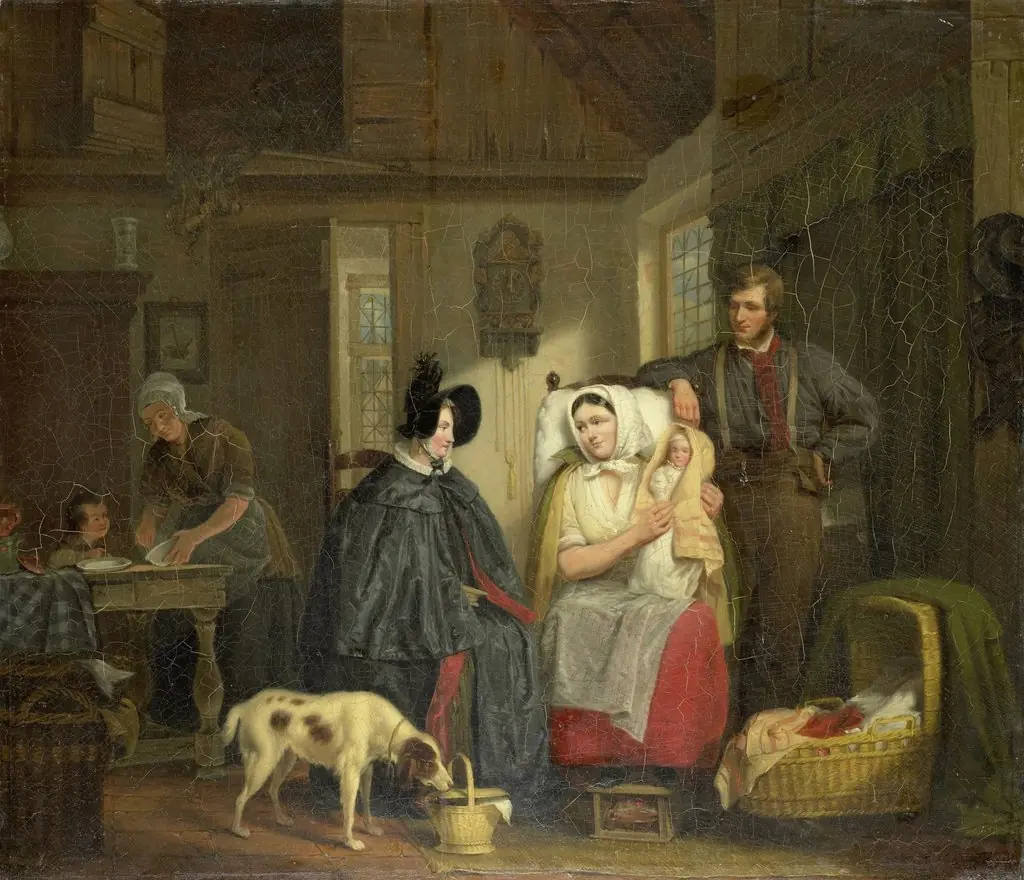 Visit to a New Mother
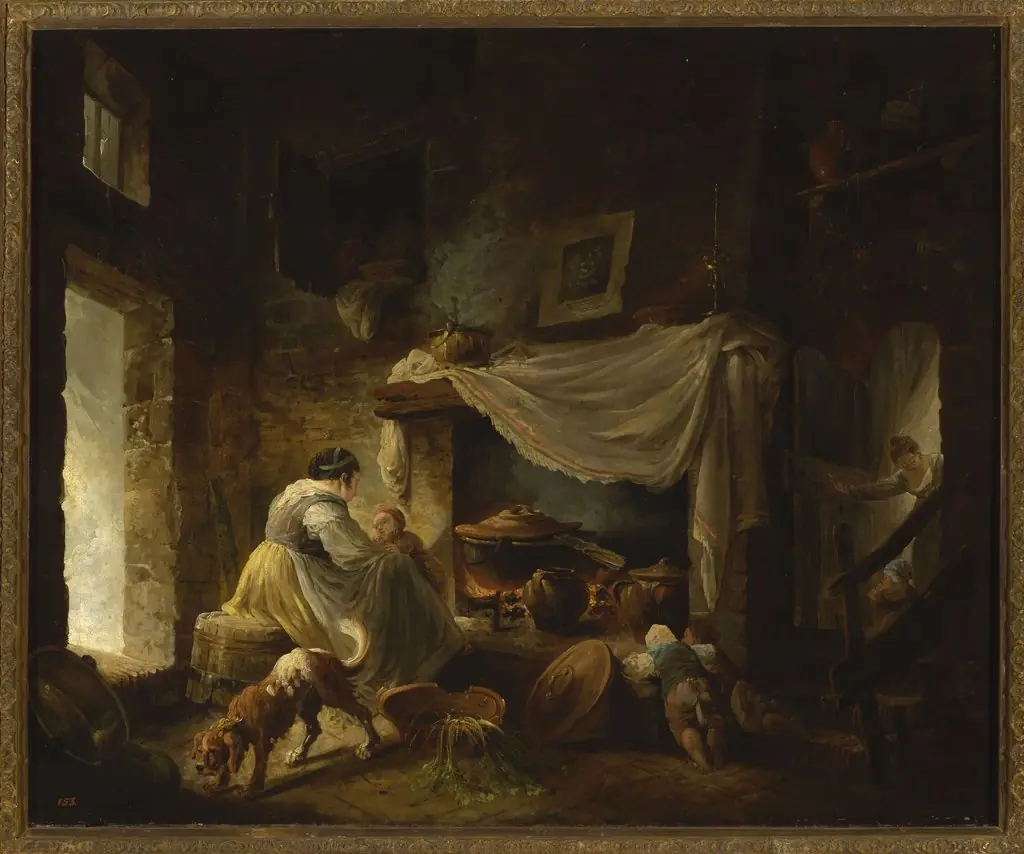 Peasant kitchen in ruins (Italian kitchen)
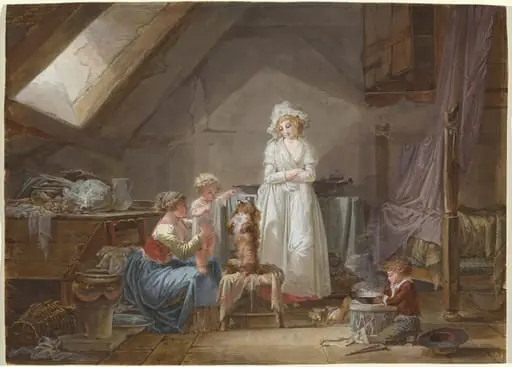 Young French Marquise in Exile in Lausanne
 Broken Eggs
 The Captured Kiss
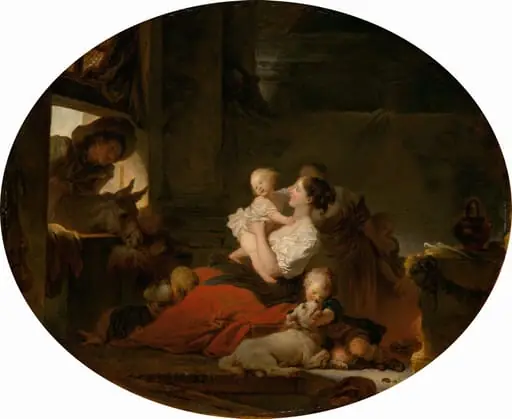 The Happy Family
 The Sailor's Return Home
 The Farewell of the Country Soldier
 Portrait of Aernout van Beeftingh, his Wife Jacoba Maria Boon and their Children
 Filial Piety (The Paralytic)
- Pamela tells a nursery tale