Artwork
Venus and Cupid
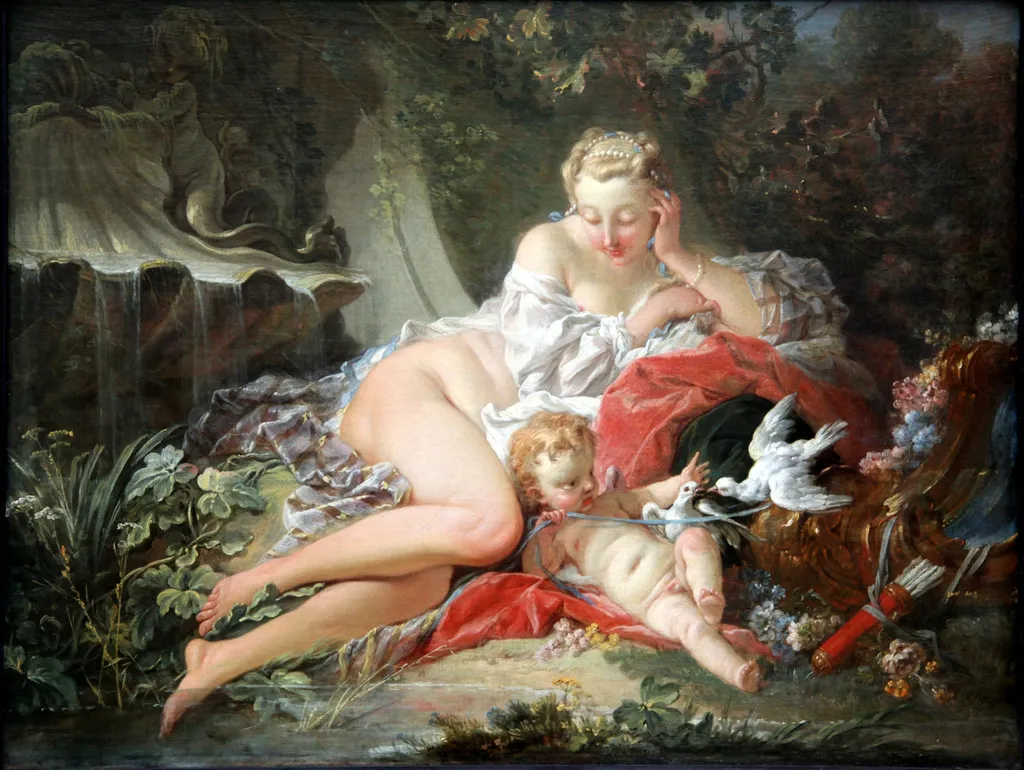
Venus and Cupid is an oil painting by the Rococo painting artist François Boucher. It dates from 1742 and is held in the collection of the Gemäldegalerie Berlin.
About this work
Overview
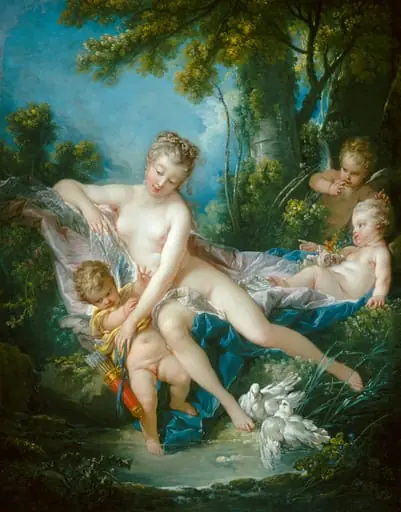
The work depicts the Roman goddess of love reclining with her son, the winged Cupid, in a lush forest setting.
Venus and Cupid is an oil on canvas painting by the French Rococo artist François Boucher, dated 1742. The work depicts the Roman goddess of love reclining with her son, the winged Cupid, in a lush forest setting. Measuring approximately 81 x 65 cm in its oval format, the painting is held in the collection of the Gemäldegalerie Berlin, where it is catalogued under the inventory number GG KFMV.272. The painting is considered one of Boucher's finest and most intimate small-format works, exemplifying the sensual, decorative aesthetic that dominated French art in the mid-eighteenth century and shaped the visual taste of an entire era.
Subject & Meaning
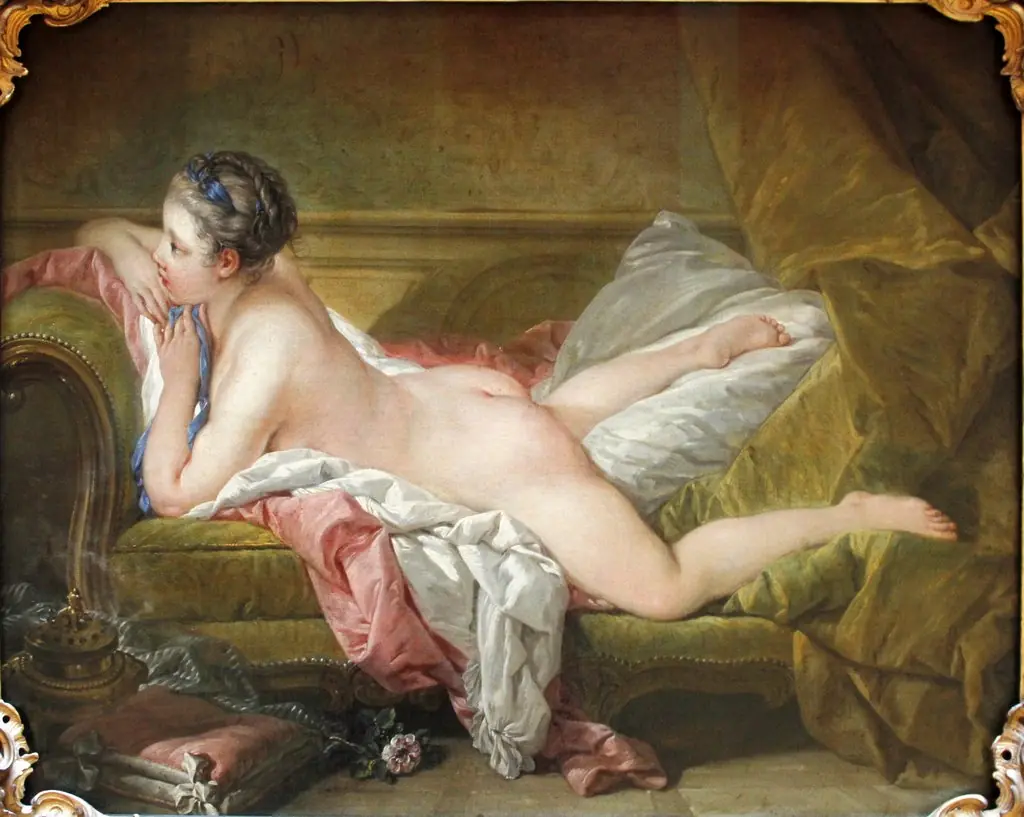
The painting depicts Venus reclining diagonally across the canvas, her body angled with legs extending toward the lower left, resting on her left elbow with her head propped in her right hand as she gazes downward at Cupid. The child stands near her torso, grasping a blue ribbon that tethers two white doves. The iconography draws upon well-established attributes of the goddess: the shell-shaped fountain with cascading water, the doves, scattered flowers, and pearls in her upswept hair all reference her mythical birth from the sea. Her Greek name, Aphrodite, means 'she who emerged from the foam.' Venus rests upon rich draperies described as striped Indian silk woven with golden thread. A quiver with arrows lies at lower right, and her slipped white blouse reveals the sensual beauty of her body. The roses, water, shell, and pearls function as traditional attributes linking the scene to Venus's marine origins. The intimate, languorous interaction between mother and son, set in a dusky forest clearing removed from human concerns, creates a fantasy of sensuality characteristic of Boucher's mythological inventions.
Technique & Style
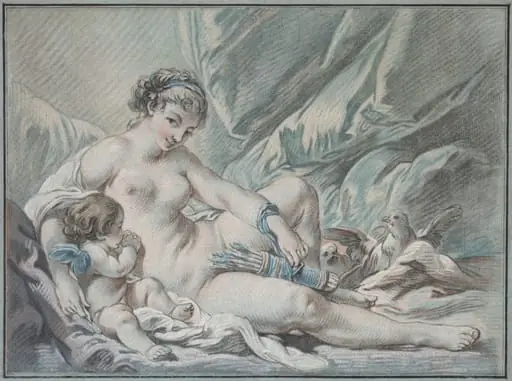
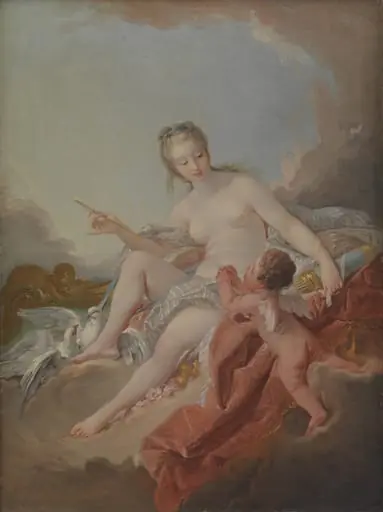
Boucher executed the work in oil on canvas, employing a technique that distinguishes between the treatment of flesh and setting. The brushwork appears smooth and blended on the skin, creating soft, yielding flesh tones, while looser, more textured strokes characterize the foliage and fabrics. The palette centers on warm pinks, creamy flesh tones, deep reds, crimson and mauve draperies, and muted greens, with soft, diffused light illuminating the figures from the left against a dark, enveloping background. The surface has a polished, finished quality with no visible underdrawing. The oval format, approximately 81 x 65 cm, suggests the painting was designed for integration into architectural settings, likely as an overdoor or within boiserie paneling. This small scale and high finish represent what scholars consider Boucher's finest and most intimate manner, comparable in style and handling to other mythological decorations of the early 1740s such as Venus Disarming Cupid and Cupid Caressing his Mother.
History & Provenance
Nothing is known of the painting's origins, first owner, or original location, though its oval format strongly suggests it was set in a boiserie frame as an overdoor decoration or as part of a larger decorative ensemble. A loosely sketched drawing in black and red chalks in the Musée des Arts Décoratifs, Paris, appears to be a preliminary study for the composition and shows its irregularly shaped format. The painting entered the celebrated Marcille collection in Paris, where it remained for more than a century. It was likely acquired by Eudoxe Marcille (1814-1890), painter and Director of the Musée des Beaux-Arts in Orléans from 1870, rather than inherited from his father François-Martial Marcille. The work was admired there by Jules and Edmond de Goncourt in the 1870s. The painting later became property of the Kaiser Friedrich Museumsverein and is now held by the Gemäldegalerie Berlin.
Context
François Boucher (1703-1770) spent nearly thirty years in the service of the king of France and estimated his own oeuvre at approximately 1,000 paintings and 10,000 drawings. His extraordinary career was unmatched by contemporaries in versatility, consistency, and scale of production. Through training with François Le Moyne and four years in Italy from 1727-1731, he mastered composition and acquired classical education. First employed by the Crown in the 1730s, he executed numerous royal and princely commissions until his death, working particularly for Louis XV's mistress, the Marquise de Pompadour, in the 1750s. Not since Charles Le Brun had a single artist so influenced the visual arts of his day. The early 1740s, when Venus and Cupid was painted, represents a period when Boucher was establishing his reputation for mythological subjects of exceptional quality. The Goncourt brothers, influential mid-nineteenth-century critics, recognized in this work Boucher's extraordinary energy as a painter, quoting Jacques-Louis David's tribute that 'it is only Boucher that one wants' as a colourist.
Legacy
Venus and Cupid stands as a defining example of Boucher's small-format mythological paintings, the genre in which he created what are probably his finest and most intimate works. The painting's reputation was secured through its residence in the Marcille collection, where it attracted the attention of the Goncourt brothers and figured in the revival of interest in the eighteenth century that gathered momentum in the 1870s. Eudoxe Marcille's Monday salon at 54, rue d'Hauteville became a gathering place for prominent figures in this revival, including the Goncourts and collector Louis La Caze, as well as contemporary artists such as Edgar Degas. The work continues to be recognized for its exceptional coloristic achievement and its encapsulation of Rococo sensuality. Its presence in the Gemäldegalerie Berlin ensures its accessibility as a key work for understanding Boucher's contribution to European painting and the broader cultural formation of French Rococo taste.
Own this work as a print
Artist & collection

Artist
François Boucher was a French painter, draughtsman and etcher, who worked in the Rococo style.