Artwork
Bullfights: A Spanish Knight Kills the Bull After Having Lost His Horse
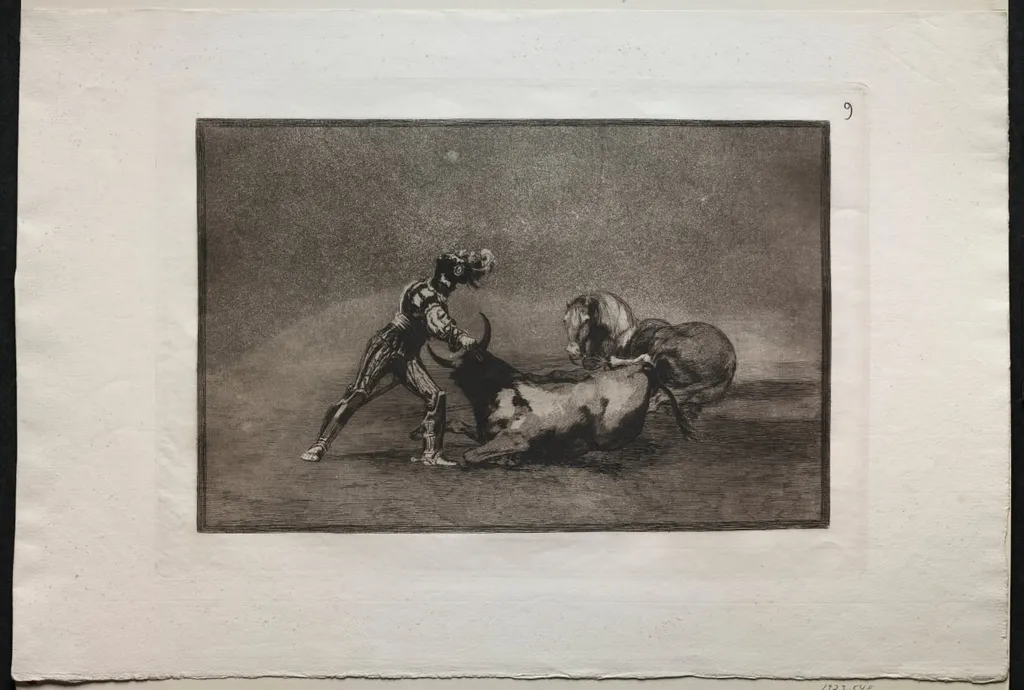
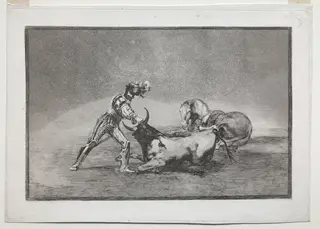
Bullfights: A Spanish Knight Kills the Bull After Having Lost His Horse is a print by the Romanticist artist Francisco de Goya. It dates from 1816 and is held in the collection of the Cleveland Museum of Art.
- Accession no.
- 1923.548
- Credit line
- Charles W. Harkness Endowment Fund
About this work
Overview
The composition emphasizes the physical exhaustion and peril of the combatant, capturing the raw brutality of the spectacle rather than its romanticized glory.
Created in 1816, 'A Spanish Knight Kills the Bull After Having Lost His Horse' is an etching by Francisco de Goya, part of his series 'La Tauromaquia' (The Art of Bullfighting). The work depicts a dramatic and chaotic moment within the bullring: a matador, clad in heavy armor, is dismounted and lies on the ground beside his fallen horse. He leans forward to deliver the final thrust to a wounded bull that sprawls nearby, its head turned toward the attacker.
Goya utilizes stark chiaroscuro, restricting illumination to specific patches on the figures to heighten the tension and isolate the violence from the surrounding darkness. The composition emphasizes the physical exhaustion and peril of the combatant, capturing the raw brutality of the spectacle rather than its romanticized glory. This piece reflects Goya's mature interest in the darker aspects of human behavior and Spanish culture, serving as a critical observation of the bullfight as a national ritual.
It stands as a significant example of his graphic work, bridging his earlier neoclassical training with the expressive, often grim realism that would later define his Black Paintings.
Subject & Meaning
The image captures the aftermath of a fatal encounter: the knight, having been unseated, lies beside his dead horse while the bull, also injured, lies nearby with its head turned toward the rider. The tableau suggests the peril inherent in the spectacle of bullfighting and the thin line between triumph and disaster for both man and animal.
Technique & Style
Executed as an etching, the piece relies on strong contrasts of light and shadow, a chiaroscuro effect that heightens the drama. Goya’s incising creates deep, velvety blacks against limited illuminated patches, emphasizing the weight of the armor, the twisted limbs of the horse, and the bulging form of the bull.
History & Provenance
Created in 1816, the print reflects Goya’s mature period, when he frequently explored violent public entertainments. It entered the Cleveland Museum of Art’s collection through acquisition in the 20th century, where it remains on view as part of the museum’s European prints and drawings department.
Context
The work belongs to a series of bullfighting images that Goya produced after the Peninsular War, a time when public spectacles served both as entertainment and as commentary on Spanish society. The depiction of a knight, a symbol of aristocratic honor, falling in the arena underscores the shifting social order of early 19th‑century Spain.
Artist & collection
Artist
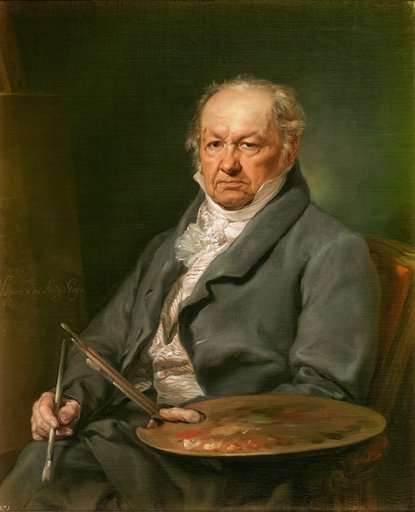
Francisco José de Goya y Lucientes was a Spanish romantic painter and printmaker.

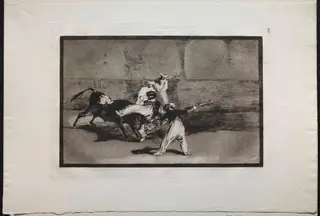
- Bullfights: A Moor Caught by a Bull in the Ring
 La Tauramaquia: A Spanish Knight Kills the Bull after Having Lost His Horse
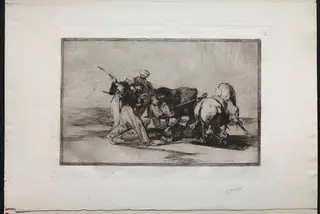 Bullfights: The Moors Settled in Spain, Giving Up the Superstitions of the Qur’an, Adopted this Art of Hunting, and Spear a Bull in the Open
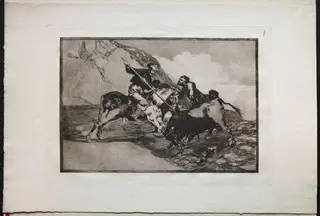 Bullfights: The Way in Which the Ancient Spaniards Hunted Bulls on Horseback in the Open Country
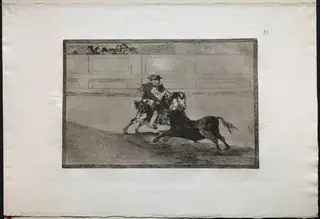 Bullfights: A Spanish Mounted Knight in the Ring Breaking Short Spears Without the Help of Assistants
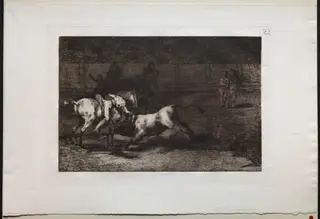 Bullfights: Mariano Ceballos, Alias the Indian, Kills the Bull From his Horse
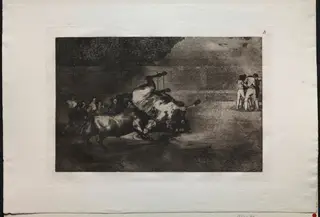 Bullfights: A Horse Thrown by the Bull
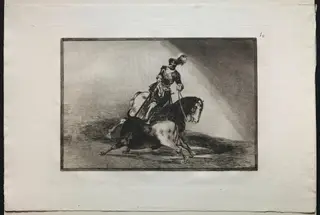 Bullfights: Charles V spearing a bull
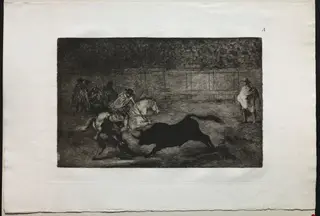 Bullfights: A Spanish Mounted Knight Breaking Short Spears with the Help of Assistants
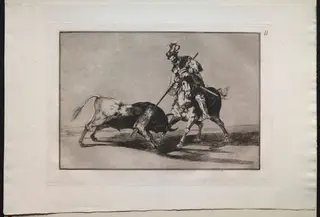 Bullfights: El Cid Campeador Spearing Another Bull
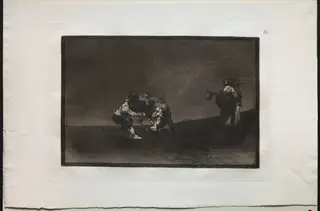 Bullfights: The Same Man Throws a Bull in the Ring at Madrid
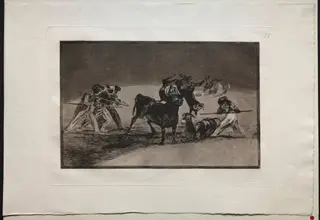 Bullfights: The Moors Use Donkeys as a Barrier to Defend Themselves Against the Bull Whose Horns Have Been Tipped with Balls