Artwork
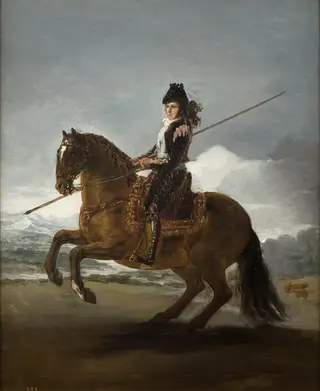
General José de Palafox on Horseback
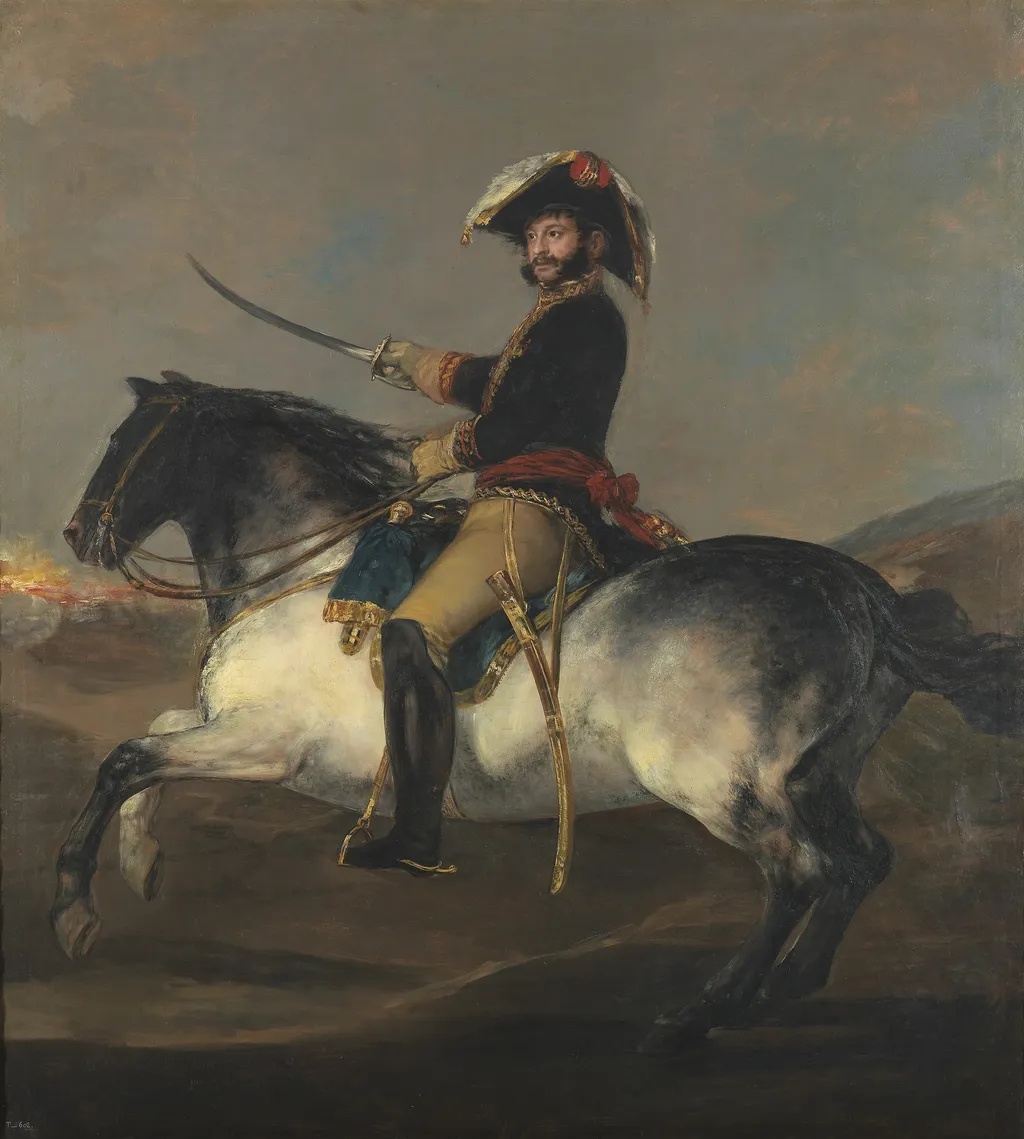
General José de Palafox on Horseback is an oil painting by the Spanish Baroque Tenebrist artist Francisco de Goya. It dates from 1814 and is held in the collection of the Museo del Prado. Francisco Goya’s 1814 oil painting presents General José de Palafonx mounted on a gray‑white horse.
About this work
Subject & Meaning
As a formal portrait created shortly after the Peninsular War, the composition serves to commemorate Palafox's leadership and status as a national hero.
The work is an equestrian portrait depicting José Rebolledo de Palafox, the 1st Duke of Saragossa, mounted on horseback. Painted in 1814 by Francisco Goya, the figure is shown holding a saber and a spotting scope, items that signify his military rank and strategic role as a commander. As a formal portrait created shortly after the Peninsular War, the composition serves to commemorate Palafox's leadership and status as a national hero.
The inclusion of specific military equipment alongside the traditional equestrian pose reinforces the subject's identity as a decisive figure in Spanish history.
Technique & Style
Created in 1814, General José de Palafox on Horseback is an oil painting executed on a canvas support. The work measures 248 cm in height and 224 cm in width, classifying it as a large-scale equestrian portrait. Francisco Goya employed oil paint to render the depiction of José Rebolledo de Palafox mounted on horseback, utilizing the medium to capture the general's attire and the inclusion of specific attributes such as a saber and a spotting scope.
The composition adheres to the formal conventions of the equestrian portrait genre, presenting the subject in a commanding stance that emphasizes his military status.
History & Provenance
General José de Palafox on Horseback is an oil-on-canvas equestrian portrait by Francisco Goya dated to 1814. The work was created in that year, as recorded in both the internal catalogue and the Wikidata entry, which gives the inception as 1814.
The painting is held in the collection of the Museo del Prado in Madrid, where it remains located according to the available records. No further details of commission, intermediate ownership, or acquisition history are documented in the sources provided.
The canvas measures 248 cm in height by 224 cm in width.
The painting is held by the Museo del Prado, which is listed as both its collection and its location. According to the Wikidata record for the work, it entered the museum's holdings as an oil on canvas measuring 248 by 224.
No specific inventory or accession number is provided in the available sources, and no exhibition history beyond its presence in the Prado's collection is documented.
Overview
Francisco Goya’s 1814 oil painting presents General José de Palafonx mounted on a gray‑white horse. The composition centers the commander in a dark military coat and tall white hat, his sword raised in one hand while the reins are held in the other. The scene is set against a vague, storm‑filled sky that recedes into darkness, emphasizing the figure’s prominence.
Context
The painting emerges from the turbulent years of the early 19th century, when Spain grappled with invasion and internal upheaval. Goya’s choice to portray a living military leader rather than a mythic figure signals a shift toward documentary realism in Spanish art. The work continues to inform studies of Goya’s engagement with political subjects and his adaptation of Baroque chiaroscuro for modern narrative.
Own this work as a print
Artist & collection
Artist
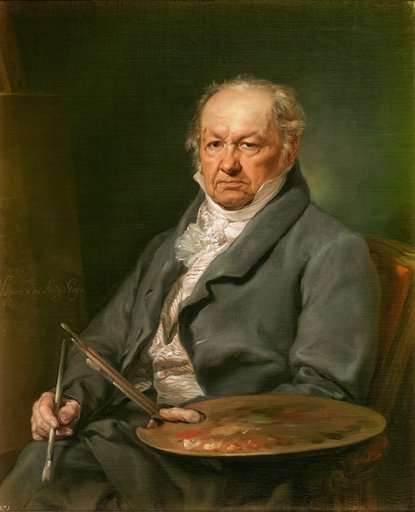
Francisco José de Goya y Lucientes was a Spanish romantic painter and printmaker.