Artwork
The Duchess of Alba and la Beata
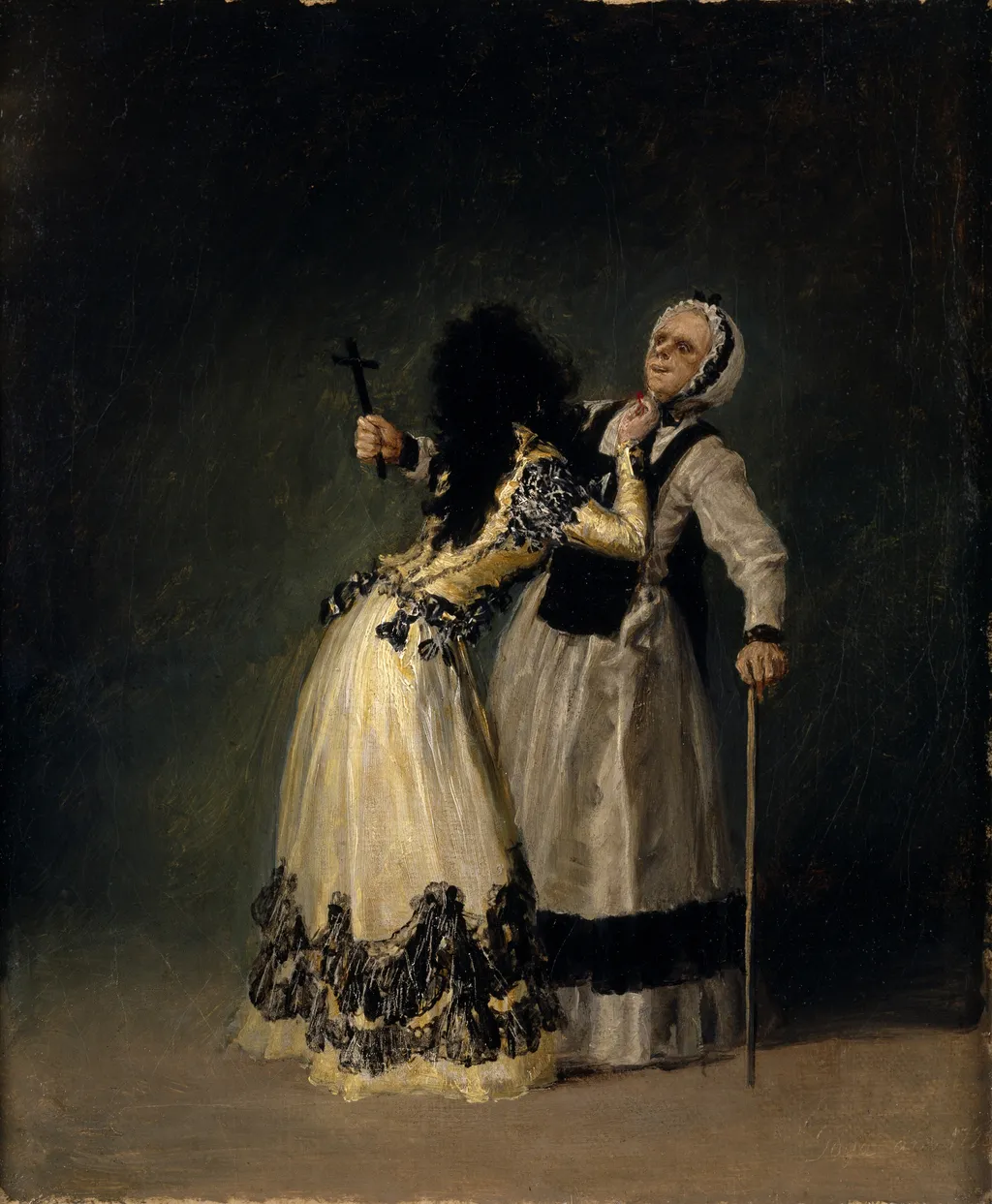
The Duchess of Alba and la Beata is an oil painting by the Neoclassicist artist Francisco de Goya. It dates from 1798 and is held in the collection of the Museo del Prado.
About this work
Subject & Meaning
The work portrays the 13th Duchess of Alba, María Cayetana de Silva, and her maid Rafaela Luisa Velázquez, known as “la Beata” or “la bigote.
The work portrays the 13th Duchess of Alba, María Cayetana de Silva, and her maid Rafaela Luisa Velázquez, known as “la Beata” or “la bigote.” The Duchess reaches toward the maid while holding a red cord beneath the older woman’s chin, a gesture that startles her; the maid recoils, leans back, rolls her eyes and curls her mouth in mock delight, gripping a wooden cross in her right hand. The Duchess is dressed in black lace and the maid in white, set against a flat black backdrop that isolates the scene.
Dated 1798 and associated with Goya’s “caprichos,” the painting offers a playful yet ambiguous commentary on piety, social hierarchy and superstition, noted for its informal intimacy and lack of spatial setting. It is housed in the Museo del Prado.
Technique & Style
The painting is an oil-on-canvas work measuring about 33 × 27.7 cm. Goya applied oil paint in broad brush strokes, using a palette dominated by white and black with touches of livid yellow, and set the figures against a flat black background. The composition isolates the Duchess and her maid and captures the Duchess mid-gesture with a red cord under the chin. Executed in 1798, the work exemplifies a freer, more informal technique than Goya’s official portraits, aligning it with the capricho spirit. The canvas is held in the Museo del Prado, having been acquired from a private collection.
History & Provenance
The Duchess of Alba and la Beata is an oil-on-canvas work by Francisco Goya dated 1798. It was painted around the time Goya was losing his hearing and is associated with his “caprichos.” The picture dates from the same period as his portraits of the Duchess dressed in white.
Before entering the Museo del Prado in Madrid, the painting belonged to a private collection, from which the museum acquired it. A Spanish source notes that the canvas forms a pair with another work depicting the same elderly servant teasing the children María de la Luz and Luis de Berganza.
Overview
Francisco Goya's 1795 oil-on-canvas painting, The Duchess of Alba and la Beata, depicts a playful interaction between the 13th Duchess María Cayetana de Silva and her maid, Rafaela Luisa Velazquez, known as 'la Beata.' This work is characterized by its dramatic composition and stark color palette, capturing a private moment. It is currently housed in the collection of the Museo del Prado in Madrid.
Context
Created in 1795, this work belongs to a period shortly after Goya experienced profound deafness, a development that influenced his artistic output. It is often associated with his 'caprichos' series, known for its satirical and imaginative themes. The Duchess of Alba was a significant figure in Goya's life and art; he painted her on several occasions, including the 1795 White Duchess and the 1797 Portrait of the Duchess of Alba, reflecting their complex relationship.
Own this work as a print
Artist & collection
Artist
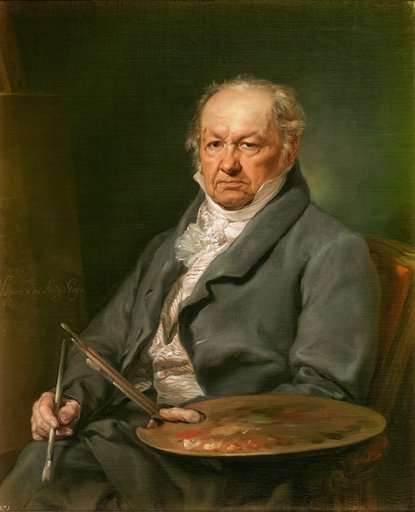
Francisco José de Goya y Lucientes was a Spanish romantic painter and printmaker.