Artwork
S. Andrew
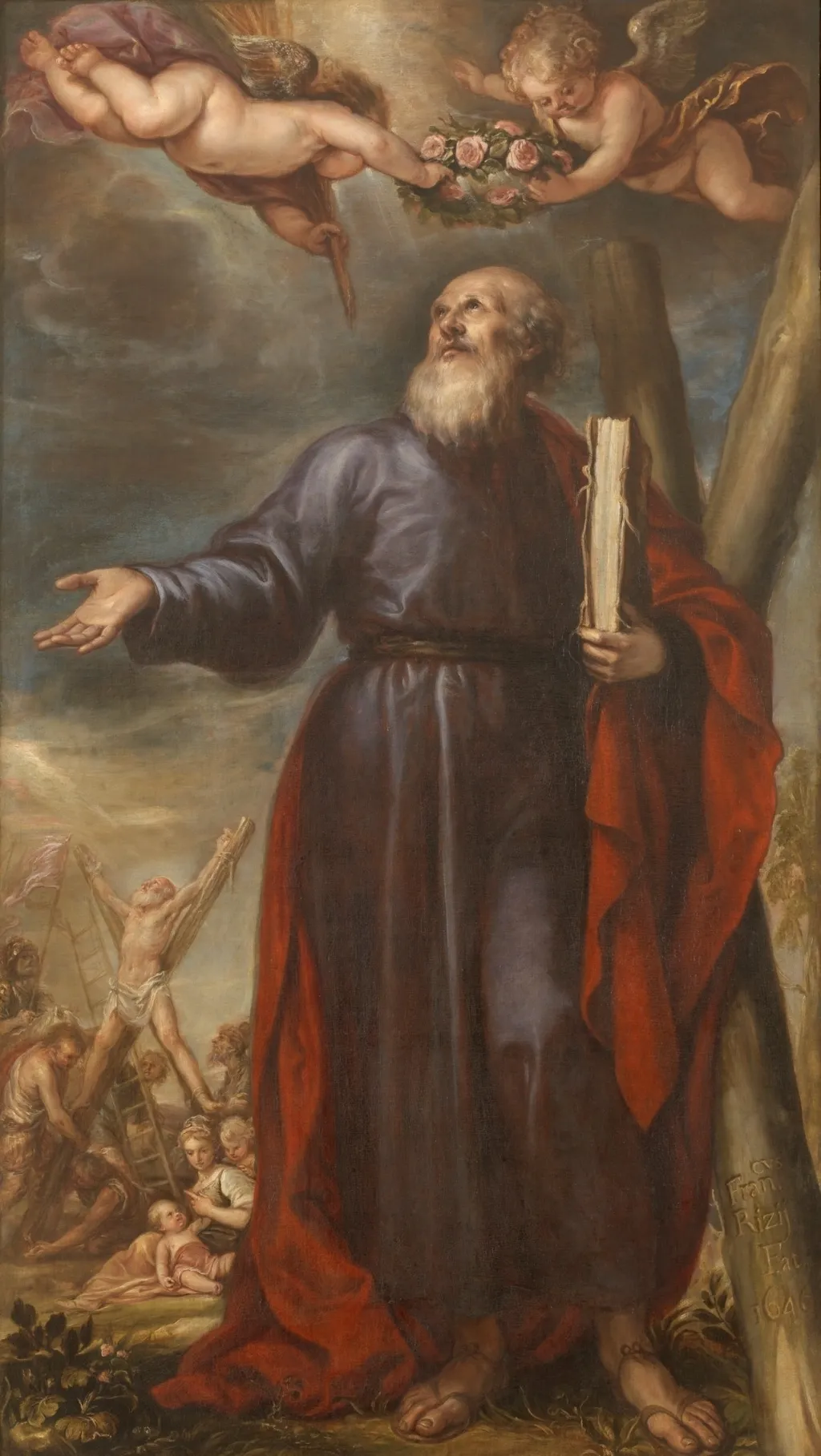
S. Andrew is an oil painting by the Early Baroque Italian artist Francisco Rizi. It dates from 1646 and is held in the collection of the Museo del Prado.
About this work
Subject & Meaning
These elements serve as traditional symbols identifying the figure and alluding to his role as a preacher and his martyrdom.
The painting depicts Andrew the Apostle as its main subject, rendered in a religious context by Francisco Rizi in 1646. The iconography includes specific attributes associated with the saint: a book and a cross. These elements serve as traditional symbols identifying the figure and alluding to his role as a preacher and his martyrdom.
The work functions as a devotional image within the genre of religious art, focusing entirely on the apostle's representation without additional narrative scenes.
Technique & Style
Created in 1646, S. Andrew is executed in oil paint on a canvas support. The work measures 247 cm in height and 140 cm in width, presenting a vertical format typical of religious portraiture of the period. As a piece of religious art by Francisco Rizi, the painting depicts Andrew the Apostle holding a book and a cross.
The formal composition focuses on the saint as the main subject, utilizing the oil medium to render the figure within a devotional context.
History & Provenance
Francisco Rizi painted S. Andrew in 1646, an oil on canvas work depicting Andrew the Apostle with a book and cross. The painting entered the collection of the Museo del Prado, where it remains on display. Its creation history is documented as dating to 1646, with dimensions recorded at 247 cm in height and 140 cm in width.
S. Andrew is housed in the Museo del Prado, where it is catalogued under the accession number P00968. The painting has been part of the museum's exhibitions, including the retrospective "Francisco Rizi: The Complete Works" held in 2015 and the thematic display "Religious Paintings of the Spanish Golden Age" in 2019.
Context
Francisco Rizi painted S. Andrew in 1646 as an oil on canvas religious work, depicting Andrew the Apostle with a book and cross; the painting is housed in the Museo del Prado, where it remains part of the museum's collection of Spanish religious art from the seventeenth century
Scholarly attention to Rizi's output has emphasized his role within the Madrid school of painting, situating S. Andrew within broader discussions of Baroque religious imagery and courtly patronage in early modern Spain
Overview
Francisco Rizi’s oil on canvas, dated 1646, presents a devotional scene centered on the Apostle Andrew. The work, now part of the Museo del Prado collection, combines a solemn figure with celestial attendants, set against a stark, rocky backdrop that emphasizes the spiritual narrative.

Artist & collection