Artwork
Frontispiece for the Sacred Cosmologia (Title with Astrologers)
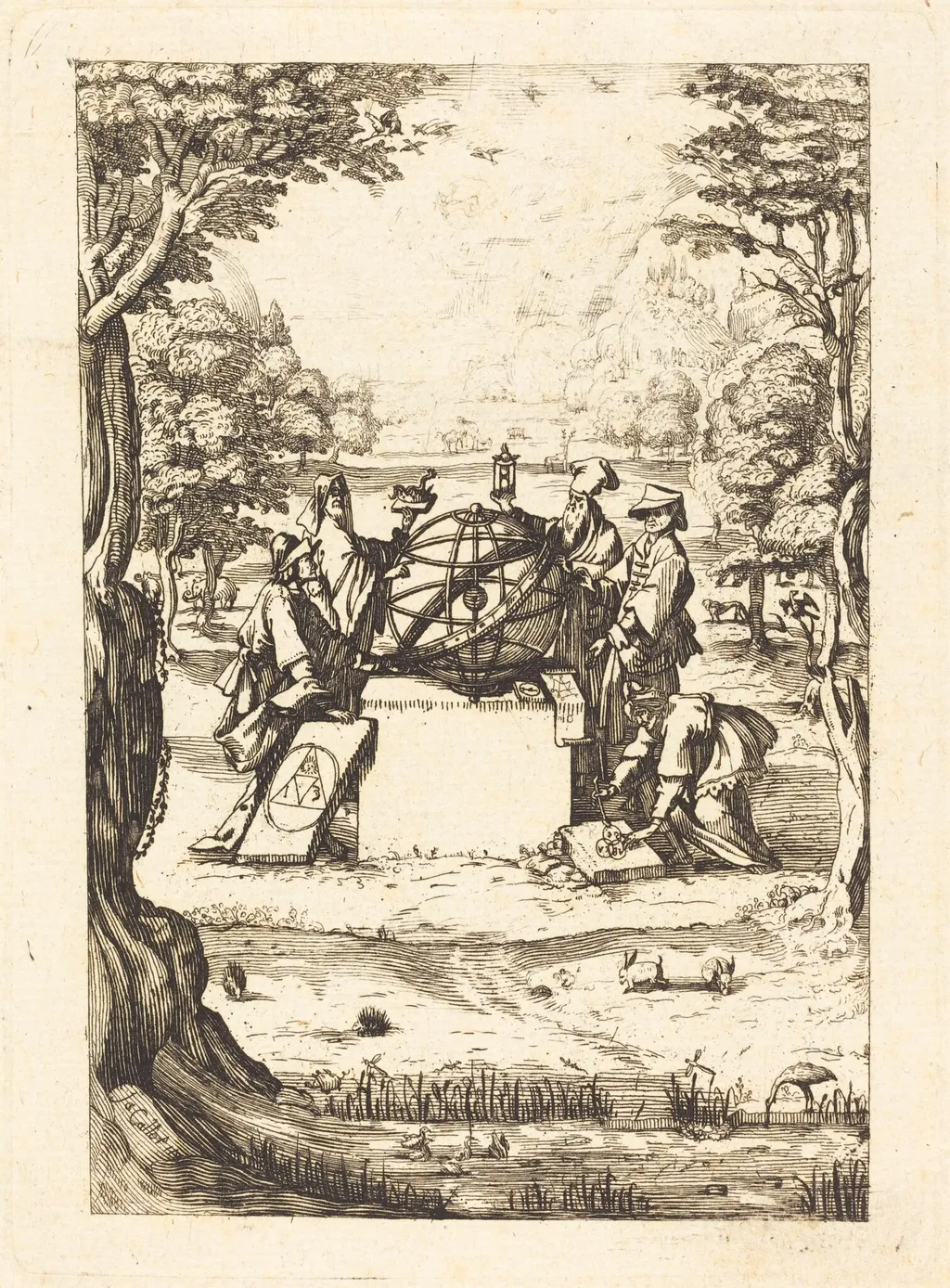
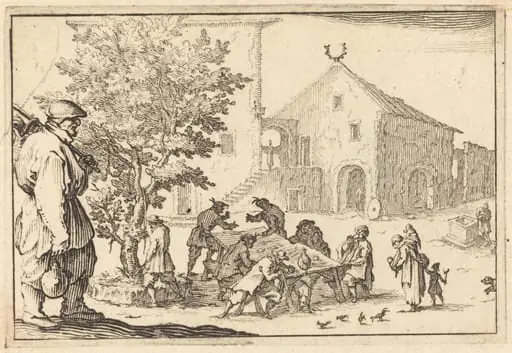
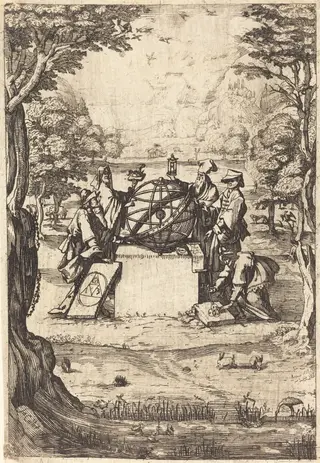
Frontispiece for the Sacred Cosmologia (Title with Astrologers) is an ink print by the Baroque artist French 17th Century. It dates from 1630 and is held in the collection of the National Gallery of Art. This black-and-white etching serves as the frontispiece for a treatise titled Sacred Cosmologia.
About this work
Overview
Rendered on laid paper, it depicts a group of figures engaged with a complex mechanical device resembling an astronomical instrument.
This black-and-white etching serves as the frontispiece for a treatise titled Sacred Cosmologia. Rendered on laid paper, it depicts a group of figures engaged with a complex mechanical device resembling an astronomical instrument. The composition blends natural elements, trees, a river, wildlife, with scholarly activity, suggesting a convergence of empirical observation and contemplative inquiry into the cosmos.
Subject & Meaning
Three figures interact with a gear-driven machine topped by a globe, symbolizing celestial study. One sits contemplatively with a small orb, while two others stand, holding a lantern and a dog, hinting at vigilance and companionship in pursuit of knowledge. The scene evokes a sacred engagement with the heavens, where science and mysticism coexist, reflecting early modern views of the universe as both measurable and divinely ordered.
Technique & Style
Executed in fine etching lines, the print achieves detail through controlled incisions on a metal plate, inked and pressed onto damp paper. The contrast between dark, dense forms and delicate background elements, birds, foliage, water, creates depth without color. The meticulous rendering of gears and textures reflects a precision typical of scientific illustration, while the atmospheric setting lends a poetic tone.
History & Provenance
The print was produced as an introductory image for a cosmological text, likely published in the late 16th or early 17th century. Its association with Sacred Cosmologia implies a scholarly or ecclesiastical context, possibly commissioned by a learned circle interested in astronomy and natural philosophy. No definitive artist or publisher is recorded, but its style aligns with Northern European print traditions of the period.
Context
During the Renaissance and early Baroque, cosmological texts often paired scientific imagery with symbolic elements to convey the harmony between divine order and human inquiry. This frontispiece reflects a time when astronomy, astrology, and theology were not yet fully distinct disciplines. The inclusion of animals and a natural landscape grounds abstract knowledge in the tangible world, reinforcing a holistic worldview.
Legacy
As a visual artifact of early scientific publishing, this etching exemplifies how printed images helped disseminate complex ideas to literate audiences. Though the original text may be obscure today, the image endures as a quiet testament to the era’s fascination with mapping the heavens. It remains a valuable reference for understanding the visual language of pre-modern natural philosophy.
Artist & collection

Artist
Seventeenth-century French printmakers worked in burin and acid. See the Beggar Woman with Rosary (1622), etched on laid paper with her hands folded in prayer, or The Siege of La Rochelle (1628/1631), one sheet from a…