Artwork
Jesus Attracting the Faithful to Heart
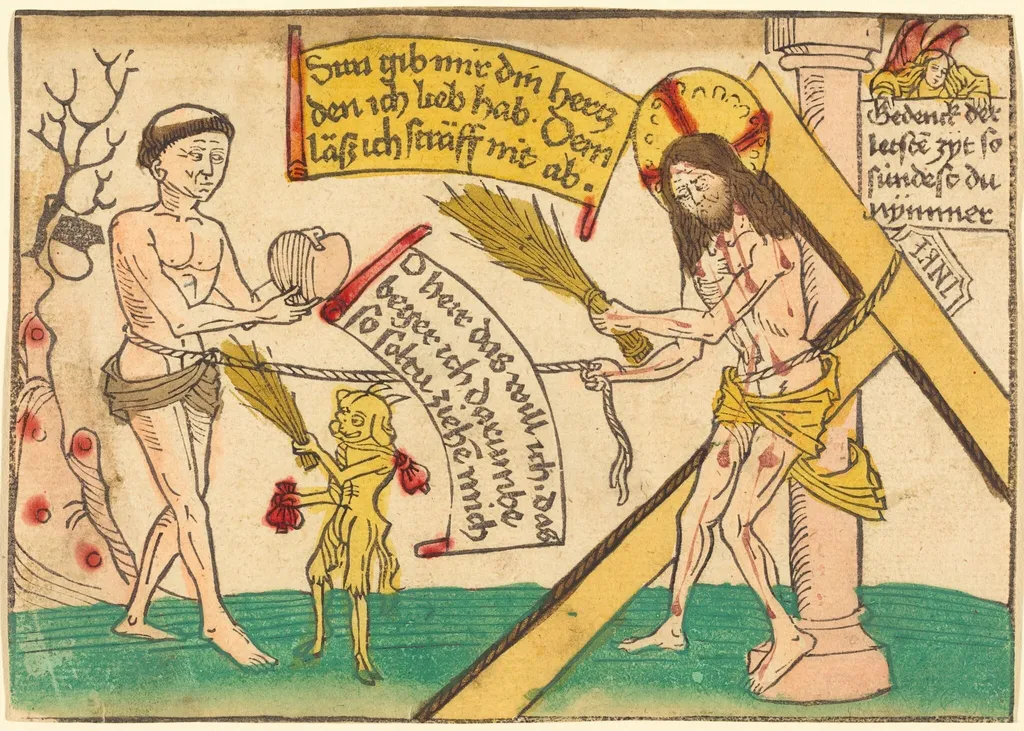
Jesus Attracting the Faithful to Heart is an ink print by the Renaissance artist German 15th Century. It dates from 1485 and is held in the collection of the National Gallery of Art.
- Inscription
- Inscribed:at top center, on banderole, in block: Sun gib mir din hercz / den ich lieg hab. Dem / läß ich sträff nit ab. (Son, give me your heart. I do not remit the punishment of the one that I hold dear.); at center, on banderole, in block: O herr das will ich. das / beger ich darumbe / so soltu ziehe mich (O Lord, this I want, I desire it, for this reason thus should you pull me.); at upper right, on card held by angel, in block: Gedenck der / letste zÿt so / sündest du / nÿmmer (Think of the last days; then you will never sin.) [translations from Parshall, Peter, and Rainer Schoch. _Origins of European Printmaking: Fifteenth-Century Woodcuts and Their Public._ Washington, DC: National Gallery of Art, 2005, p. 282.]
About this work
Overview
This hand-colored woodcut depicts a religious scene centered on a figure identified as Jesus, rendered with bold, flat colors and simplified forms.
This hand-colored woodcut depicts a religious scene centered on a figure identified as Jesus, rendered with bold, flat colors and simplified forms. The image was produced by carving an image into a wooden block, inking it, and pressing it onto paper, then adding pigment by hand in yellow, green, brown, red lake, and olive brown. The technique reflects early modern printmaking practices in which images were mass-produced yet individually colored, blending mechanical reproduction with artisanal detail.
Subject & Meaning
The central figure, marked by a halo and crown of thorns, holds a whip and a scroll inscribed with German text, suggesting a call to repentance or devotion. A shirtless man with a jug and a small child holding a red object stand nearby, possibly representing different responses to divine appeal. The composition invites viewers to consider spiritual receptivity, with the child symbolizing innocence and the man perhaps embodying earthly needs drawn toward sacred authority.
Technique & Style
Executed as a hand-colored woodcut, the image relies on strong outlines and minimal shading, typical of Northern European print traditions. Colors were applied manually after printing, resulting in variations between impressions. The flat, unmodulated hues and stylized figures reflect a folk or devotional aesthetic, prioritizing symbolic clarity over naturalism. The crude yet deliberate lines suggest an artisanal workshop rather than a refined academic studio.
History & Provenance
The work likely originated in early 16th-century Germany, during a period when woodcuts were widely used for religious instruction and popular devotion. Its German text and stylistic features align with Protestant Reformation-era prints meant for lay audiences. While its exact origin and early owners are undocumented, similar prints circulated among communities seeking accessible visual theology outside ecclesiastical control.
Context
This print emerged amid widespread religious upheaval, when printed images became tools for conveying doctrine to non-literate populations. The depiction of Jesus with a whip may reference the cleansing of the temple, while the scroll’s message reinforces moral urgency. Hand-coloring made such prints more valuable and personal, bridging the gap between mass production and private piety in a time of shifting spiritual authority.
Legacy
As a surviving example of devotional woodcut art, this piece illustrates how visual culture supported religious engagement before the dominance of oil painting or lithography. Its survival speaks to the enduring role of print in shaping popular piety. Though not attributed to a known artist, it contributes to understanding how ordinary people encountered and internalized sacred narratives through accessible, tactile imagery.
Artist & collection

Artist
This 15th-century German artist carved vivid religious scenes into metal and wood, then hand-painted them in bright, symbolic colors.

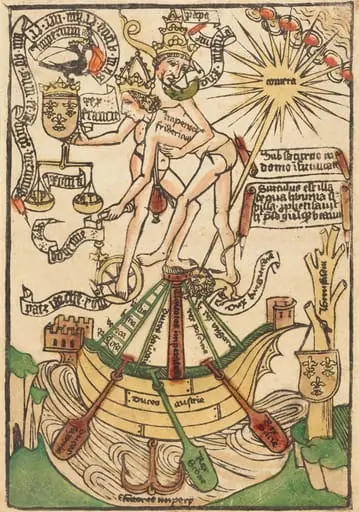 Allegory of the Meeting of Pope Paul II and Emperor Frederick III
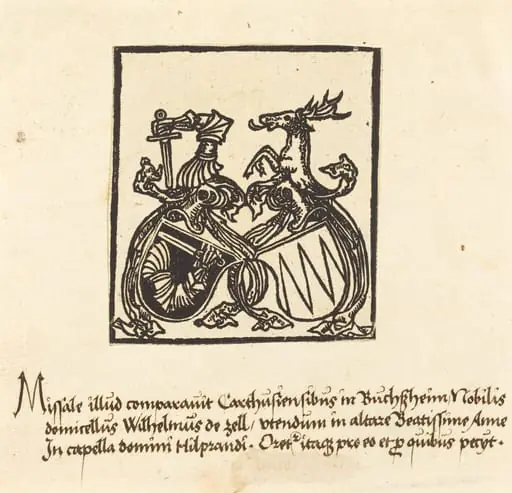 Bookplate of Wilhelm von Zell
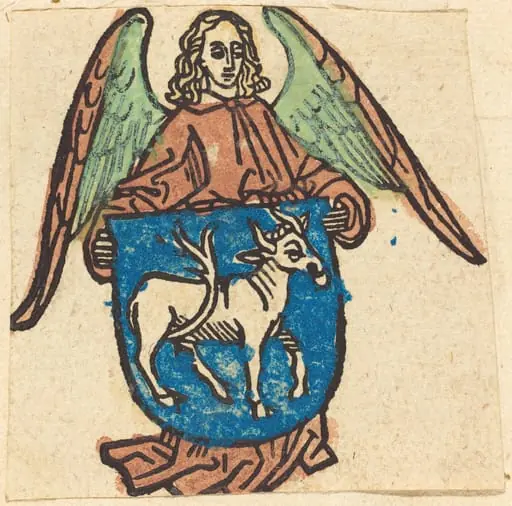 Bookplate of Hilprand Brandenburg of Bibrach
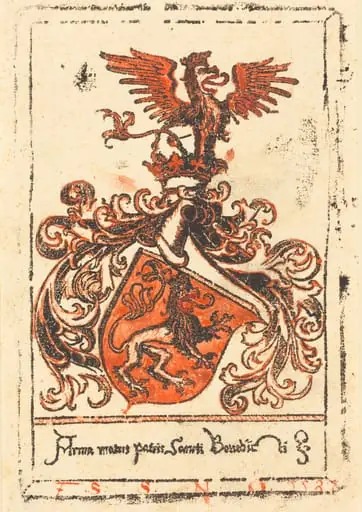 Bookplate of the Abbey of Ottobeuren
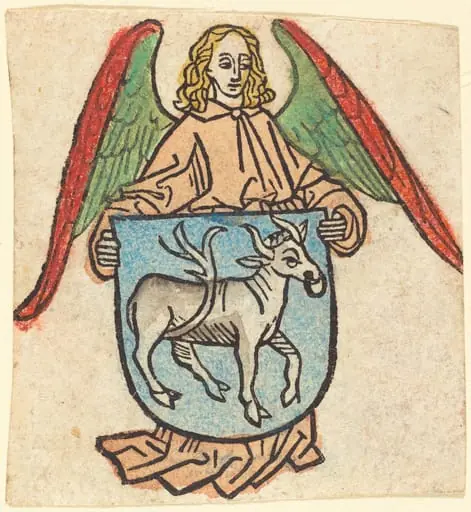 Bookplate of Hilprand Brandenburg of Bibrach
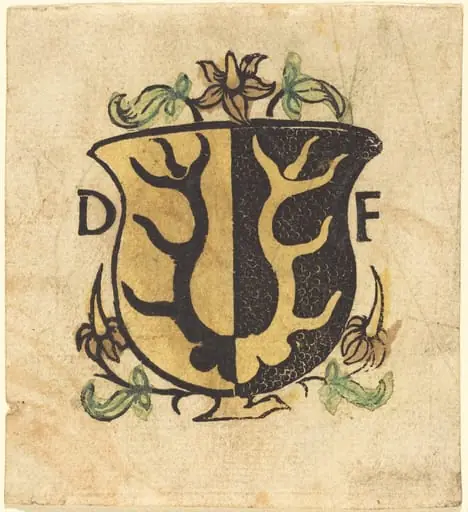 Bookplate of Dominicus Frauenfelder
![Studies for Six Figures (sheet from a model book) [recto], by German 15th Century](https://artifactworldgallery.com/img/german-15th-century--studies-for-six-figures-sheet-from-a-model-book-recto--4837429e0755bc3f-w320.webp) Studies for Six Figures (sheet from a model book) [recto]
Studies for Six Figures (sheet from a model book) [recto]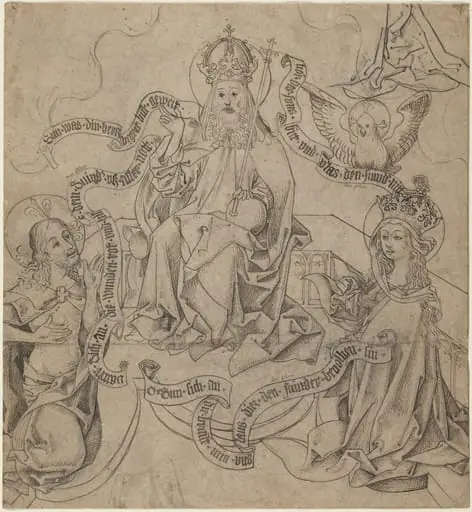 Christ and Mary Interceding with God the Father