Artwork
Farmhouse in Provence
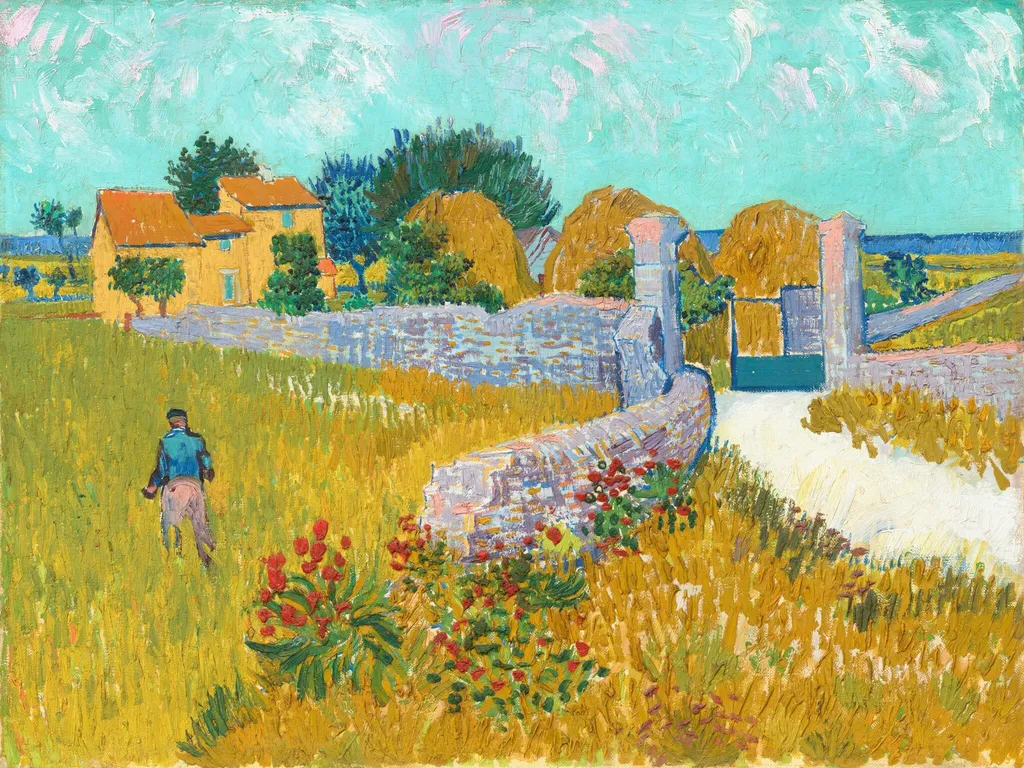
Farmhouse in Provence is an oil painting by the Impressionist artist Vincent van Gogh. It dates from 1888 and is held in the collection of the National Gallery of Art.
About this work
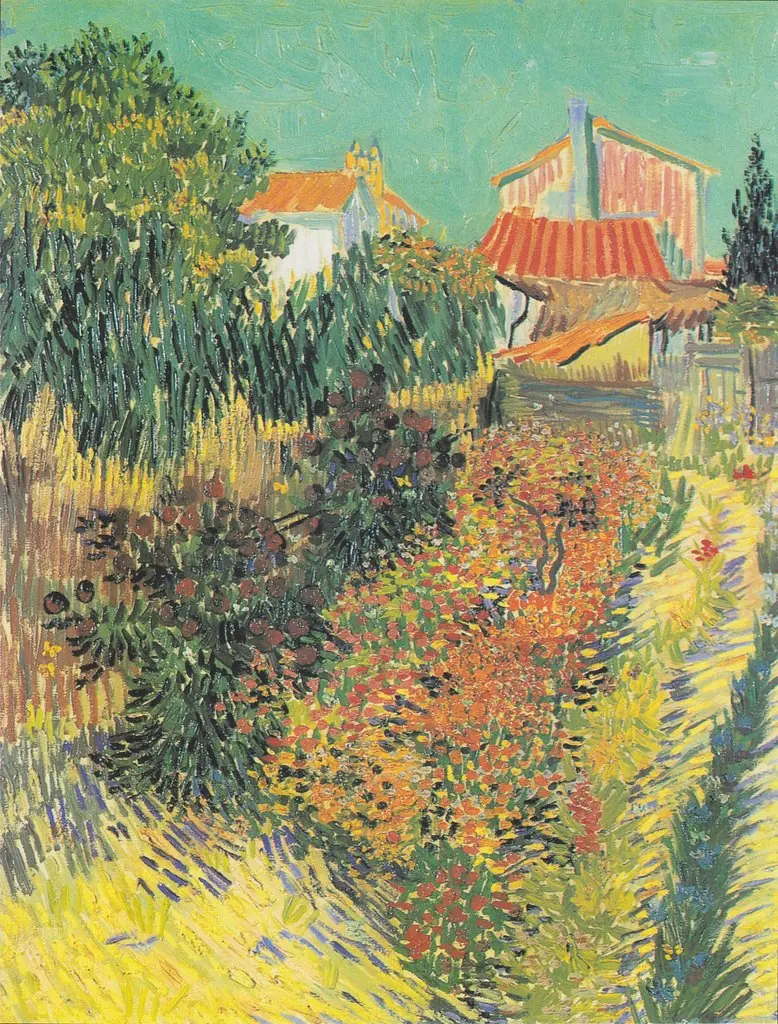
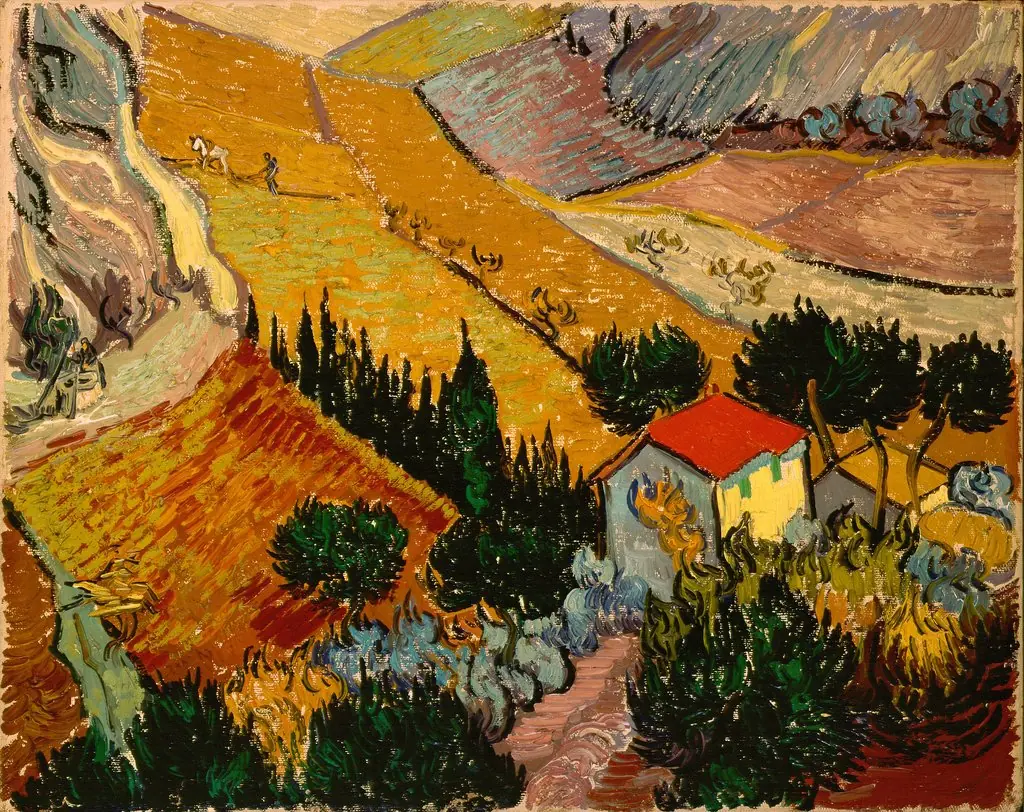
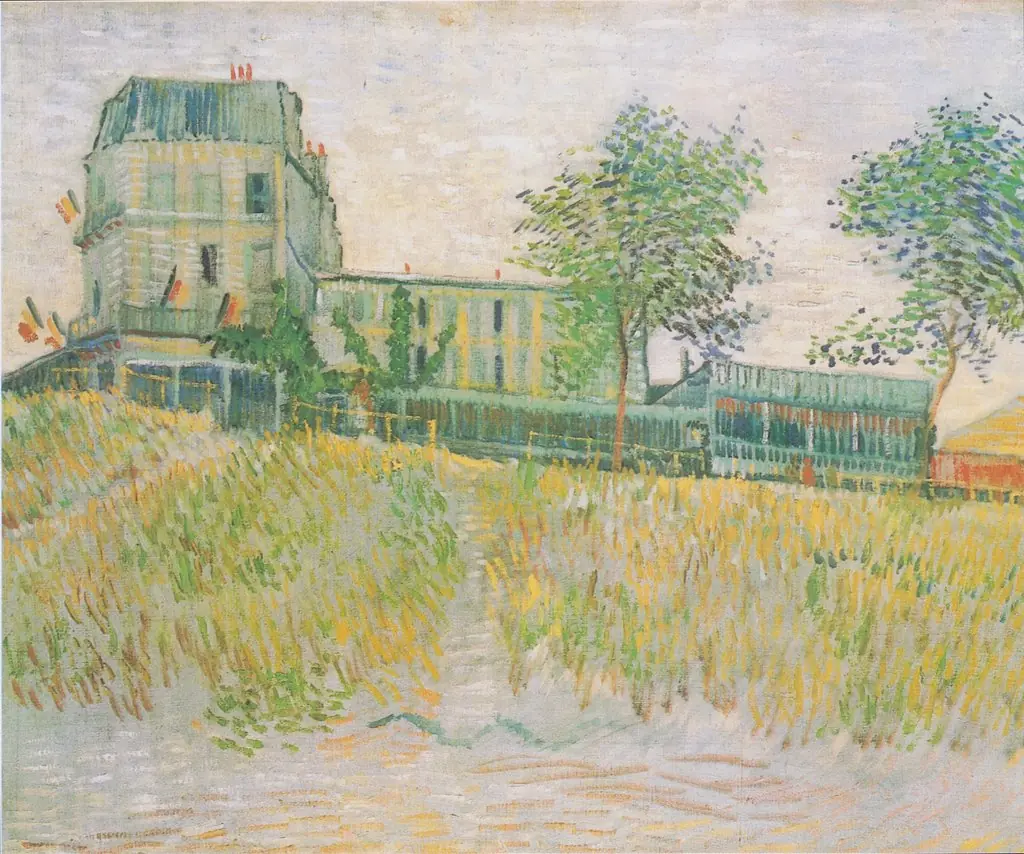
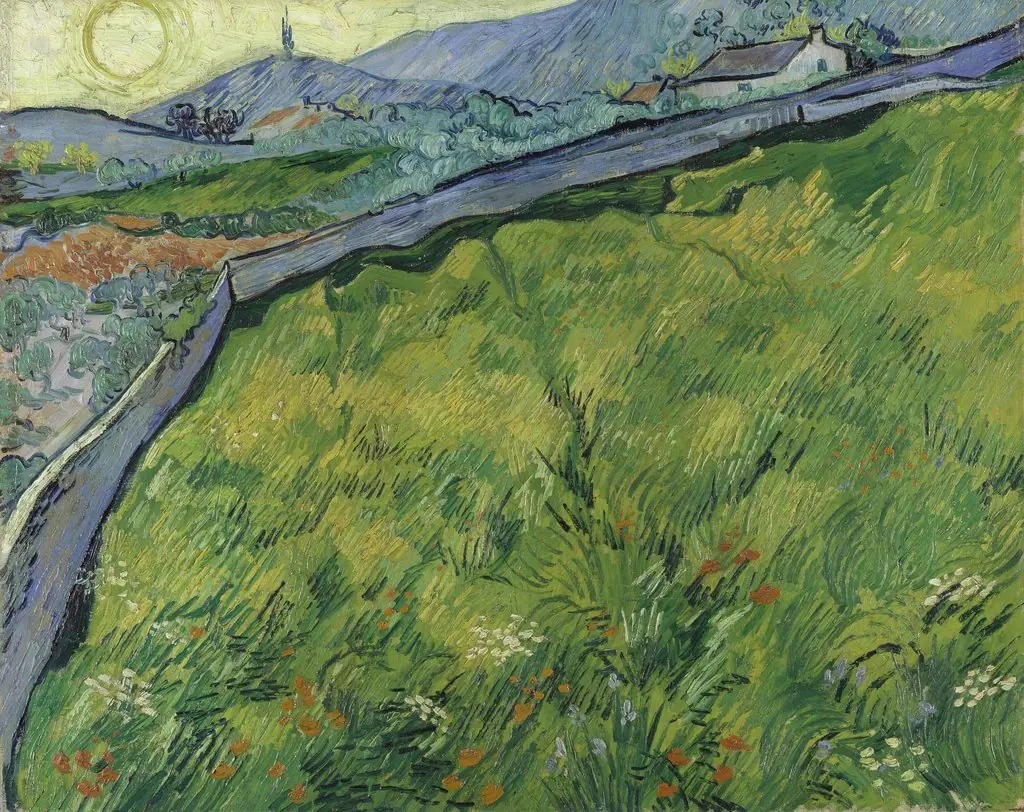
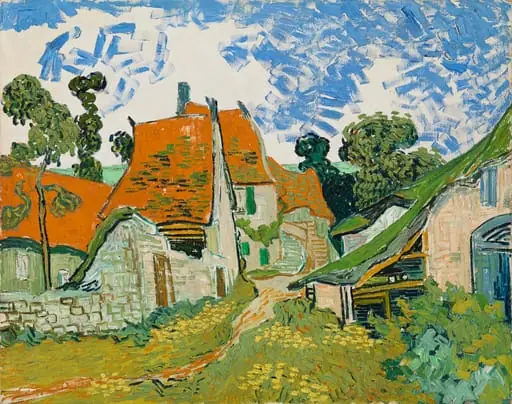
Van Gogh paints a Provence farmhouse with bright yellow walls and a patchwork roof of red tiles, a leafy tree leaning into the frame. Thick paint and swirling brushstrokes give the whole scene a restless, living texture. Oil on canvas, 1888.
Technique & Style
The handling privileges expressive contour over naturalistic detail, with the gate’s arch and tree silhouettes sharply defined against luminous fields.
Executed in oil on canvas in Arles during September 1888, the work employs thick, tactile impasto laid on a prepared canvas support, aligning with Van Gogh’s late-summer practice of building up pigment with the palette knife. The composition distills the motif into broad, simplified planes, wall, foliage, and sky, rendered in flat, unmodulated color areas that echo the graphic flatness of contemporaneous Japanese woodblock prints. Complementary pairings of orange and blue, red and green, and pink clouds against a turquoise sky intensify chromatic vibration through simultaneous contrast, a deliberate application of Chevreul’s theories Van Gogh had studied in Paris.
The handling privileges expressive contour over naturalistic detail, with the gate’s arch and tree silhouettes sharply defined against luminous fields.
History & Provenance
Farmhouse in Provence was painted by Vincent van Gogh in Arles in September 1888 during his prolific stay in Provence. The work appears to have been made without a specific commission, emerging from the artist’s intensive landscape practice during this period. Upon Van Gogh’s death in 1890, the painting entered the collection of his sister-in-law, Johanna van Gogh-Bonger, who sold it in November 1890 through Julien Tanguy’s gallery in Paris to the Danish dealer Willy Gretor.
Gretor later gifted it to the German painter Maria Slavona, whose husband, Otto Ackermann, subsequently owned it. By 1919 the painting was with Gaston Bernheim de Villers in Paris, passing to Capt. Edward H. Molyneux, then to Ailsa Mellon Bruce, who bequeathed it to the National Gallery of Art, Washington, in 1970.
The painting is held by the National Gallery of Art in Washington, D.C., where it entered the collection in 1970 as a bequest from Ailsa Mellon Bruce. While the specific inventory or accession number is not provided in the sources, the work's provenance traces back to the artist's sister-in-law, Johanna van Gogh-Bonger, who sold it in November 1890. The documented exhibition history includes a showing in Amsterdam at the Stedelijk Museum in 1905 and an exhibition at Reid and Lefevre in London in 1934.
Ownership subsequently passed through Willy Gretor, Maria Slavona, Otto Ackermann, Gaston Bernheim de Villers, and Captain Edward H. Molyneux before its final sale to Bruce in 1955.
Context
Farmhouse in Provence was created during Van Gogh’s Arles period, when he sought to expand his practice under the Provence light he described as washing out detail to simplify forms into patterns akin to Japanese woodblocks. The work exemplifies his use of complementary contrasts, orange and blue, red and green, pink and turquoise, to heighten chromatic intensity, a method he linked to Chevreul’s theories and to the coloristic boldness of Adolphe Monticelli, whose southern still lifes he admired and whose influence partly motivated his move to Provence. Within Van Gogh’s oeuvre, the painting belongs to the prolific 1888 Arles production, when in fewer than 444 days he completed over 200 canvases and more than 100 drawings while writing hundreds of letters.
Its later provenance through Johanna van Gogh-Bonger, Willy Gretor, Maria Slavona, and Ailsa Mellon Bruce culminated in a 1970 bequest to the National Gallery of Art, situating it within a canonical trajectory of Van Gogh’s reception and dispersal among early twentieth-century collectors and dealers.
Legacy
Farmhouse in Provence has become a touchstone of Van Gogh’s Provençal oeuvre, frequently cited for its bold complementary colors and luminous treatment of light. Its documented chain of ownership, from Johanna van Gogh‑Bonger, sold through Julien Tanguy to Willy Gretor, gifted to Maria Slavona, then to Gaston Bernheim de Villers, Edward Molyneux, Ailsa Mellon Bruce and finally the National Gallery of Art, mirrored its rising institutional profile. Early public exposure came via the 1919 Bernheim‑Jeune catalogue and a 1934 showing at Reid and Lefevre, while a 1905 display at the Stedelijk Museum Amsterdam signaled contemporary museum interest.
The work’s inclusion in the National Gallery’s collection and numerous scholarly discussions of its color strategy have reinforced its reputation as a key example of post‑impressionist landscape painting and an influence on later modernist approaches to color and form.
Overview
Farmhouse in Provence, an oil on canvas created by Dutch artist Vincent van Gogh in 1888, captures a rural scene from his time in Arles. Also known by the title Entrance Gate to a Farm with Haystacks, this work dates from a particularly productive period in his artistic development. The painting is currently held in the collection of the National Gallery of Art in Washington, D.C.
Subject & Meaning
The painting depicts a farmhouse with vibrant yellow walls and a roof composed of red tiles, set within the Provençal landscape. A leafy tree leans into the composition, framing the structure. Van Gogh's energetic brushwork imbues the scene with a dynamic quality, suggesting a living, breathing presence within the rural setting.
Own this work as a print
Artist & collection
Artist
Vincent Willem van Gogh was a Dutch Post-Impressionist painter who is among the most famous and influential figures in the history of Western art.