Artwork
Young Lady Wearing a Mantilla and Basquina
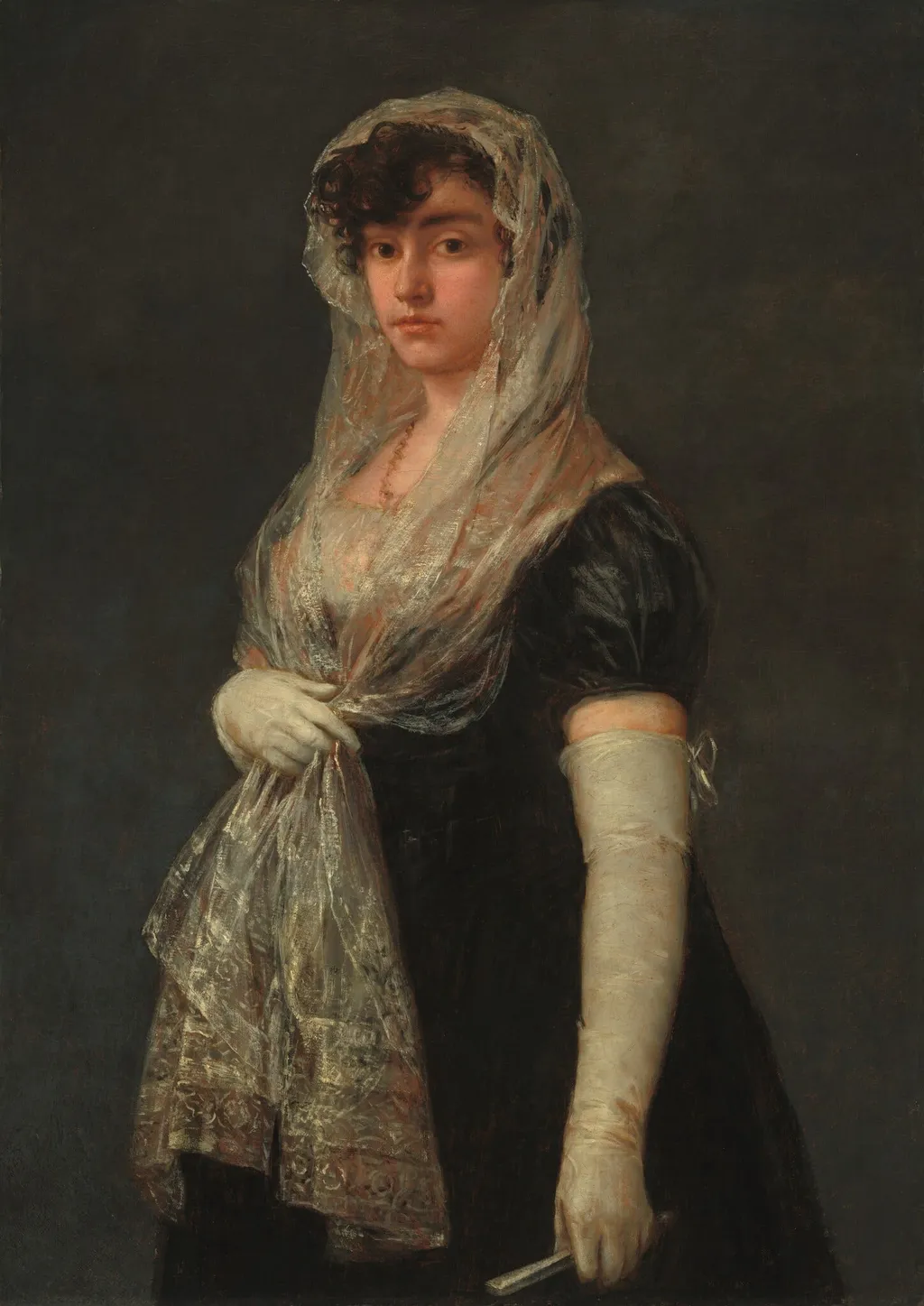
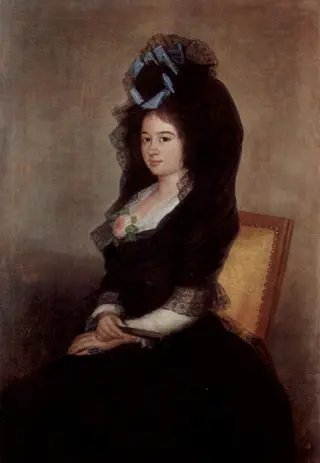
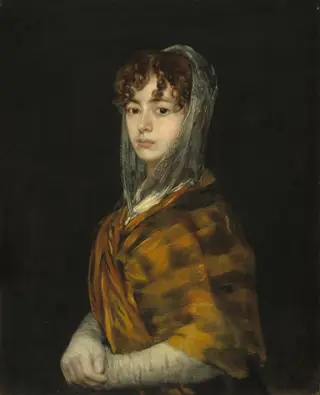
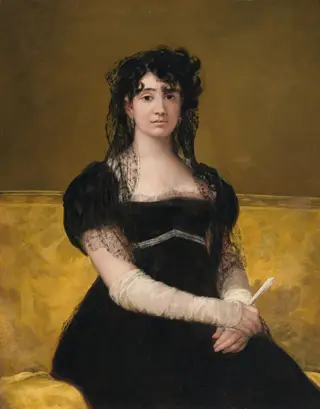
Young Lady Wearing a Mantilla and Basquina is an oil painting by the Romanticist artist Francisco de Goya. It dates from 1802 and is held in the collection of the National Gallery of Art. Executed in oil on canvas around 1802, this portrait by Francisco Goya presents a young Spanish woman in traditional dress.
- Inscription
- Inscribed:lower left: Goya
About this work
Overview
Young Lady Wearing a Mantilla and Basquina is an oil on canvas portrait by the Spanish painter Francisco de Goya, generally dated between 1800 and 1805.
Young Lady Wearing a Mantilla and Basquina is an oil on canvas portrait by the Spanish painter Francisco de Goya, generally dated between 1800 and 1805. Measuring 109.5 by 77.5 centimeters, the work depicts an unidentified woman in traditional Spanish dress standing before a dark, neutral background. The painting has been known by various titles, including The Bookseller's Wife, but modern scholarship prefers the descriptive current title, as earlier names are considered romantic invention. The canvas entered the National Gallery of Art in Washington in 1963 as a gift from Adaline Havemeyer Frelinghuysen, and it remains there today, accessioned as 1963.4.2.
Subject & Meaning
The three-quarter-length portrait presents a woman viewed from a slight left profile, gazing directly at the observer. She wears a black dress with a fitted bodice and short puffed sleeves, overlaid with a basquina, a dark skirt customary for women of the period. A white lace mantilla covers her head and shoulders, revealing curly hair across her forehead. Her right hand gathers the mantilla beneath her chin, while her left hand holds a closed fan at her side. Long pale gloves extend above her elbows, the left one tied with a small ribbon, and a necklace adorns her neck. The traditional attire carries cultural-political meaning, as the mantilla and basquina represented a deliberate assertion of Spanish national identity against the dominant French fashions adopted by the aristocratic upper classes at the Spanish court.
Technique & Style
Goya executed the painting with a restrained palette dominated by deep blacks and browns, set against the pale cream of the lace and gloves, with warm tones illuminating the sitter's face. Light enters from the left, modeling her features and the textures of the fabrics while the background recedes into atmospheric shadow. The brushwork varies considerably across the canvas, applying smooth strokes for the face while employing quick, textured, and visible strokes to render the lace mantilla. Rather than describing the lace thread by thread, Goya dissolved the pattern into an atmospheric impressionism, finding a full range of tonal values within the black lace to create simultaneous depth and transparency. This technical bravura combines the traditional portrait format with a thoroughly modern psychological presence.
History & Provenance
The earliest probable owner was the Madrid collector Serafin Garcia de la Huerta, who died in 1839. An 1840 inventory of his collection lists a Goya of a lady with mantilla and basquina, with dimensions slightly smaller than the present canvas, a discrepancy attributed to the inclusion of a frame in the earlier measurements. By 1867, the painting belonged to the Marques de Heredia in Madrid. Benito Garriga acquired it by 1887, and it was sold at the Hotel Drouot in Paris in 1890. Hubert Debrousse subsequently owned it before another Drouot sale in 1900 transferred it to Kraemer in Paris. Durand-Ruel purchased it in 1906 and sold it to the New York collector Henry Osborne Havemeyer. Upon his death, his widow Louisine W. Havemeyer inherited it, followed by their daughter Adaline Havemeyer Frelinghuysen, who gifted the work to the National Gallery of Art in 1963. The painting has been exhibited internationally, including shows in New York, Hamburg, Amsterdam, Lille, Madrid, and Mexico City between 1912 and 2006.
Context
The identity of the sitter remains unresolved. In 1867, Charles Yriarte identified her as The Bookseller's Wife, and in 1887, the Conde de la Vinaza called her The Bookseller from Calle de las Fuentes. Aureliano de Beruete later linked her to the wife of a Madrid bookseller named Antonio Bailo, whose shop sat at number 4 Calle Carretas. Modern scholars have dismissed these identifications as romantic legend, favoring the descriptive title. The painting fits within Goya's broader engagement with maja culture, which aligned him with popular Spanish traditions even as he served as the official court painter. The work entered the Havemeyer collection alongside other significant Goya works, as recorded in Louisine Havemeyer's memoirs, and has since been featured in major scholarly catalogues by Xavier Desparmet Fitz-Gerald, August L. Mayer, and Francisco Javier Sanchez Canton.
Legacy
The painting's influence and reputation are tied to its role in shaping the understanding of Goya's portraiture and his cultural nationalism. By depicting traditional Spanish garments as deliberate political statements against Frenchification, the work has served as a key reference in exhibitions examining Goya's relationship to female iconography and popular dress, notably the 2001 exhibition Goya: La imagen de la mujer at the Museo Nacional del Prado. Its presence in major international exhibitions has reinforced its status as a prime example of Goya's ability to merge traditional formats with modern painterly technique and direct, individual psychology, securing its place in the canon of Spanish portraiture.
Own this work as a print
Artist & collection
Artist
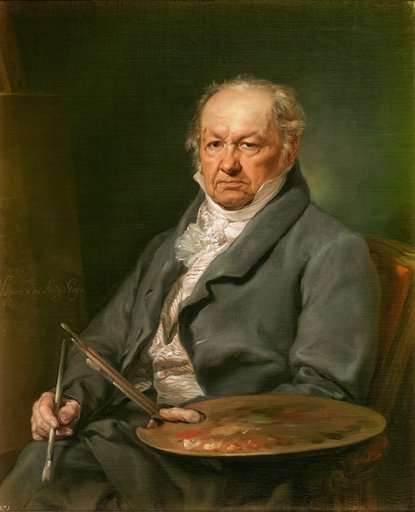
Francisco José de Goya y Lucientes was a Spanish romantic painter and printmaker.