Artwork
Bacchus and Ariadne
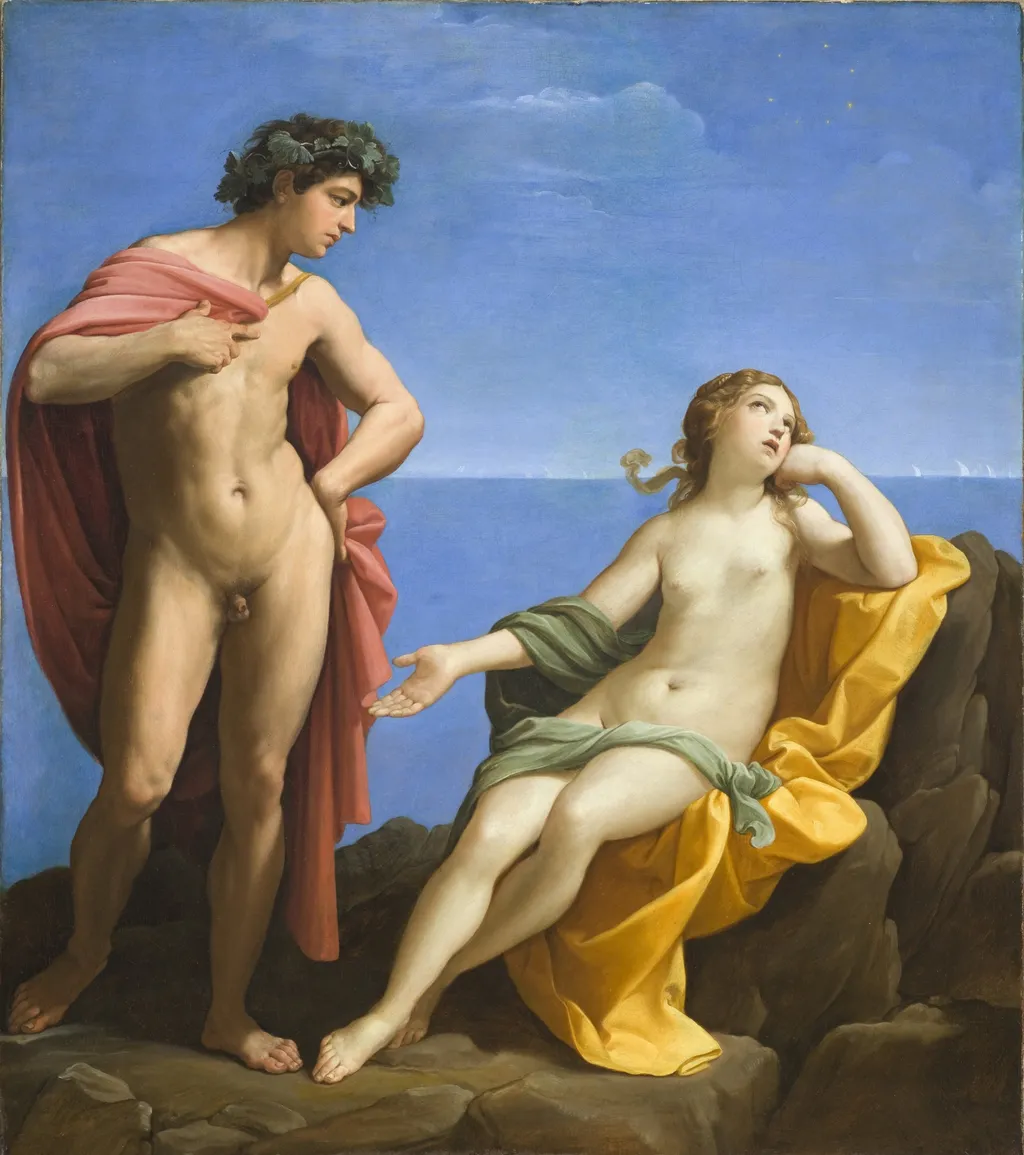
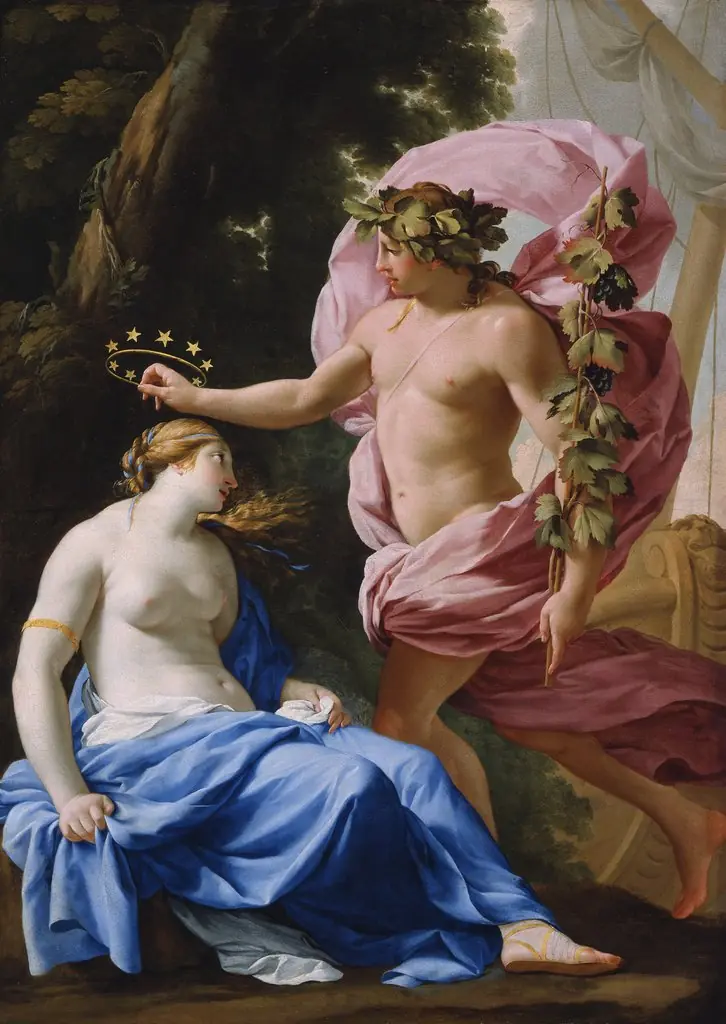
Bacchus and Ariadne is an oil painting by the Early Baroque Italian artist Guido Reni. It dates from 1619 and is held in the collection of the Los Angeles County Museum of Art.
About this work
Subject & Meaning
Reni pares Ovid’s narrative to two figures, distilling the moment through controlled gesture and a palette of bright primaries against a coastal backdrop.
The painting depicts the myth of Bacchus (Dionysus) and Ariadne on the island of Naxos. Ariadne, abandoned by Theseus whose departing ships are visible on the horizon, turns away with an open hand as the god approaches. Bacchus, nude and draped in red, points to himself in an offer of consolation, his pose echoing classical sculpture such as the Meleager or the Hermes Belvedere.
Reni pares Ovid’s narrative to two figures, distilling the moment through controlled gesture and a palette of bright primaries against a coastal backdrop.
Critics interpret the composition as a theatrical tableau, aligning it with contemporaneous opera such as Monteverdi’s L’Arianna and its lament aria. Some read the scene as ironic play, a visual ‘scherzo’ responding to Marino’s poetic gallery, while others emphasize the restrained drama of Ariadne’s gesture and Bacchus’s self-offering as a mythic substitution for Theseus.
Technique & Style
The painting is executed in oil on canvas, measuring 96.5 × 86.4 cm. Reni’s handling emphasizes clear contours and sharply defined forms, with a palette restricted to vivid primary colors that heighten the scene’s legibility. The composition isolates Bacchus and Ariadne against a minimal landscape, their bodies modeled with chaste nudity and contrapposto borrowed from antique sculpture; Ariadne’s pose recalls antique figures such as the Ariadne asleep in the Cortile del Belvedere, while Bacchus’s stance echoes classical Apollo types like the Meleagros or the Hermes Belvedere. The figures appear almost sculptural, as if carved from stone, and their gestures, Bacchus’s self-referential right hand and Ariadne’s open palm, convey the drama with rhetorical restraint.
History & Provenance
Guido Reni's Bacchus and Ariadne is dated to circa 1619–1620 by Stephen Pepper, based on stylistic features shared with the contemporary Apollo and Marsyas in Toulouse. The earliest documented candidate for the canvas is a painting noted by Rinaldo Ariosti in a 21 February 1627 letter from Bologna as belonging to the poet Cesare Rinaldi. Pepper reconstructed the work's later movements: it passed through the collection of Giovanni Pietro Tirabosco in Venice during the 1650s, then entered Cardinal Pietro Ottoboni's Roman collection by 1693.
After Ottoboni's death the collection was dispersed, and an original "Bacco et Arianna" by Reni sold for six hundred scudi on 5 March 1740. The painting surfaced at Kedleston Hall in 1769, acquired by Nathaniel Curzon, Baron Scarsdale, likely through the London dealers Hogard & Co. It remained at Kedleston until 1979, when it was sold to Agnew's Gallery in London and subsequently donated to the Los Angeles County Museum of Art by the Ahmanson Foundation.
Guido Reni's Bacchus and Ariadne (1619) is held by the Los Angeles County Museum of Art (LACMA) in Los Angeles. The work entered the museum's collection in 1979 after being donated by the Ahmanson Foundation, following its acquisition from the Agnews Gallery in London. Prior to this donation, the painting resided at Kedleston Hall in Derbyshire as part of the collection of Nathaniel Curzon, Baron Scarsdale, from 1769 until 1979.
Historical records indicate the canvas was likely purchased by Curzon from the London dealer Hogard & Co. after an auction in March 1769. Before reaching England, the painting is traced to the collection of Cardinal Pietro Ottoboni in Rome, where it was sold in 1740, and earlier to the collection of Giovanni Pietro Tirabosco in Venice during the 1650s.
Context
Guido Reni's Bacchus and Ariadne has generated sustained scholarly attention, particularly through the provenance research of Stephen Pepper, who traced the canvas from Bologna to Venice (Giovanni Pietro Tirabosco collection, 1650s), Rome (Cardinal Pietro Ottoboni, from 1693), and England (Kedleston Hall, where it sold at the 1740 Ottoboni dispersal for six hundred scudi and entered the Curzon collection by 1769), before its 1979 sale through Agnew's and gift to the Los Angeles County Museum of Art by the Ahmanson Foundation. Pepper dated the work to around 1619–1620 on stylistic grounds, noting its firm contours and well-defined spaces akin to the contemporary Apollo and Marsyas in Toulouse, and proposed it as a pictorial "scherzo" responding to Giovan Battista Marino's La Galleria. Richard Cocke contested that reading, arguing that Reni's controlled rhetorical gestures distill Ovid's narrative rather than treat it ironically, while other critics have linked the composition to Claudio Monteverdi's Arianna and the "Lamento di Ariadne."
Raffaella Morselli described the figures as emerging "come se uscissero da una gemma antica," citing classical models such as the Meleager of Skopas and the Sleeping Ariadne. The canvas also entered modern visual culture through Alberto Arbasino's description in Le muse a Los Angeles and Banksy's 2009 Bacchus at the Seaside, exhibited at Bristol Museum & Art Gallery.
Legacy
The painting Bacchus and Ariadne by Guido Reni exerted influence through subsequent artistic references and reinterpretations. In 2009 Banksy created Bacchus at the Seaside, a large-scale work that directly referenced Reni’s composition, enlarging it to 235×206 cm and removing the figures’ faces while adding a traffic cone to obscure the god’s genitals. The piece was exhibited at Bristol Museum & Art Gallery.
Earlier provenance records show the work passed through notable collections, including that of Nathaniel Curzon at Kedleston Hall and the Torlonia family’s Villa Albani, before its acquisition by the Los Angeles County Museum of Art.
Overview
Guido Reni’s oil painting Bacchus and Ariadne, executed in 1619, belongs to the Baroque period and is part of the collection of the Los Angeles County Museum of Art. The work presents a mythological encounter on a rocky shoreline, rendered in a clear, luminous palette that emphasizes the figures against a bright sky.
Own this work as a print
Artist & collection
Artist
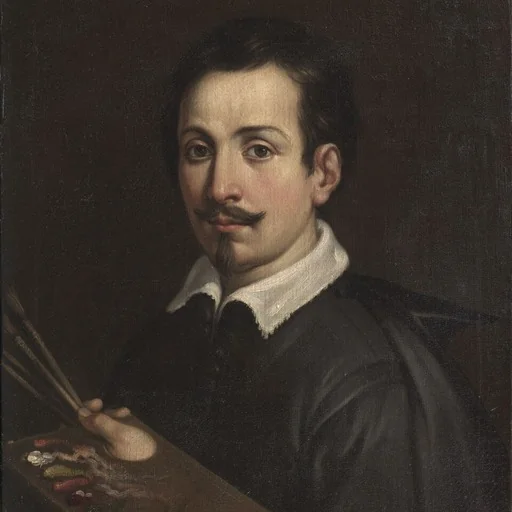
Guido Reni was an Italian Baroque painter, although his works showed a classical manner, similar to Simon Vouet, Nicolas Poussin, and Philippe de Champaigne.