Artwork
Cupid and Psyche
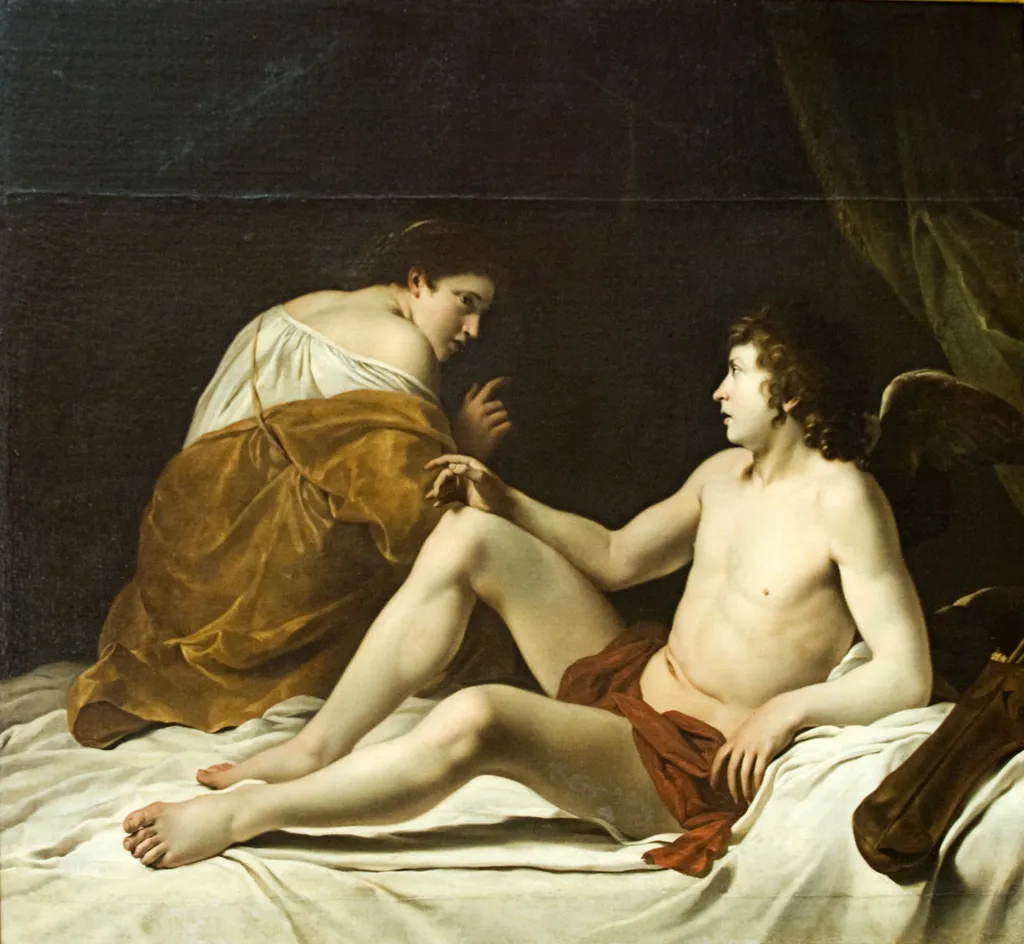
Cupid and Psyche is an oil painting by the Early Baroque Italian artist Orazio Gentileschi. It dates from 1610 and is held in the collection of the Hermitage Museum.
About this work
Overview
Cupid and Psyche is an oil on canvas painting by Orazio Gentileschi, an Italian Baroque painter active in the late sixteenth and early seventeenth centuries.
Cupid and Psyche is an oil on canvas painting by Orazio Gentileschi, an Italian Baroque painter active in the late sixteenth and early seventeenth centuries. The work measures 136.5 by 160 centimeters, or approximately 137 by 160 centimeters according to some accounts. Dated variously to 1610, the late 1610s, or 1628-30, the painting depicts an mythological scene drawn from the classical tale of Cupid and Psyche. It is currently held in the collection of the Hermitage Museum in Saint Petersburg, Russia, where it has been accessioned as part of the museum's holdings of Italian Baroque painting. The work matters as a significant example of Gentileschi's mature style, demonstrating his characteristic chiaroscuro and intimate approach to mythological narrative.
Subject & Meaning
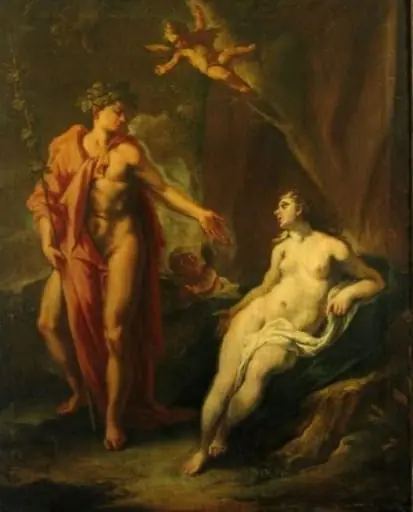
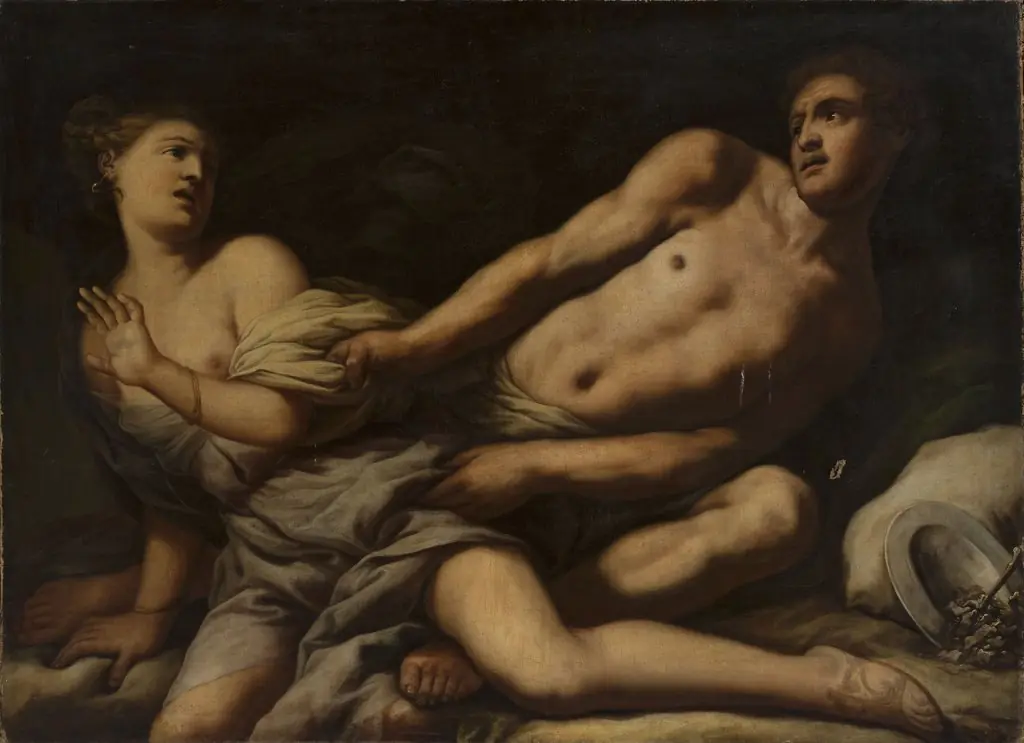
The painting illustrates a scene from the tale of Cupid and Psyche, a late antique fairy tale recounted by Lucius Apuleius in his second-century AD Metamorphoses, or Golden Ass. In Apuleius's narrative, Psyche was a maiden of such beauty that she aroused the envy of Venus; Cupid, dispatched by the goddess to make Psyche fall in love with a worthless being, instead fell in love with her himself. Gentileschi depicts the two figures in a moment of intimate dialogue. Cupid, identifiable by his wings and quiver, reclines on a bed covered with white sheets, a dark red cloth wrapped around his hips. Psyche kneels beside the bed, wearing a white blouse that slips off her right shoulder and a golden-brown skirt, her body leaning toward him. Their hands meet at the center of the composition, a gesture that symbolizes their connection and affection. The scene captures a moment of vulnerability and burgeoning intimacy, with the tension between them conveyed through their hesitant gazes and open mouths as if in conversation. The iconography explores themes of love, trust, and the trials inherent in relationships between mortals and divinities, with the juxtaposition of light and shadow suggesting the hidden nature of their relationship and the uncertainty that surrounds it.
Technique & Style
Gentileschi executed the work in oil on canvas, a medium that allowed for the smooth modeling of flesh and fabric evident in the finished painting. The composition centers on the intimate gesture between the two figures, their hands meeting at the middle of the canvas, with a dark and undefined background that includes a greenish drapery visible in the upper right corner. Strong light falls from the left, illuminating the figures and creating dramatic contrasts between light skin and the dark surroundings, a chiaroscuro technique that pulls the couple forward out of the surrounding gloom. The palette consists of warm browns, creamy whites, and deep shadows. The brushwork appears smooth, with careful modeling of flesh and fabric, and the flesh is rendered with great smoothness, catching highlights against the darker folds of Psyche's drapery and Cupid's shadowed torso. The figures seem illuminated from within, their forms rendered with a soft, almost sculptural quality. This treatment, while rooted in naturalism, elevates the scene beyond mere representation, exploring the tension between concealment and revelation through the strategic application of muted tones.
History & Provenance
The precise commission and early provenance of Cupid and Psyche remain unclear from the available sources. The painting is dated variously in the literature: the corpus source gives 1610, while other sources suggest the late 1610s or 1628-30. This discrepancy in dating reflects ongoing scholarly discussion about the work's place within Gentileschi's chronology. The painting is currently located in the Hermitage Museum in Saint Petersburg, Russia, where it is held in the permanent collection. A photograph of the work was taken at the Hermitage Museum in 2010 by Ealdgyth and made available through Wikimedia. Exhibition history is not extensively documented in the provided sources, though the work's presence in the Hermitage indicates its importance within the museum's presentation of Italian Baroque art to international audiences.
Context
Orazio Gentileschi (1563-1639) was born in Pisa and died in London, working across Italy and England during a career that spanned the transition from late Mannerism to the Baroque. His Cupid and Psyche occupies a significant place within the broader tradition of mythological painting in early seventeenth-century Italy. The work has been associated with both Mannerist and Baroque stylistic tendencies, with one source characterizing it as exemplifying Mannerism and others emphasizing its naturalistic Baroque qualities. Critical reception has focused on Gentileschi's distinctive handling of light and his intimate, psychologically nuanced approach to mythological subjects. Scholarship on the painting has noted its exploration of ambiguous emotions and the subtle commentary on the nature of love and knowledge that emerges from the interaction between the two figures. The painting's attribution to Gentileschi has been discussed in the literature, with Wikidata describing it as attributed to the artist, suggesting some degree of scholarly consideration of its authorship.
Legacy
The cultural afterlife of Gentileschi's Cupid and Psyche is tied to its place within the broader reception of the Cupid and Psyche narrative in Western art. The story, known to Boccaccio by approximately 1370 and first printed in 1469, has been retold extensively in poetry, drama, opera, and visual art. Gentileschi's interpretation contributes to this tradition through its emphasis on psychological intimacy and emotional ambiguity rather than dramatic action. The painting's presence in the Hermitage Museum has ensured its visibility to generations of viewers and scholars, with photographic documentation making it accessible beyond the museum's walls. The work's exploration of the tension between divine mystery and mortal curiosity, embodied in Cupid's averted gaze and Psyche's probing expression, continues to resonate as a visual meditation on the nature of love and knowledge. Its legacy lies in its demonstration of how Baroque naturalism could be deployed to serve complex emotional and intellectual ends within the framework of classical mythology.
Own this work as a print
Artist & collection

Artist
Orazio Lomi Gentileschi (Italian pronunciation: ; 1563 – 7 February 1639) was an Italian painter.