Artwork
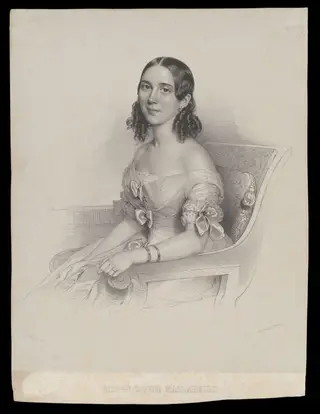
Pauline, the Wife of the Artist
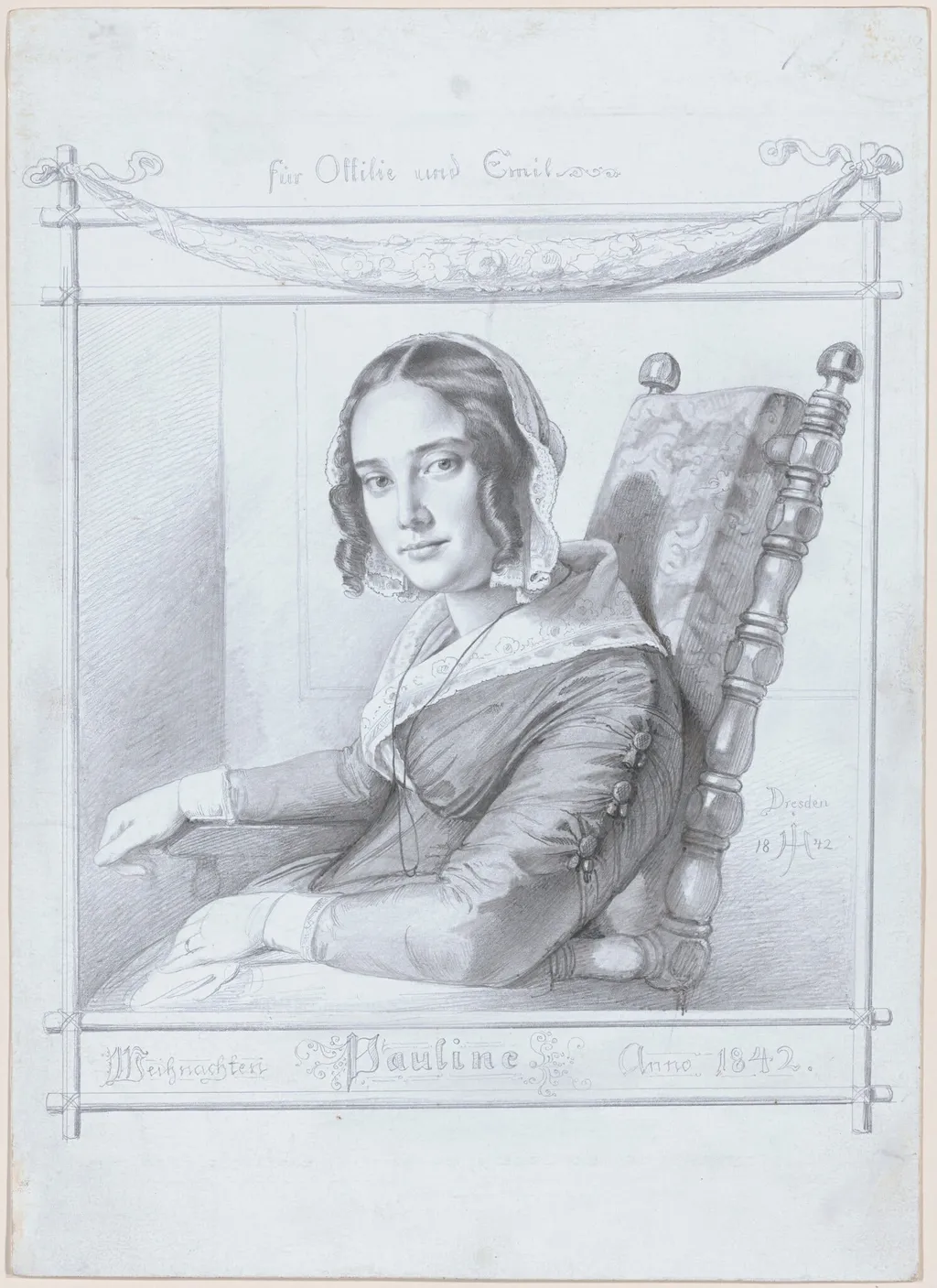
Pauline, the Wife of the Artist is a graphite drawing by the Romanticist artist Julius Hübner. It dates from 1842 and is held in the collection of the National Gallery of Art.
- Inscription
- Inscribed:upper center: für Ottilie und Emil; center right in image: Dresden 18 JH 42; lower center: Weinachten Pauline Anno 1842.; by later hand, lower right verso in graphite: 1/2
About this work
The chair has a carved wooden frame, and the whole scene is framed like a window with decorative moldings.
This sketch shows a woman sitting on a chair, leaning back with one arm resting on its high back. She’s dressed in a high-necked dress with lace trim, and her hair is pulled back neatly. The chair has a carved wooden frame, and the whole scene is framed like a window with decorative moldings.
The artist signed it “Julius Hübner” and dated it 1842 in the corner. The soft shading and careful lines suggest it was made with graphite and ink.
Check out Hübner, Julius to see more of his work.
Overview
Julius Hübner’s 1842 drawing, titled Pauline, the Wife of the Artist, presents a seated female figure rendered on a prepared white card. The work combines graphite, stumping, pen, and gray ink, and bears the artist’s signature and date in the lower corner. The composition is enclosed by a decorative moulding that resembles a window frame, giving the image a formal, interior setting.
Subject & Meaning
The sitter is Pauline Hübner, the artist’s wife, portrayed in a relaxed pose with one arm resting on the high back of a carved wooden chair. She wears a high‑necked dress trimmed with lace, and her hair is neatly pulled back, suggesting a modest, domestic elegance typical of mid‑nineteenth‑century middle‑class portraiture.
Technique & Style
Hübner employed graphite for the overall modeling, enhancing the tonal transitions with stumping to achieve soft shadows. Fine pen and gray‑ink lines define details such as the lace trim, the chair’s carving, and the surrounding moulding. The drawing balances precise linear work with delicate shading, characteristic of academic drawing practices of the period.
History & Provenance
The piece is signed and dated by Hübner in the lower corner, confirming its creation in 1842. It remains a personal study rather than a public commission, likely kept within the artist’s household. Documentation of its later ownership is limited, but the work is recognized as part of Hübner’s early oeuvre.
Context
Created during the Biedermeier era, the drawing reflects contemporary tastes for intimate, domestic subjects rendered with technical clarity. Hübner, a German painter trained in the Düsseldorf school, often produced portrait studies of family members, and this work exemplifies his attention to detail and the period’s emphasis on modest, interior scenes.
Own this work as a print
Artist & collection


 Portrait of Madame Monnerot
 Mary Crosby
 Portrait of Mrs Milnes
 Anne Charlotte Lynch (Later Mrs. Vincenzo Botta)
 Print Collection
 Lady Elizabeth Herbert
 H Beard Print Collection
 Maria Margaretta Oswald
 H Beard Print Collection
 An unknown young lady
 H Beard Print Collection
- Mrs. George Henry Loring (Amalia Heredia)