Artwork
Man with a Roman coin
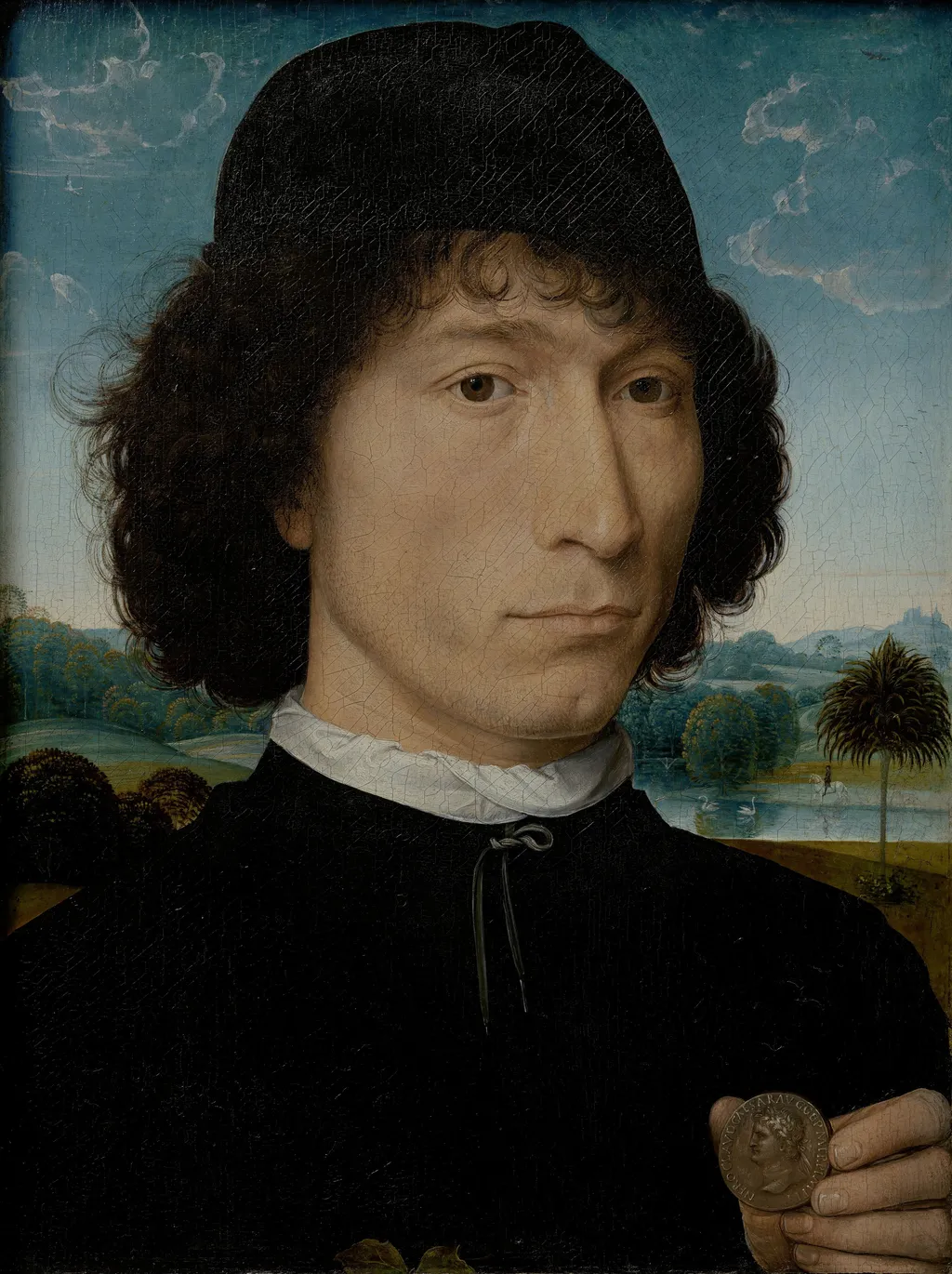
Man with a Roman coin is an oil painting by the Northern Renaissance artist Hans Memling. It dates from 1473 and is held in the collection of the Royal Museum of Fine Arts Antwerp.
About this work
The work shows a sitter holding a Roman medal, a detail that helps date the piece to about 1480 according to the museum’s catalogue.
The painting Man with a Roman coin is a portrait by Hans Memling, the German‑Flemish artist who worked in the late 15th century. It was created around 1473 and is done in oil paint.
The work shows a sitter holding a Roman medal, a detail that helps date the piece to about 1480 according to the museum’s catalogue. It belongs to the collection of the Royal Museum of Fine Arts Antwerp.
If you’re curious about where you can see it, check out the museum: Royal Museum of Fine Arts Antwerp.
Subject & Meaning
The painting depicts a middle-aged man of southern appearance in three-quarter view, dressed in a black cloak and matching black beretta over dark curls, with a white collar loosely emerging above the fastening, attire following late fifteenth-century Italian, likely Venetian, fashion. In his left hand he displays a Roman sestertius struck under Emperor Nero at Lyon, bearing the inscription "NERO CLAUD[IUS]. CAESAR AVG[USTUS]. GERM[ANICUS]. TR[IBUNICIA]. P[ODESTATI]. IMPER[ATOR]." The coin functions as a humanist attribute, signaling the sitter's classical learning and antiquarian interests, while in the late medieval imagination Nero's coinage was already associated with arbitrary cruelty and unjust exercise of power. The man's gaze meets the viewer directly, unusual in Memling's portraiture, yet remains dreamy and inward, avoiding real confrontation. His hand is positioned between his chest and the picture edge to suggest spatial depth. Behind him, an open lake landscape with a rider crossing an idyllic vista replaces the conventional dark background, an innovation by Memling that influenced Italian Renaissance portraitists. The sitter's identity is unknown, though he may have been an Italian residing in Antwerp or Bruges; he has been variously proposed as the Venetian statesman Bernardo Bembo, the Florentine medallist Niccolò di Forzore Spinelli, or Giovanni di Candida.
Technique & Style
Hans Memling executed *Man with a Roman coin* using oil paint on an oak panel, measuring 31 cm in height and 23.3 cm in width. The work exemplifies Early Netherlandish technique through its meticulous attention to detail and the rendering of a three-quarter view. The figure, dressed in a black coat and hat, is positioned against a naturalistic lake landscape, a stylistic innovation where Memling replaced traditional dark backgrounds with open scenery. A parapet creates an illusion of depth, with the subject's hand resting upon it to bridge the pictorial space. The lighting is tempered yet effective, utilizing a strong light source from the left to illuminate the face while minimizing shadow to a narrow strip along the nose and cheek. This approach highlights the subject's curly hair and distinct facial features, such as a robust nose and thin lips, demonstrating a high degree of plasticity and realism.
History & Provenance
Hans Memling painted the panel in Lyon, according to the Dutch-language source, which also notes that the work was attributed to Antonello da Messina until 1871, when James W.H. Weale established Memling as the actual maker. The sitter's Italian-style black mantle and berretto, fastened with a lace over a white collar, mark the costume as Venetian fashion of the period, and on that basis art historians concluded the portrait could not have been produced before around 1480, overturning an earlier preference for a date near 1478. The painting is dated c. 1480 in multiple sources, though one internal record gives 1473 and Wikidata lists both 1473 and 1480 as inception dates. The sitter's identity remains unresolved; he has been variously proposed as the Venetian statesman Bernardo Bembo, the Florentine medallist Niccolò di Forzore Spinelli (who died in Lyon, where the painting was located in the early nineteenth century), or Giovanni di Candida. The work today belongs to the Royal Museum of Fine Arts Antwerp, part of the Vlaamse Kunstcollectie.
The painting is held by the Royal Museum of Fine Arts Antwerp (Koninklijk Museum voor Schone Kunsten) in Antwerp, Belgium, and forms part of the Vlaamse Kunstcollectie. No specific inventory or accession number is recorded in the available sources.
Its documented exhibition history includes the Exposition des primitifs flamands à Bruges and the exhibition titled "Remember Me," which was associated with Leonardo da Vinci. Earlier in its provenance the panel was located in Lyon during the early nineteenth century, before entering the Antwerp collection. Until 1871 the work was attributed to Antonello da Messina; James W.H. Weale subsequently established Hans Memling as the actual author.
Context
Art historians regard this work as a pivotal example of Hans Memling's innovation in portraiture, specifically his introduction of natural landscapes as backgrounds instead of the traditional black void. This approach, featuring a lake scene with a rider, is cited as a direct influence on later Italian Renaissance masters such as Sandro Botticelli and Pietro Perugino. The painting also marks a shift in engagement; unlike Memling's other subjects, this figure gazes dreamily past the viewer rather than making direct eye contact, creating an introspective mood.
Scholarship regarding the sitter's identity remains divided, with proposals ranging from the Venetian diplomat Bernardo Bembo to the Florentine medallist Niccolò di Forzore Spinelli or Giovanni di Candida. The attribution itself evolved over time; the work was assigned to Antonello da Messina until James W.H. Weale correctly identified Memling as the creator in 1871. The inclusion of a Nero sestertius highlights the subject's humanist interests, reflecting the cultural exchange between Flemish painters and the Italian merchants residing in Bruges.
Legacy
The painting is recognized for its pioneering use of a natural landscape background, departing from the traditional dark backdrops of earlier portraiture. This innovation is cited as a direct influence on later Italian Renaissance masters, specifically Sandro Botticelli and Pietro Perugino, who adopted similar scenic settings for their own portraits. The work's reputation was solidified in the 19th century when it was reattributed from Antonello da Messina to Hans Memling by the scholar James W.H. Weale in 1871. Prior to this correction, the portrait's attribution had been misidentified, obscuring its true origin within the Early Netherlandish tradition. The piece remains a significant example of Memling's impact on the evolution of portraiture, particularly in its synthesis of Flemish detail with Italianate humanist themes.
Own this work as a print
Artist & collection
Artist
Hans Memling was a German-Flemish painter who worked in the tradition of Early Netherlandish painting.

![Saint Veronica [obverse], by Hans Memling](https://artifactworldgallery.com/img/hans-memling--saint-veronica-obverse--5a649fd8b09c96b9-w320.webp)