Artwork
A Basement Shop in Cracow
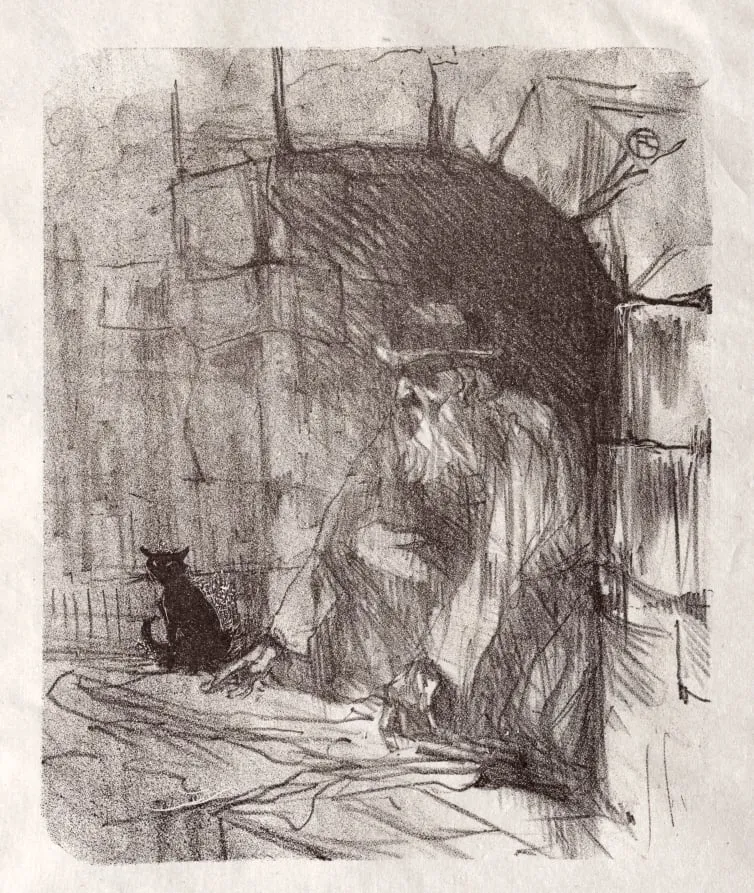
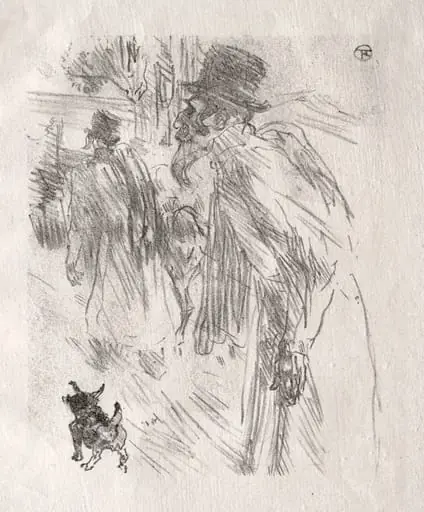
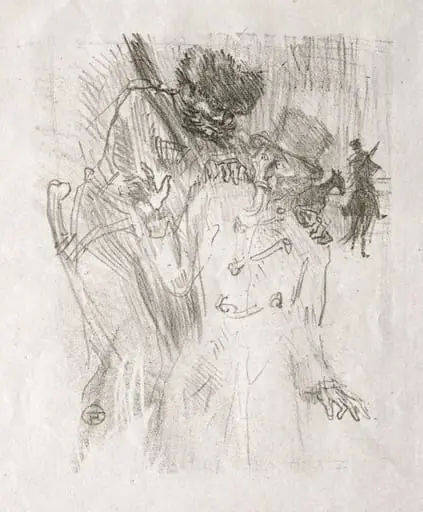
A Basement Shop in Cracow is a print by the Impressionist artist Henri de Toulouse-Lautrec. It dates from 1898 and is held in the collection of the Cleveland Museum of Art. This print depicts a modest cellar shop in Krakow, rendered in ink and wash with loose, observational lines.
- Accession no.
- 1950.594
- Credit line
- Dudley P. Allen Fund
About this work
Toulouse-Lautrec drew these scenes while illustrating a book about Jewish life in Poland.
This painting shows a dimly lit cellar shop in Krakow. Wooden barrels line the walls. A man in a cap sits behind a counter. Two women in long dresses stand nearby.
Toulouse-Lautrec drew these scenes while illustrating a book about Jewish life in Poland. He used people from Paris’s Jewish quarter as models. The shop feels real, but the people look like sketches.
Next time you’re in Paris, look up Henri de Toulouse-Lautrec (French, 1864–1901).
Overview
This print depicts a modest cellar shop in Krakow, rendered in ink and wash with loose, observational lines. Though titled after a Polish setting, the scene was not drawn on-site. Henri de Toulouse-Lautrec created it while illustrating Georges Clemenceau’s 1894 book of stories about Jewish life in Poland, using sketches of Jewish residents from Paris’s Tournelle district as visual references.
Subject & Meaning
The scene portrays a quiet moment in a Jewish-owned basement shop: a man behind a counter, two women nearby, surrounded by wooden barrels. No narrative action is present, yet the composition suggests daily endurance. The figures, rendered with minimal detail, reflect Clemenceau’s literary focus on ordinary lives amid rising antisemitism in Europe, subtly aligning with the book’s humanist tone.
Technique & Style
Toulouse-Lautrec employed swift ink lines and diluted washes to suggest form and shadow, avoiding polished finish. The dim interior is implied through tonal contrasts rather than detailed lighting. Figures appear as sketchlike silhouettes, emphasizing atmosphere over individual identity. This approach reflects his journalistic eye, recording presence rather than idealizing it.
History & Provenance
The print was made in 1894 as an illustration for Clemenceau’s collection At the Foot of Mount Sinai, published during the Dreyfus Affair. Toulouse-Lautrec, though not Jewish, was drawn to marginalized communities. The illustrations were never widely exhibited as standalone works; they remained tied to the book’s limited print run and were largely overlooked until later scholarly interest in his lesser-known projects.
Context
Clemenceau’s book emerged amid France’s intense antisemitic climate, as he used his newspaper L’Aurore to defend Alfred Dreyfus. The illustrations, though set in Poland, responded to contemporary French debates about identity and belonging. Toulouse-Lautrec’s choice to depict Jewish life through Parisian models reveals a broader European concern with Jewish visibility, even when geographically displaced.
Legacy
Though not among Toulouse-Lautrec’s most recognized works, these illustrations reveal his engagement with social themes beyond Parisian nightlife. They offer a rare glimpse into his interest in diasporic communities and the quiet dignity of marginalized lives. The print remains a quiet artifact of how art and journalism intersected during a pivotal moment in European Jewish history.
Artist & collection
Artist
Comte Henri Marie Raymond de Toulouse-Lautrec-Montfa (24 November 1864 – 9 September 1901), known as Toulouse-Lautrec (French: ), was a French painter, printmaker, draughtsman, caricaturist, and illustrator.