Artwork
Sawmill, Outskirts of Paris
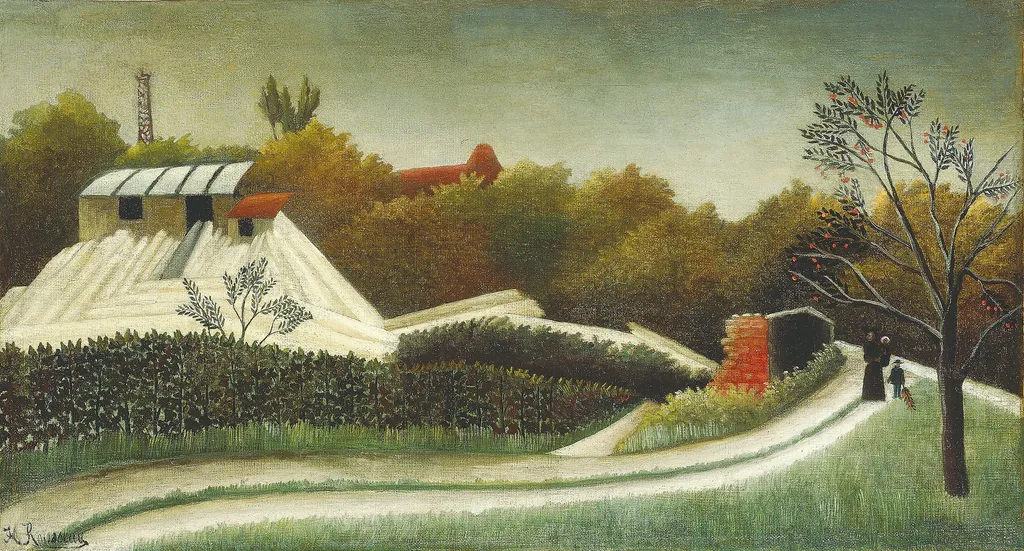
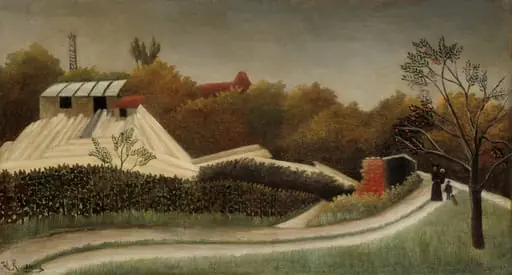
Sawmill, Outskirts of Paris is an oil painting by the Naïve art artist Henri Rousseau. It dates from 1896 and is held in the collection of the Art Institute of Chicago.
About this work
Overview
Sawmill, Outskirts of Paris is a 1896 oil painting by French post-Impressionist Henri Rousseau, created in his characteristic Naïve style. The work depicts a everyday urban landscape on the outskirts of Paris, featuring a sawmill as its central element.
Subject & Meaning
The painting captures a serene scene of industrial and natural coexistence. A tree with sparse leaves and red berries, a winding dirt path with two figures, and a hedge lead the viewer to the sawmill, emphasizing the intersection of daily life, nature, and industry.
Technique & Style
Rousseau's self-taught Naïve approach is evident in the bold, expressive brushstrokes and vivid color palette. This stylistic choice lends a sense of simplicity and immediacy to the scene, while the manipulation of light and color creates depth and atmosphere.
History & Provenance
Created in 1896 by Henri Rousseau, a former toll collector who began painting in his forties, the painting is now part of the Art Institute of Chicago's collection.
Artist & collection

Artist
Henri Julien Félix Rousseau (French: ; 21 May 1844 – 2 September 1910) was a French post-Impressionist painter in the Naïve or Primitive manner.