Artwork
The Invocation of Saint Apollonia
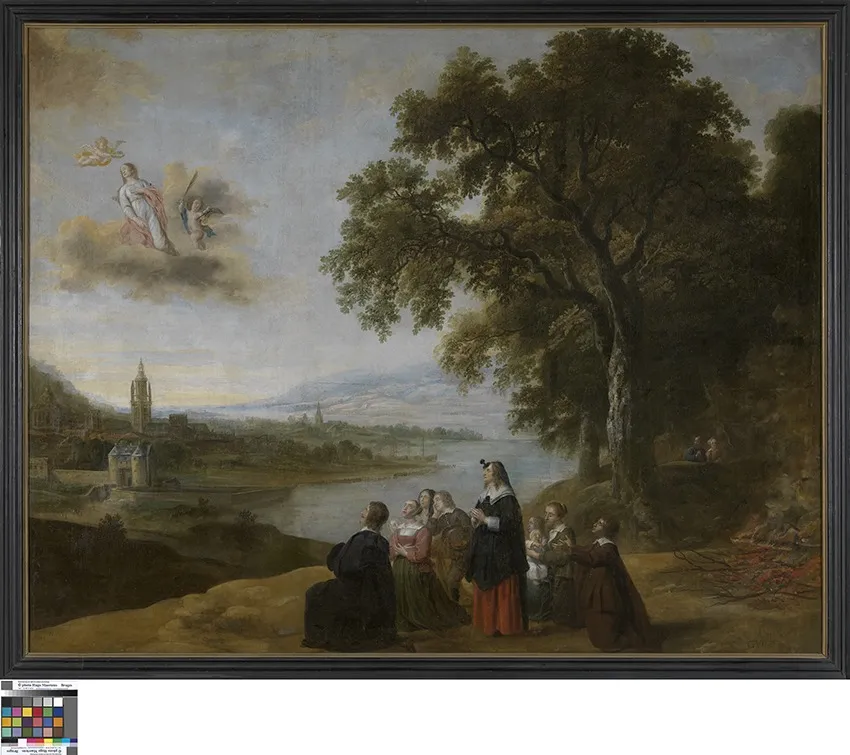
The Invocation of Saint Apollonia is an oil painting by Henricus Guilielmus. It dates from 1645 and is held in the collection of the Groeningemuseum.
About this work
Subject & Meaning
The composition integrates these figures within a landscape setting that features a tree, a church building, a gate, and a waterway containing a boat.
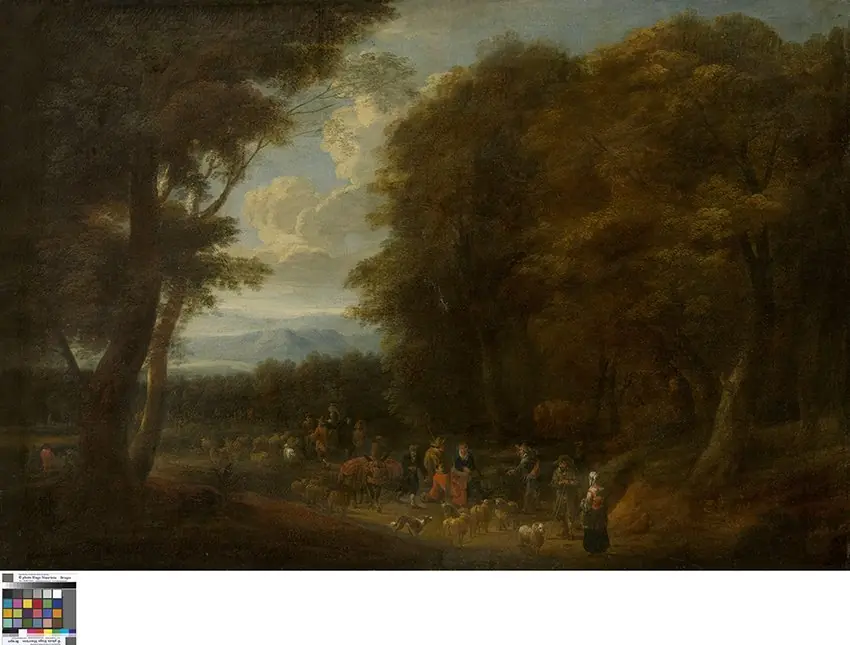
The Invocation of Saint Apollonia is a religious painting that centers on the figure of Saint Apollonia, flanked by a diverse group of human figures including men, women, and children. The composition integrates these figures within a landscape setting that features a tree, a church building, a gate, and a waterway containing a boat. Elements such as clouds and the surrounding waterway contribute to the atmospheric context of the scene.
As a work of religious art, the piece depicts a narrative moment involving the saint, though the specific theological action of the invocation is conveyed through the assembly of these figures and the architectural and natural elements present in the oil painting.
Technique & Style
The work is an oil painting executed on canvas, reflecting the religious genre typical of 17th-century Flemish art. Its large dimensions of 191 cm by 242 cm were achieved through careful handling of the canvas support, contributing to a stable composition that emphasizes spatial depth and chiaroscuro. The formal qualities reveal meticulous attention to architectural detail and figure arrangement, aligning with the stylistic conventions of the period.
History & Provenance
The work titled The Invocation of Saint Apollonia was created in 1645 by Henricus Guilielmus as an oil painting on canvas. It entered the collection of the Groeningemuseum, where it remains part of the Vlaamse Kunstcollectie and is displayed within the museum's religious art holdings.
The painting measures 191 centimeters in height and 242 centimeters in width and portrays a scene that includes a tree, Saint Apollonia, a church building, a gate, a boat, a cloud, a waterway, a man, a woman, and a child.
The work is recognized as part of the religious genre and was produced during the 17th century, with its inception recorded as 1645.
The provenance indicates a continuous ownership chain from its creation to its current placement in the Groeningemuseum collection.
The Invocation of Saint Apollonia is held in the Groeningemuseum, where it forms part of the Vlaamse Kunstcollectie. The painting, executed in oil on canvas and measuring 191 cm in height by 242 cm in width, has been associated with the museum's holdings of religious works by Henricus Guilielmus. No specific inventory or accession number is recorded in the available documentation.
No exhibition history is documented in the available sources for this work.
Context
Henricus Guilielmus created The Invocation of Saint Apollonia in 1645 as an oil painting on canvas depicting Saint Apollonia within a religious composition featuring a tree, church, and figures. The work is housed in the Groeningemuseum collection in Bruges, reflecting Flemish artistic traditions of the 17th century. Contemporary scholarship situates the painting within the artist's devotional output during the mid-1600s, though specific critical reception details are not documented in available sources.
Overview
Henricus Guilielmus painted The Invocation of Saint Apollonia in 1645 using oil on canvas. The work is part of the collection of the Groeningemuseum and presents a devotional scene that combines a landscape setting with a celestial figure.
Artist & collection
Artist
This Dutch painter in the 1600s had a habit of slipping tiny scenes into the corners of his religious paintings, like a dog chasing its tail in the shadows of a saint’s halo.