Artwork
East Hampton Beach, Long Island
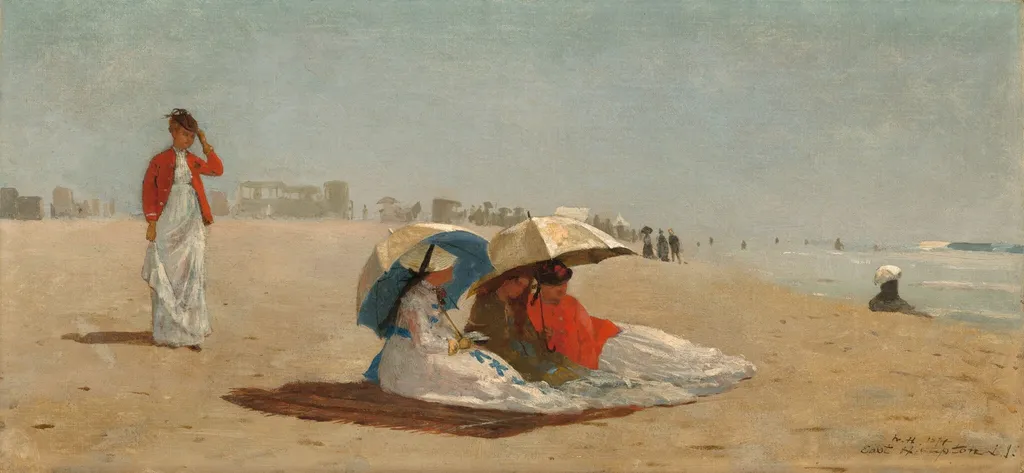
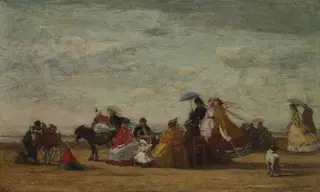
East Hampton Beach, Long Island is an oil painting by the American Impressionist artist Winslow Homer. It dates from 1874 and is held in the collection of the National Gallery of Art.
- Inscription
- Inscribed:lower right: W. H. 1874 / East Hampton L.I.
About this work
Technique & Style
The sources do not provide further detail on specific handling, brushwork, stylistic characterization, or current condition.
East Hampton Beach, Long Island is an oil painting on canvas executed by Winslow Homer in 1874. The work is painted in oil paint on canvas support, a standard combination for Homer's mid-1870s studio practice. Its horizontal format is notably elongated, measuring 26.04 cm in height by 55.25 cm in width, giving the composition a panoramic sweep suited to its open coastal subject.
The painting is classified as a painting within the National Gallery of Art collection in Washington, D.C., where it has been held since the bequest of Paul Mellon in 1999.
The sources do not provide further detail on specific handling, brushwork, stylistic characterization, or current condition.
History & Provenance
Winslow Homer created the oil painting East Hampton Beach, Long Island in 1874. The work's documented ownership history begins circa 1956, when actor William Roerick acquired the piece in Tulsa, Oklahoma. It was subsequently sold through the Zabriskie Gallery in New York to Harold K. Hochschild of Princeton in 1961.
Hochschild's estate sold the painting at Sotheby's in New York on October 22, 1981, after which it entered the collection of Dr. and Mrs. John E. Larkin, Jr. of Dellwood, Minnesota. The Larkins sold the work at Sotheby's on June 2, 1983, and it was acquired by Paul Mellon of Upperville, Virginia. Upon Mellon's death in 1999, the painting was bequeathed to the National Gallery of Art, with a life interest retained by Mrs. Mellon until its release in 2012.
East Hampton Beach, Long Island is held by the National Gallery of Art in Washington, D.C. The painting was acquired by William Roerick around 1956 in Tulsa, Oklahoma, later sold through Zabriskie Gallery in New York and then to Harold K. Hochschild in 1961; it changed hands again via Sotheby’s sales in 1981 and 1983 before entering the collection of Paul Mellon, who bequeathed it to the National Gallery of Art in 1999 with a life interest for his wife, later released in 2012. The work is catalogued in the National Gallery of Art’s collection as inventory number 1999.141.1.
Exhibition history includes its 1961 showing at the National Gallery of Art in Washington, D.C., and its 1983 display as part of the Paul Mellon collection at the same institution.
Dimensions are recorded as 26.04 cm in height and 55.25 cm in width.
Context
Critical reception of East Hampton Beach, Long Island has been shaped by its significance within Winslow Homer's oeuvre and his engagement with coastal landscapes. Scholarship highlights the work as part of Homer's mature period focused on the Atlantic shore, reflecting broader 19th-century American artistic interest in seascapes and light effects. The painting's provenance, documented through multiple ownership transitions including acquisition by the National Gallery of Art in 1961, underscores its established place in institutional art history collections.
Its inclusion in major Homer retrospectives and academic analyses of American realism further situates it within the artist's critical legacy, demonstrating how coastal subjects contributed to evolving narratives of American identity in art.
Overview
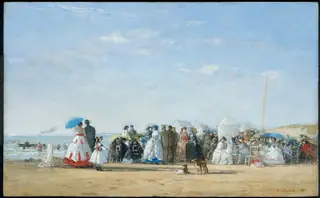
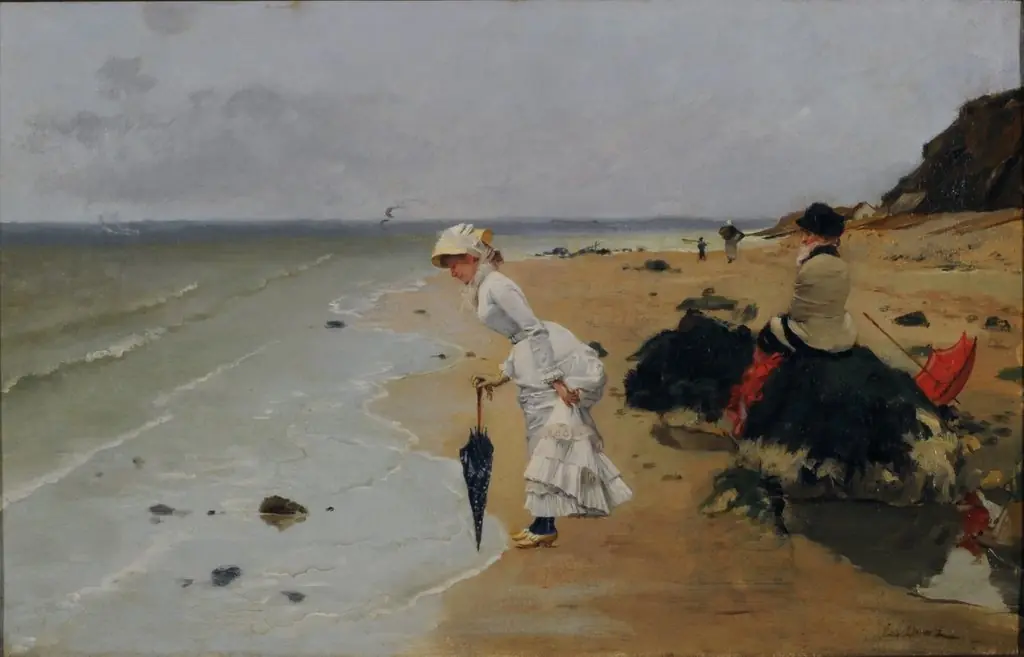
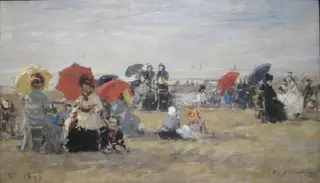
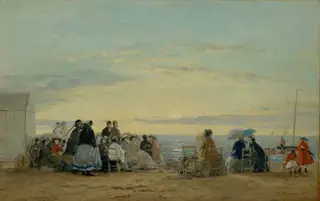
Winslow Homer’s 1874 oil on canvas titled East Hampton Beach, Long Island depicts a tranquil seaside scene. Three women occupy the foreground on a sandy shore: one in a flowing white dress clutching a hat, and two seated beneath a blue and a straw umbrella, each wearing wide-brimmed hats and bright red tops. The water lies smooth, and the sky is rendered in a pale, hazy light.
Subject & Meaning
The work presents a leisurely moment of summer recreation, emphasizing the casual elegance of 19th‑century beachgoing. The contrast between the women’s vivid red garments and the muted sand and sea highlights their presence within an otherwise serene landscape, suggesting a focus on everyday leisure rather than narrative drama.
Legacy
While not among Homer’s most frequently reproduced works, the painting exemplifies his skill in capturing light and atmosphere. It contributes to the understanding of his shift toward genre scenes and informs studies of American realism’s treatment of everyday leisure in the post‑Civil War period.
Artist & collection
Artist
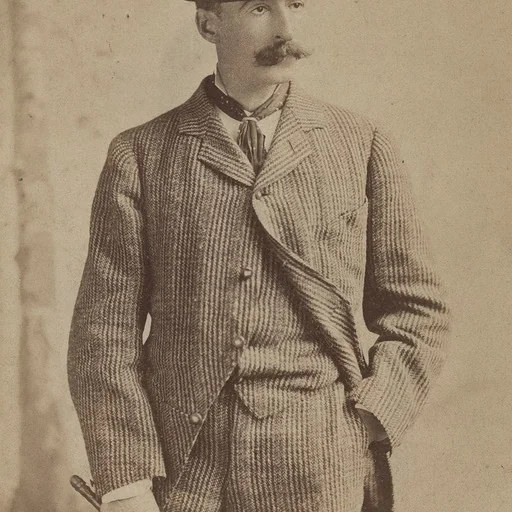
Winslow Homer (February 24, 1836 – September 29, 1910) was an American landscape painter and illustrator, best known for his marine subjects.