Artwork
Landscape with Waterfall
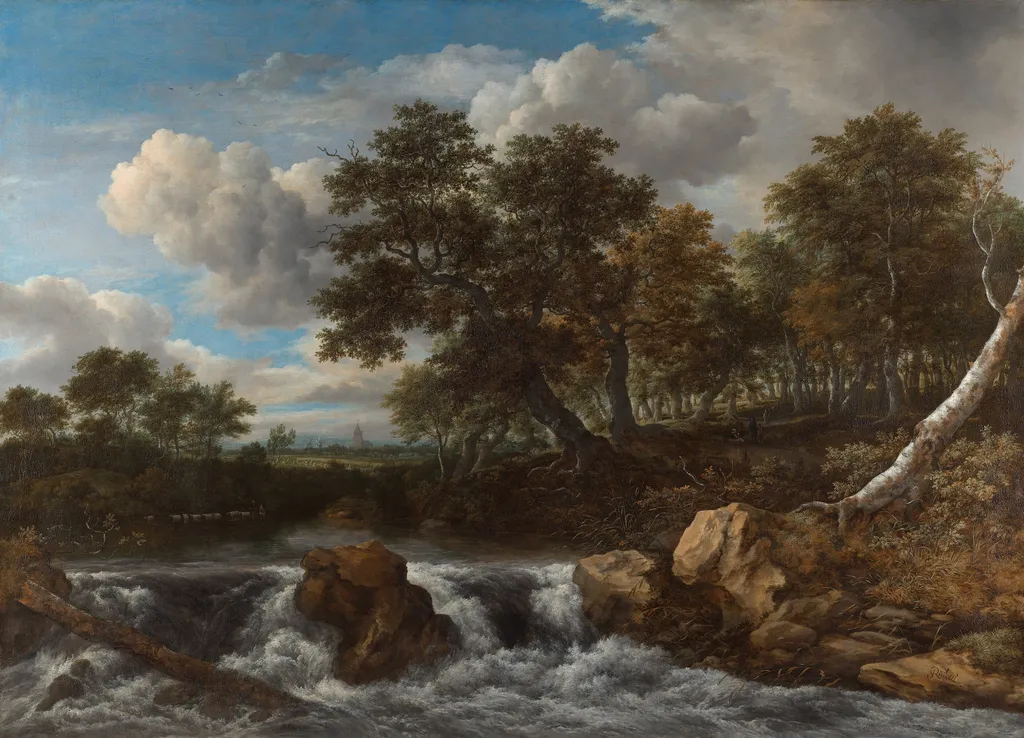
Landscape with Waterfall is an oil painting by the Dutch Golden Age artist Jacob van Ruisdael. It dates from 1668 and is held in the collection of the Rijksmuseum. Created in the 1660s, this oil on canvas depicts a Dutch countryside scene centered on a waterfall framed by rocky banks and trees.
About this work
Subject & Meaning
The background reveals a sunlit cornfield, a village with a church, and two windmills under a cloudy sky.
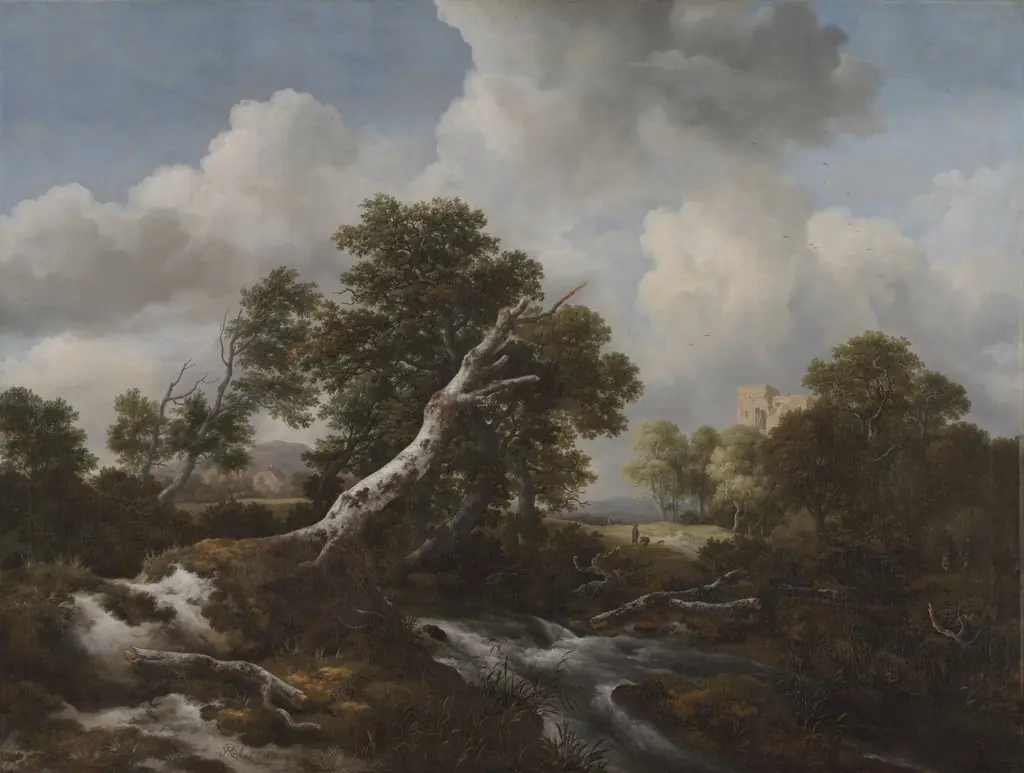
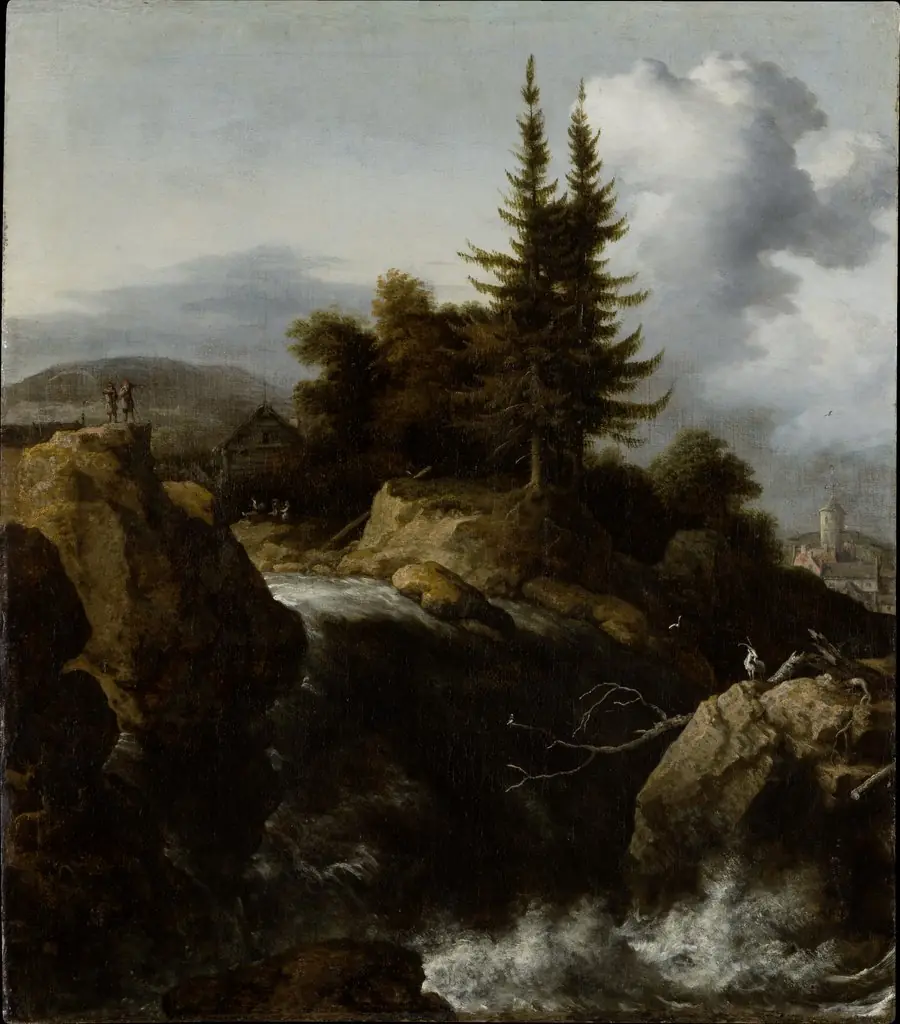
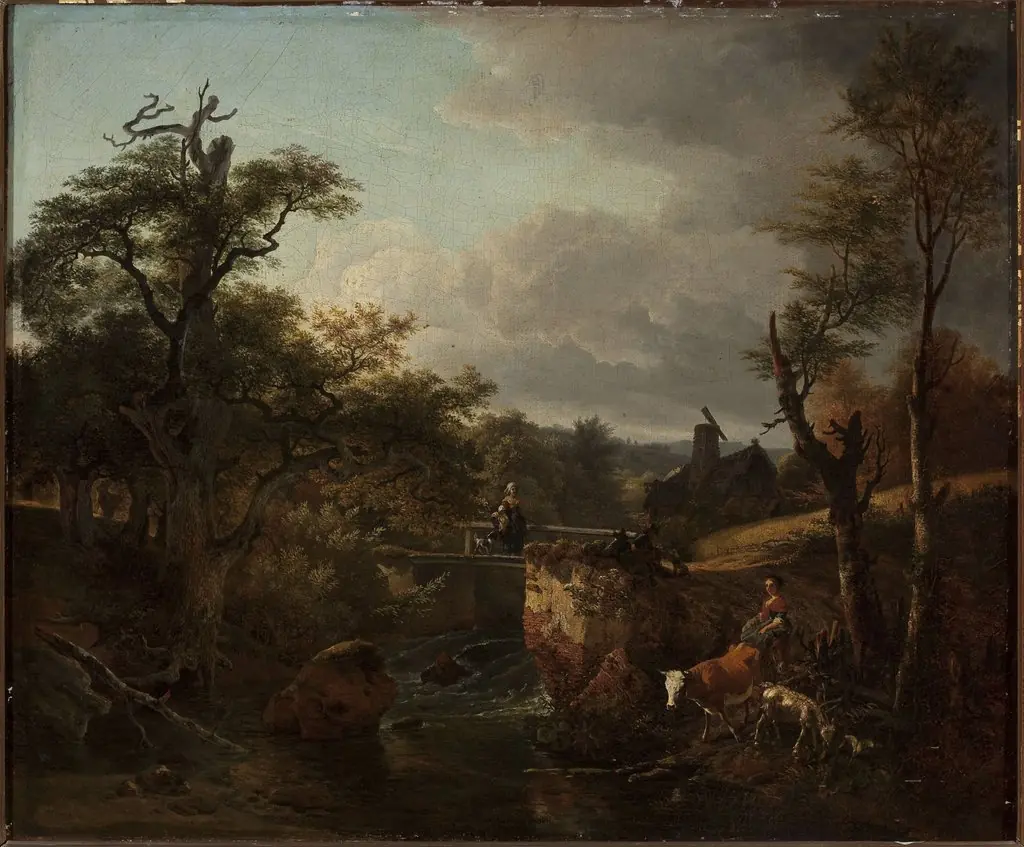
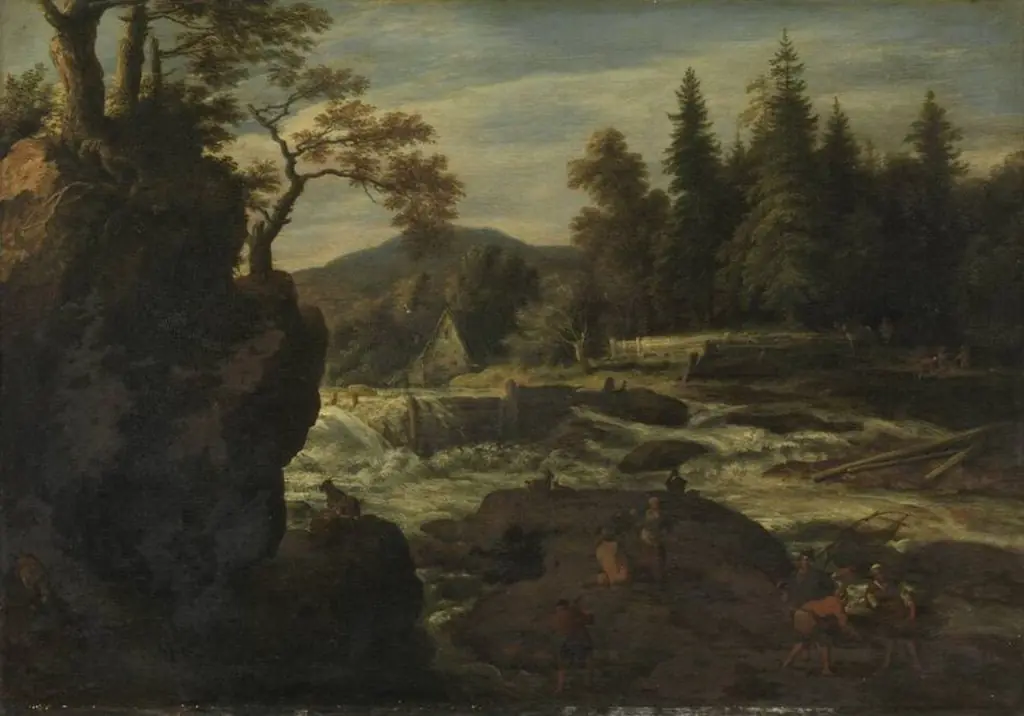
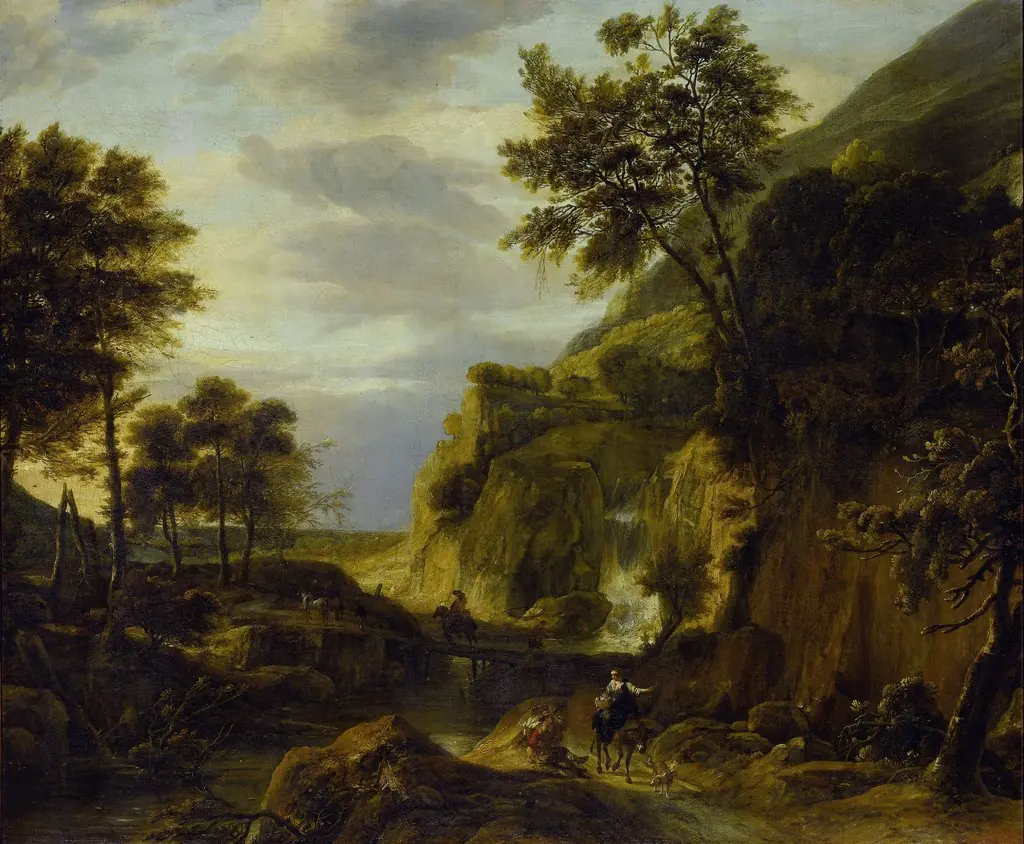
The painting depicts a dramatic Dutch landscape dominated by a low, wide waterfall in the left foreground, split by a central rock and flanked by a fallen tree trunk and a bent birch. In the middle distance, figures traverse the scene: a shepherd drives sheep through shallow water, while a group including a nursing woman rests near an oak wood. The background reveals a sunlit cornfield, a village with a church, and two windmills under a cloudy sky.
Iconographically, the inclusion of broken logs and uprooted trees serves as a silent witness to nature's destructive power, acting as a warning about the forces of the natural world. This motif suggests a scene that was once more turbulent than the calm moment currently depicted. The composition contrasts the immediate violence of the cascading water with the peaceful, sunlit agriculture in the distance, representing both the danger and the bounty of the landscape.
Technique & Style
The painting is executed in oil on canvas, with a brownish ground layer applied to prepare the support. Jacob van Ruisdael employed a preparatory brown underpainting to establish tonal values before blocking in large color areas such as sky, trees, and terrain. He used smalt for an initial sky layer and reserved costly ultramarine for highlights, creating a cost-effective yet luminous effect. Translucent green pigments, prone to darkening over time, were used for foliage, allowing the underlying brown ground to subtly illuminate the leaves. Brushwork varies to suggest movement in water, with splashes rendered through contrasting white and warm tones, while still surfaces reflect surrounding elements. The work measures 142.5 cm in height and 196 cm in width, making it the largest known canvas by the artist. Restoration records indicate prior varnish yellowing, excessive cleaning, and multiple repairs, including a 20 cm tear that was reworked; X-ray studies revealed an earlier canvas tear and a thick lead-white layer used to conceal damage. These technical and material choices contribute to the painting’s dramatic composition, characterized by a dominant waterfall in the foreground, framed by angled trees, a sunlit distant landscape, and figures that enhance spatial depth.
History & Provenance
Landscape with Waterfall was painted by Jacob van Ruisdael in 1668, as recorded in the artist’s catalogue and confirmed by multiple sources. The work remained in the private collection of Adriaan van der Hoop, who acquired it in 1837 from the English collector Sir Charles Blount and subsequently bequeathed it to the city of Amsterdam in 1854; the painting has been on loan to the Rijksmuseum since 1885 and is now part of the Rijksmuseum’s holdings. The painting’s dimensions are 142.5 cm by 196 cm, matching the measurements cited in the Rijksmuseum catalogue. Provenance details trace its ownership from van der Hoop’s bequest to the Amsterdam Museum, with documented exhibitions in Amsterdam in 1845 and later displays at the Rijksmuseum. The work was documented by Arnold Houbraken and later scholars, including Hofstede de Groot, who noted its acquisition history and praised its compositional grandeur.
Landscape with Waterfall is held in the Rijksmuseum, Amsterdam, and is part of the Adriaan van der Hoop bequest collection. Its inventory number is 2075, recorded in the 1910 Rijksmuseum catalogue. The work has been on loan to the Rijksmuseum since 1885 and was documented in exhibitions including Amsterdam 1845 (No. 134). Its provenance traces from Sir Charles Blount, Bart., to Sm., then to A. van der Hoop in 1837, and finally to Amsterdam in 1854.
The painting measures 142.5 cm by 196 cm and is executed in oil on canvas. It was acquired by Adriaan van der Hoop in 1837 and bequeathed to the city of Amsterdam in 1854. The work remains in the collection of the Amsterdam Museum but has been displayed at the Rijksmuseum since 1885.
Context
Landscape with Waterfall is recognized as a quintessential example of Dutch Golden Age painting, distinguished by its monumental scale which, at 142.5 by 196 cm, represents the largest known work by Jacob van Ruisdael. Art historical analysis dates the piece to circa 1668, noting that its composition of a wide, low cascade and open flat landscape typifies the artist's late style. The painting's dramatic elements, including broken tree trunks serving as silent witnesses to nature's force, reflect the influence of Allaert van Everdingen's earlier Nordic landscapes.
Early scholarship by Hofstede de Groot in 1911 cited John Smith's earlier assessment of the work as a "chef d'oeuvre," praising its grand composition and masterly execution. The scene's similarity to other waterfall motifs in Ruisdael's oeuvre suggests these images were commercially successful during his lifetime. In the nineteenth century, the Swiss painter Alexandre Calame viewed the work in Amsterdam and hailed Ruisdael as a "magnificent master," underscoring the painting's enduring critical reputation.
Legacy
Landscape with Waterfall has shaped Jacob van Ruisdael’s reputation as a master of dramatic natural scenery, particularly through his innovative treatment of waterfalls that influenced later Romantic and Dutch landscape painters. The work’s monumental scale, measuring 142.5 cm by 196 cm, has been cited as a benchmark for compositional grandeur, inspiring artists such as Alexandre Calame, who described Ruisdael as a “magnifique maître” after viewing the painting. Its legacy is reinforced by a well‑documented provenance, including acquisition by Adriaan van der Hoop in 1837 and bequest to Amsterdam in 1854, which ensured public access and continuous scholarly attention. The painting’s technical innovations, such as the use of a brown underpainting and layered pigments to achieve atmospheric depth, have been studied in recent conservation reports, highlighting its role in advancing 17th‑century oil techniques. Contemporary scholarship, including Benders and Rikken’s 2011 article in The Rijksmuseum Bulletin, underscores its status as a “chef d'oeuvre” that continues to inform both art historical narratives and museum display practices.
Own this work as a print
Artist & collection
Artist
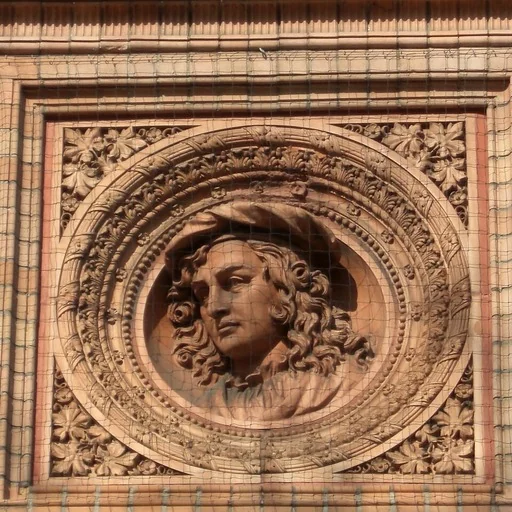
Jacob Isaackszoon van Ruisdael was a Dutch painter, draughtsman, and etcher. He is generally considered the pre-eminent landscape painter of the Dutch Golden Age, a period of great wealth and cultural achievement when…