Artwork
The Birth of John the Baptist
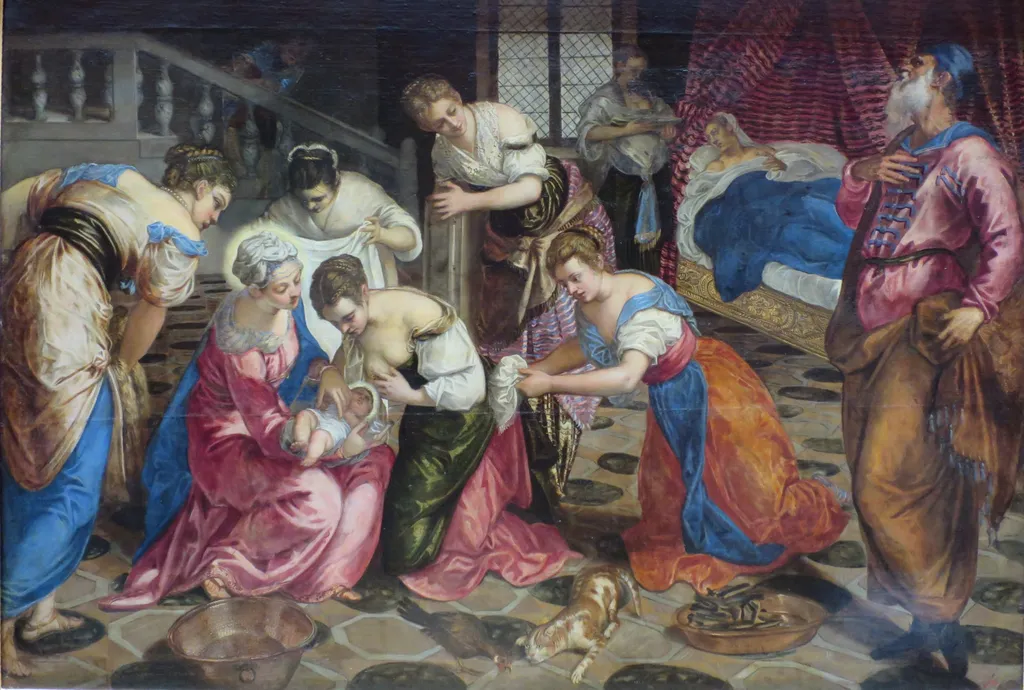
The Birth of John the Baptist is an oil painting by the Mannerist artist Jacopo Tintoretto. It dates from 1550 and is held in the collection of the Hermitage Museum. Created circa 1550, this oil on canvas portrays the biblical moment of John the Baptist’s birth.
About this work
Subject & Meaning
The work underscores themes of faith, miraculous birth, and prophetic destiny, positioning John the Baptist as a precursor to Christ.
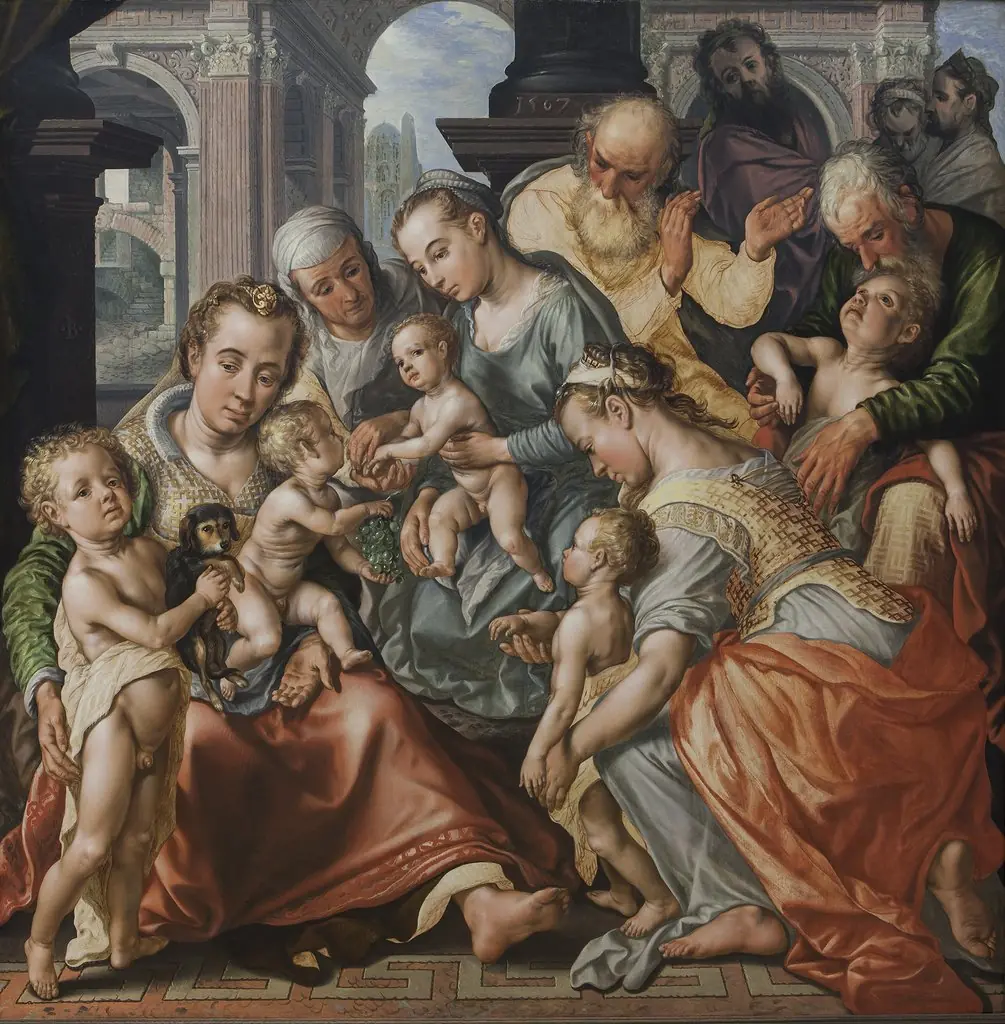
The painting depicts the birth of John the Baptist as narrated in the Gospel of Luke. The scene centers on the moment immediately following Elizabeth’s childbirth, with the newborn John being cared for by female attendants, including a wet nurse breastfeeding him. Elizabeth reclines in bed, while her husband, Zechariah, stands nearby, gesturing in astonishment and acceptance, a response to his earlier disbelief at the angel’s prophecy of their child’s birth due to their advanced age. Zechariah’s muted state, a consequence of his initial skepticism, is subtly implied. The iconography aligns with Christian traditions, emphasizing divine intervention in human affairs. The luxurious Venetian attire of the figures, rendered in vibrant, rich colors, reflects the artist’s contemporary context, blending sacred narrative with the opulence of 16th-century Venetian society. The work underscores themes of faith, miraculous birth, and prophetic destiny, positioning John the Baptist as a precursor to Christ.
Technique & Style
Executed in 1550, this early work by Jacopo Tintoretto is an oil painting on canvas measuring 181 by 266 cm. The composition reflects the Venetian school and Mannerist movement, characterized by brilliant colors and the depiction of luxurious fabrics that mirror contemporary Venetian society.
The scene captures the moment immediately following the birth of John the Baptist, with Elizabeth resting in bed while female attendants care for the infant, including a nurse breastfeeding the child. To the side, the priest Zacharias displays a gesture of surprise and acceptance. The handling of light and rich textiles emphasizes the opulence of the setting, distinguishing it as a significant example of the artist's youthful style before he gained full prominence in Venice.
History & Provenance
The Birth of John the Baptist is held in the State Hermitage Museum, Saint Petersburg, with accession details recorded as 181 × 266 cm, oil on canvas, inventory number not specified in sources.
The painting has been exhibited at the Hermitage in Hall 237, where it remains on permanent display according to institutional records.
Context
Executed in 1550, this canvas represents an early work by Jacopo Tintoretto, created during a period when the artist was rapidly gaining influence within Venice. The painting is classified as a product of the Venetian school and the Mannerist movement, distinguished by its use of brilliant colors and depiction of luxurious fabrics that reflect contemporary Venetian society. While the composition adheres to the religious narrative found in the Gospel of Luke, it stands as a significant example of Tintoretto's developing style prior to his later mature commissions. The work is currently held in the Hermitage Museum, where it remains a key representation of the artist's youthful output alongside a later homonymous piece located in the Church of San Zaccaria.
Own this work as a print
Artist & collection
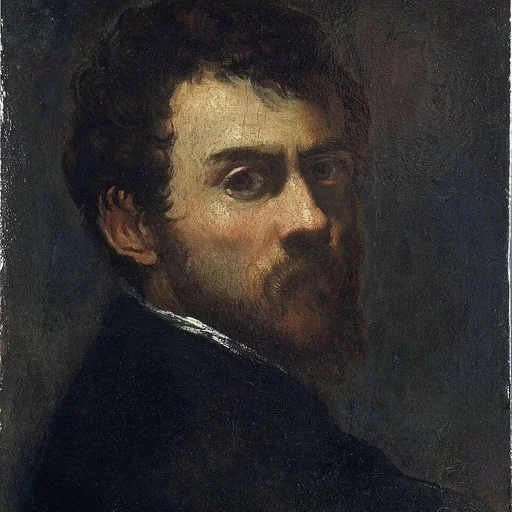
Artist
Jacopo Robusti (late September or early October 1518 – 31 May 1594), best known as Tintoretto ( TIN-tə-RET-oh; Italian:; Venetian: ), was an Italian Renaissance painter of the Venetian school.