Artwork
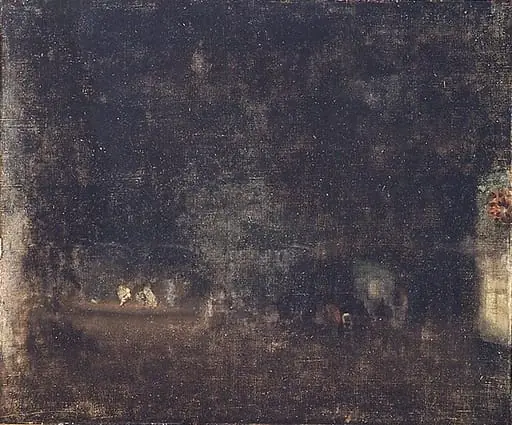
Cremorne Gardens, No. 2
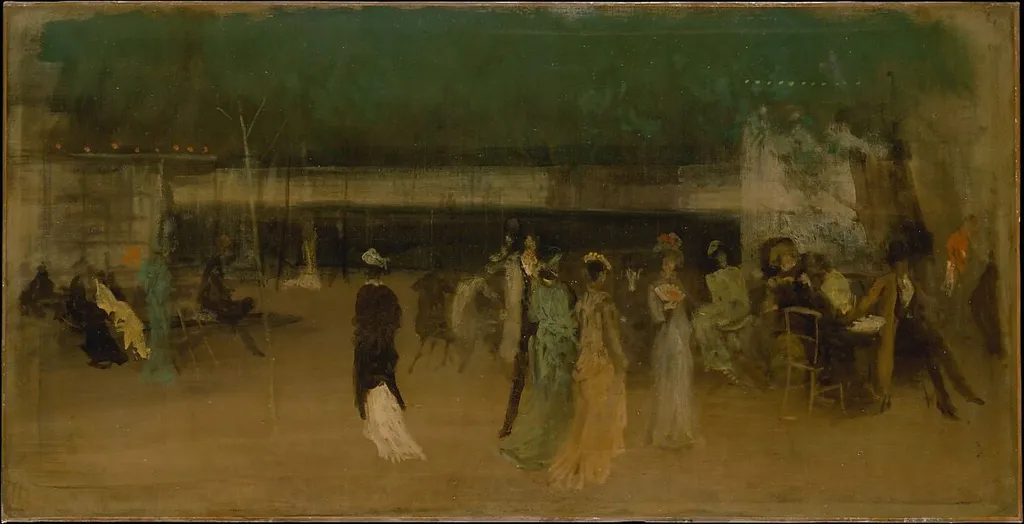
Cremorne Gardens, No. 2 is an oil painting by the American Impressionist artist James McNeill Whistler. It dates from 1875 and is held in the collection of the Metropolitan Museum of Art. Cremorne Gardens, No.
- Accession no.
- 12.32
- Credit line
- John Stewart Kennedy Fund, 1912
About this work
Technique & Style
The work belongs to the Aestheticism movement and is classified as a landscape, though it also depicts a male figure.
Cremorne Gardens, No. 2 is an oil painting on canvas, measuring 68.6 by 134.9 cm. The work belongs to the Aestheticism movement and is classified as a landscape, though it also depicts a male figure. The horizontal format and relatively modest height compared to its width suggest an expansive, panoramic composition typical of Whistler's atmospheric nocturnal scenes.
As an oil on canvas from 1875, the painting reflects Whistler's characteristic handling of the medium during this period, employing oil paint to achieve tonal harmonies and evocative mood rather than detailed naturalistic description. The work's emphasis on aesthetic effect over narrative content aligns with Aestheticist principles.
History & Provenance
Cremorne Gardens, No. 2 is held by the Metropolitan Museum of Art, where it is listed in the museum's records as part of the American Wing collection; no specific accession number is provided in the cited documentation. The work, an 1875 oil on canvas measuring 68.6 cm by 134.9 cm, was created by James McNeill Whistler and is categorized as a landscape depicting a man. The sources do not record any exhibition history for this piece beyond its inclusion in the museum's catalog.
Its presence in the Met's holdings is documented in both the internal classification entry and the publicly accessible Wikidata entry.
Overview
Cremorne Gardens, No. 2, painted by James McNeill Whistler in 1875, depicts a nocturnal scene within the popular London pleasure gardens of the same name. The composition focuses on the atmospheric interplay of artificial illumination and shadow rather than topographical precision. A luminous sky, rendered in hues of orange and purple, contrasts with the dark silhouettes of trees and foliage.
In the foreground, two female figures walk arm-in-arm along a gas-lit path, while a solitary male figure sits on a bench to the side, observing the surroundings. Executed in oil on canvas, the work exemplifies Whistler's commitment to aesthetic harmony over narrative detail. He employs soft, blurred brushstrokes to dissolve distinct forms, prioritizing the arrangement of color and tone to evoke a specific mood.
This approach aligns with his broader artistic philosophy, often described as 'art for art's sake,' where the visual experience supersedes literal representation. Created during a period when Whistler was refining his 'nocturne' series, the painting captures the fleeting effects of gaslight on the human figure and the environment, marking a significant development in his exploration of tonal abstraction and modern urban life.
Subject & Meaning
The painting portrays a tranquil evening in Cremorne Gardens. A man sits alone on a bench, while two women stroll arm-in-arm along a path bathed in light. Above, the sky transitions from orange to purple, casting a subtle glow behind the dark silhouettes of trees.
This arrangement of figures and light creates a sense of quiet observation, reflecting the contemplative atmosphere of a public garden at night.
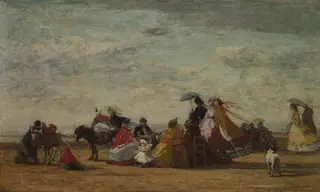
Artist & collection
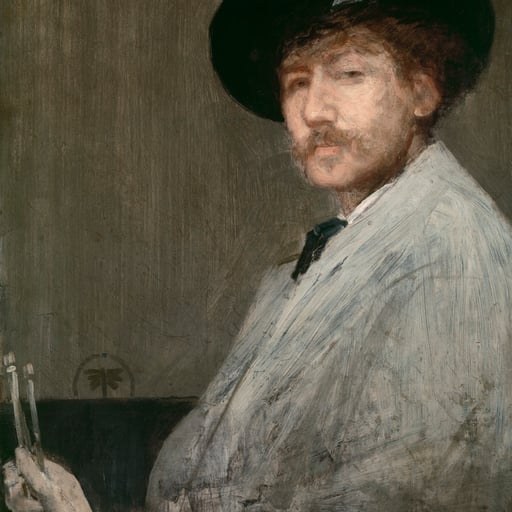
Artist
James Abbott McNeill Whistler (; July 10, 1834 – July 17, 1903) was an American painter in oils and watercolor, and printmaker, active during the American Gilded Age and based primarily in the United Kingdom.

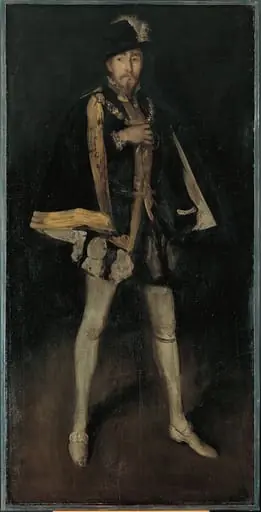 Arrangement in Black, No. 3: Sir Henry Irving as Philip II of Spain
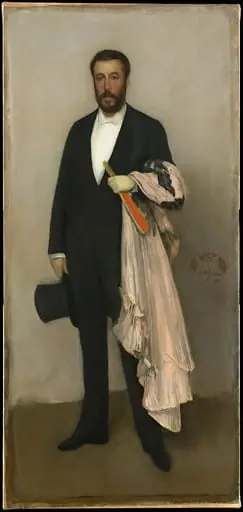 Arrangement in Flesh Colour and Black: Portrait of Theodore Duret
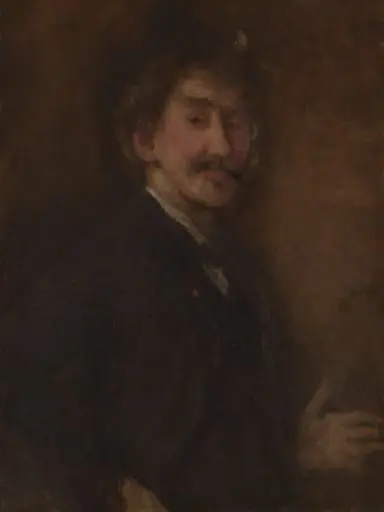 Gold and Brown: Self-Portrait
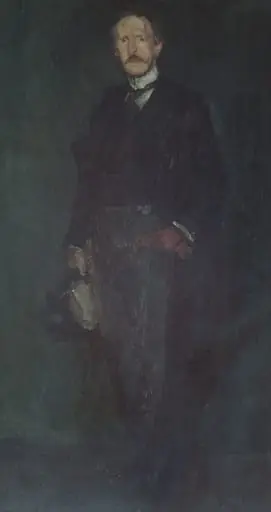 Edward Guthrie Kennedy
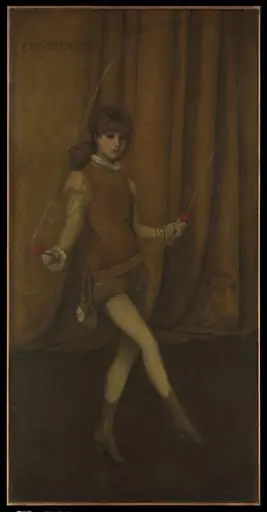 Harmony in Yellow and Gold: The Gold Girl—Connie Gilchrist
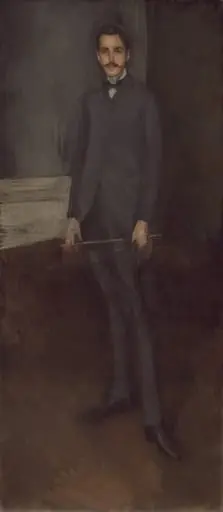 George W. Vanderbilt
 Symphony in White, No. 1: The White Girl
 Henry Irving as Philip II of Spain