Artwork
The procession of the schools in 1878
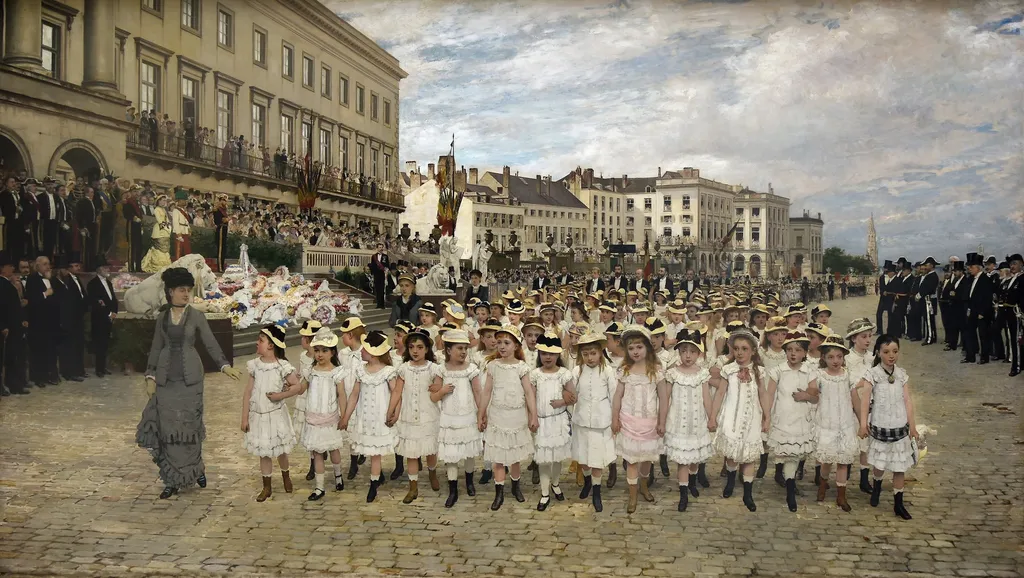
The procession of the schools in 1878 is an oil painting by the Impressionist artist Jan Verhas. It dates from 1890 and is held in the collection of the Royal Museums of Fine Arts of Belgium.
About this work
Overview
The Procession of the Schools in 1878 is a large oil-on-canvas painting by the Belgian artist Jan Verhas, completed in 1880.
The Procession of the Schools in 1878 is a large oil-on-canvas painting by the Belgian artist Jan Verhas, completed in 1880. Measuring 241 by 423 centimeters, the work depicts a massive parade of schoolchildren on the Place des Palais in Brussels and is now held in the Oldmasters Museum, part of the Royal Museums of Fine Arts of Belgium. The painting ranks among the best-known works in the Belgian artistic patrimony and serves as a complex document of political, educational, and national identity in late nineteenth-century Belgium.
Subject & Meaning
The painting records a parade of approximately 23,000 schoolchildren from Brussels municipal schools that took place on 24 August 1878 on the Place des Palais before the Royal Palace of Brussels. The occasion was the silver wedding anniversary of King Leopold II and Queen Marie-Henriette, both of whom appear on a raised platform to the left, accompanied by Archduke Charles-Louis of Austria in a white uniform and Philippe, Count of Flanders. The procession carried potent political symbolism: the children of official state education were presented as the future of young Belgium, demonstrating the supposed superiority of secular over Catholic schooling. Verhas, a freemason and liberal partisan, appears to have depicted only schoolgirls, deliberately omitting the boys who followed in the actual parade, in order to highlight improved educational access for girls as an achievement of Enlightenment-inspired pedagogical liberalism. The ultramontane press denounced the event as political exploitation of innocent children, and the controversy helped spark Catholic resistance to the so-called law of misfortune that eventually brought down the liberal government.
Technique & Style
The painting is executed in oil on canvas with a horizontal format suited to the panoramic procession it depicts. The visual composition shows young girls in white dresses and straw hats crossing a cobblestone square, led by a woman in a grey fitted dress with bustle and yellow gloves, while rows of similarly dressed girls recede into the distance. To the left, adults in formal dark clothing gather on a raised platform and building balcony amid floral wreaths and banners; to the right, uniformed men stand in formation. The palette is dominated by whites, greys, and muted earth tones with touches of black. Brushwork is precise and detailed in the foreground figures, growing looser in the distant architecture and cloudy sky. Strong daylight enters from the left, casting soft shadows across the cobblestones. The date 1878 appears on a banner near the platform. The handling combines documentary observation with the polished finish expected in bourgeois salon painting of the period.
History & Provenance
Verhas completed the painting in 1880, and it was immediately displayed at the Exposition historique de l'art belge 1830-1880 in Brussels. On 8 September 1880, Minister of the Interior Gustave Rolin-Jaequemyns purchased it on behalf of the liberal government for preservation in Brussels, where it received a prominent place at the Palais des Beaux-Arts. The painting was exhibited at the Salon des artistes français in Paris in 1881, an occasion that earned Verhas the cross of knight of the Ordre national de la Légion d'honneur from Jules Ferry. The work later entered the collection of the Royal Museums of Fine Arts of Belgium and is now housed in the Oldmasters Museum. As of 2019, it hung outside category in the entrance hall of the museum in Brussels.
Context
The painting emerged from a charged political moment. In 1878, the homogeneous liberal government of Frère-Orban-Van Humbeeck came to power and enacted a new school law, triggering the Belgian school struggle that would persist for decades. Leopold II, though fond of parades and processions, attempted to maintain neutrality in the conflict. Verhas occupied a privileged position in bourgeois art circles as a favored salon painter, and this commission aligned with his liberal convictions. The work's immediate official purchase and prominent display underscore its function as state propaganda. Emerging photomechanical reproduction techniques allowed mass circulation of the image, which appeared in official buildings and state schools but was conspicuously absent from free Catholic schools. James Ensor later reacted against this type of art with his painting The Entry of Christ into Brussels, positioning Verhas's work as a foil for more radical aesthetic developments.
Legacy
For Verhas, the painting brought both celebrity and financial reward, making it the most celebrated and lucrative work of his career. Its mass reproduction through photomechanical processes ensured wide circulation as a visual emblem of liberal educational policy. Yet by the twentieth century, the painting's reputation had diminished: it could at most be considered a bourgeois icon, increasingly out of step with avant-garde developments in Belgian art. Its significance persists primarily as a historical document, preserving the appearance of the old facade of the Royal Palace before Leopold II's renovations and recording a pivotal episode in Belgium's culture wars over education. The work remains a touchstone for understanding the intersection of art, politics, and national identity formation in nineteenth-century Belgium.
Artist & collection
Artist
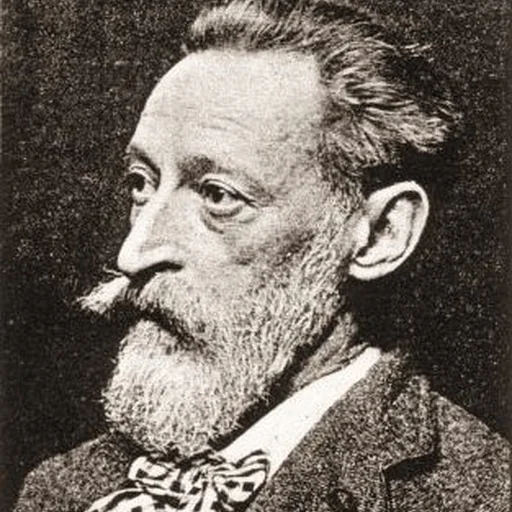
Jan Verhas or Jan Frans Verhas (9 January 1834 – 31 October 1896) was a Belgian painter of the Realist school.

Museum
Royal Museums of Fine Arts of Belgium
Continue through works from the same source collection.
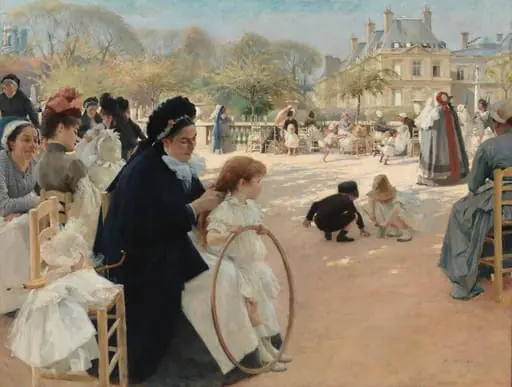 Pariisin Luxembourgin puistossa
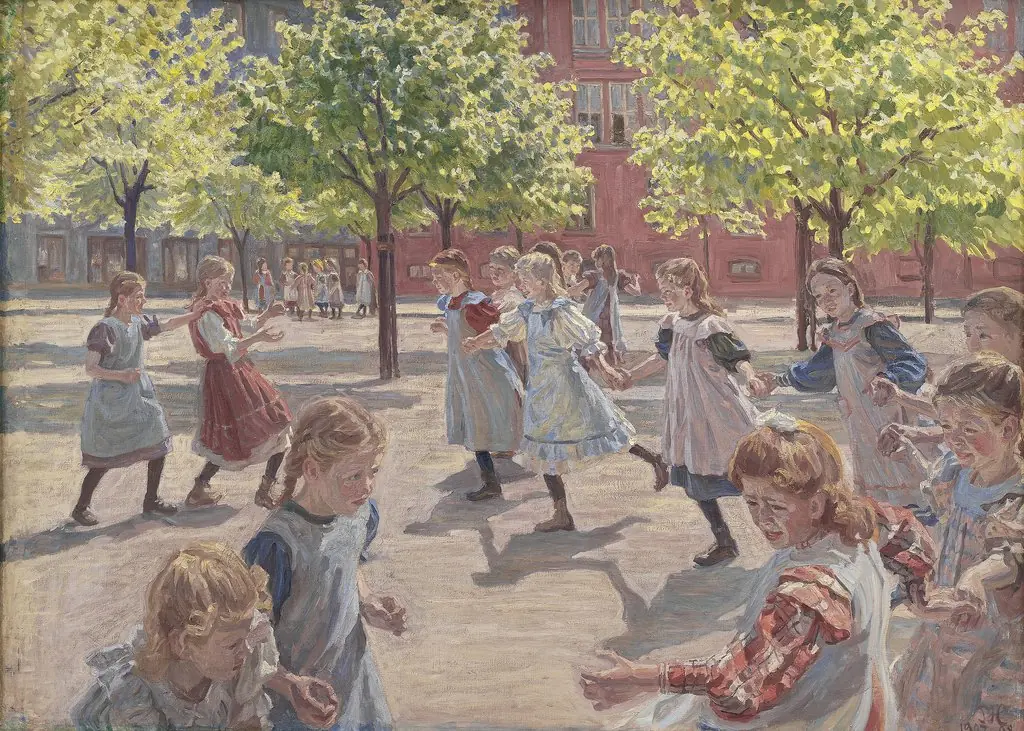 Playing Children, Enghave Square
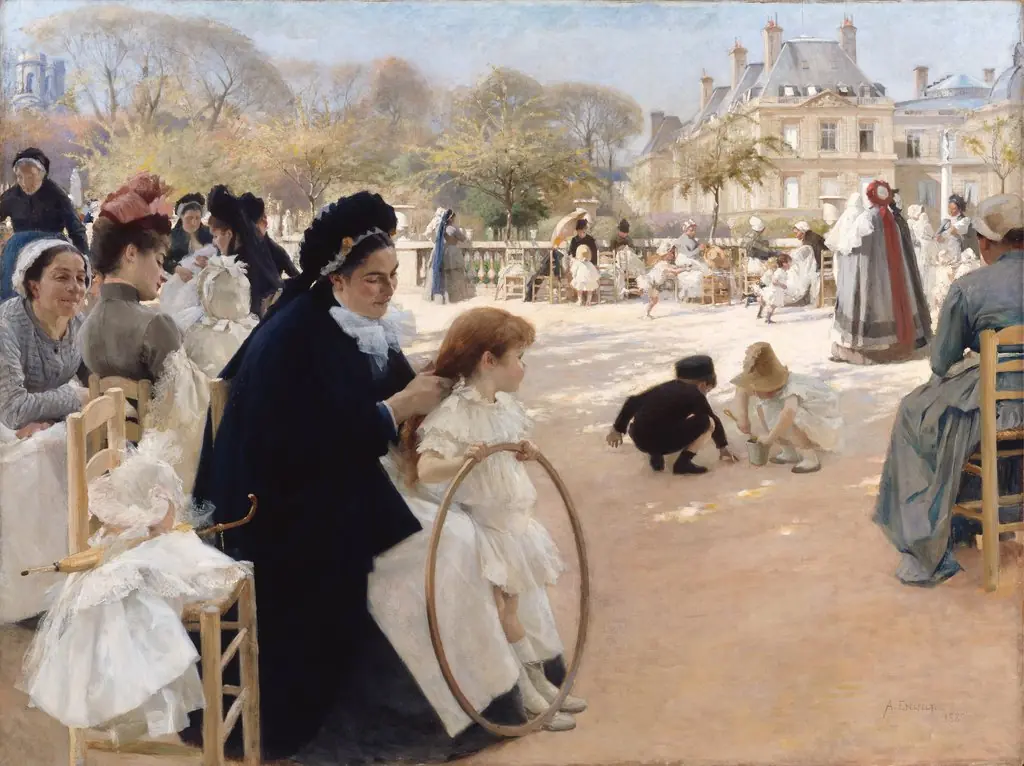 The Luxembourg Gardens, Paris
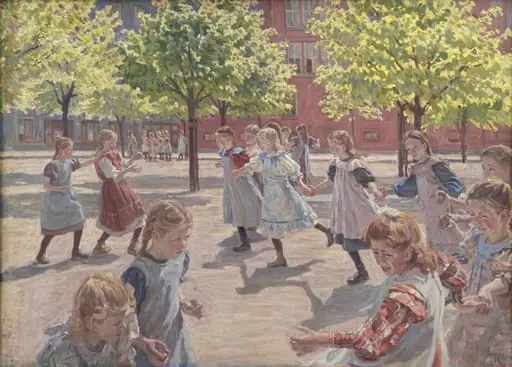 Playing Children, Enghave Square
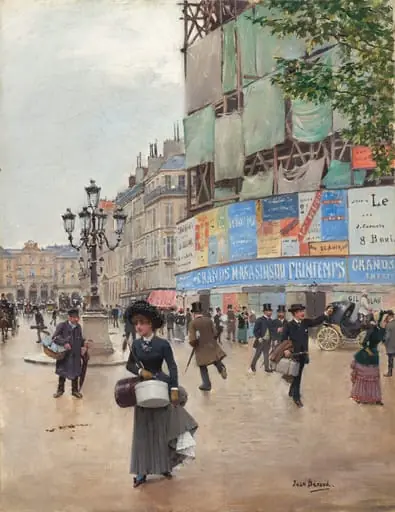 Paris, rue du Havre
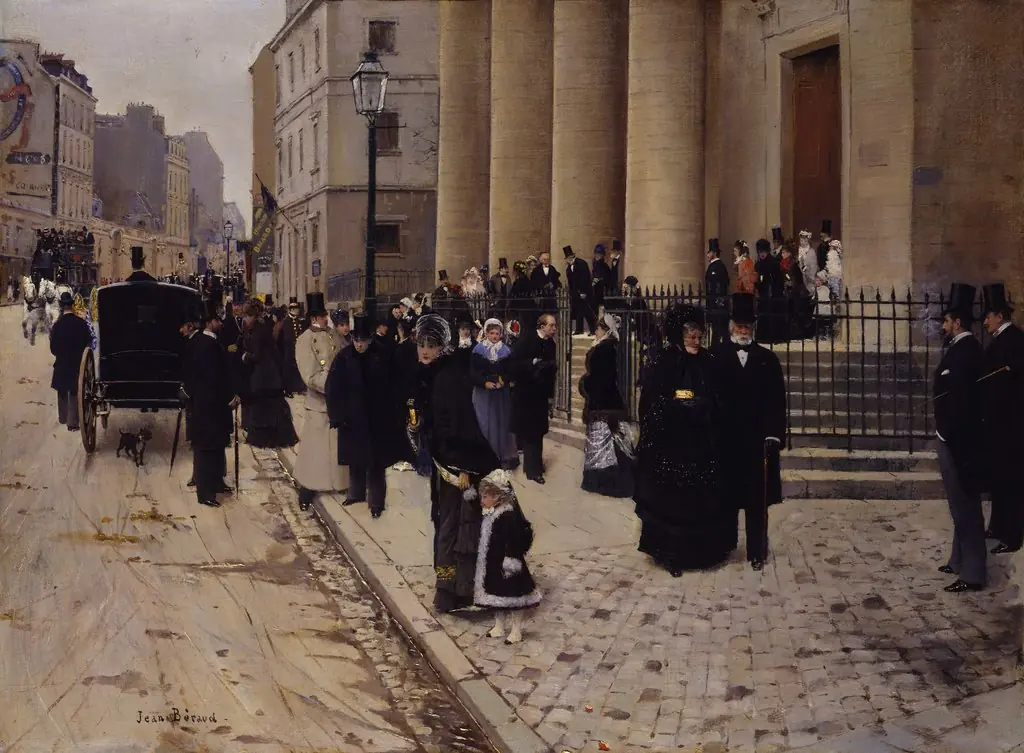 Sunday at the Church of Saint-Philippe-du-Roule, Paris
 Tomando el sol
 La Place Pigalle
 The Corpus Christi Procession
 Sunday at the Bois de Boulogne
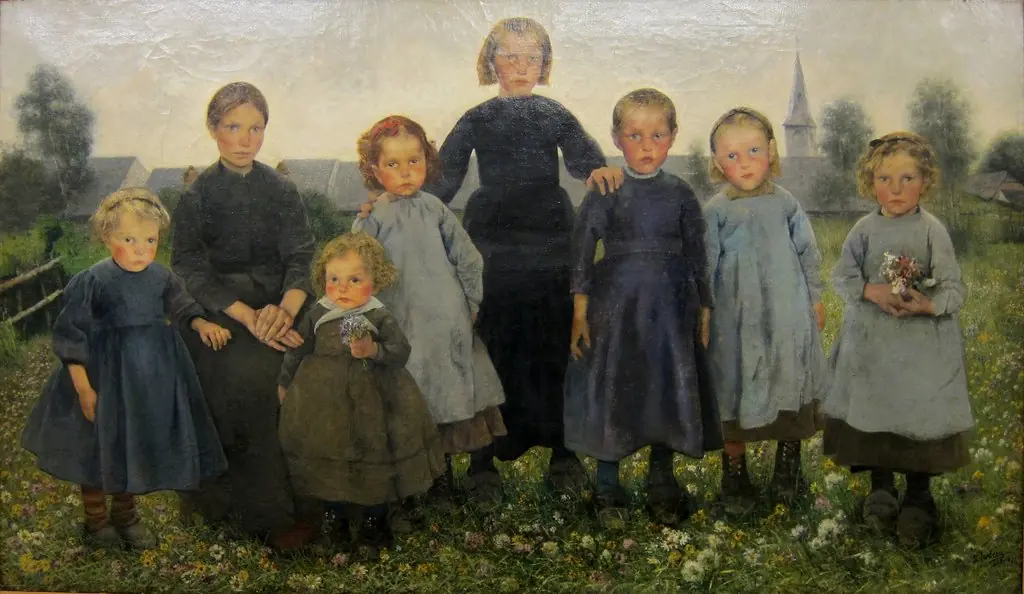 The Girls
- Great procession