Artwork
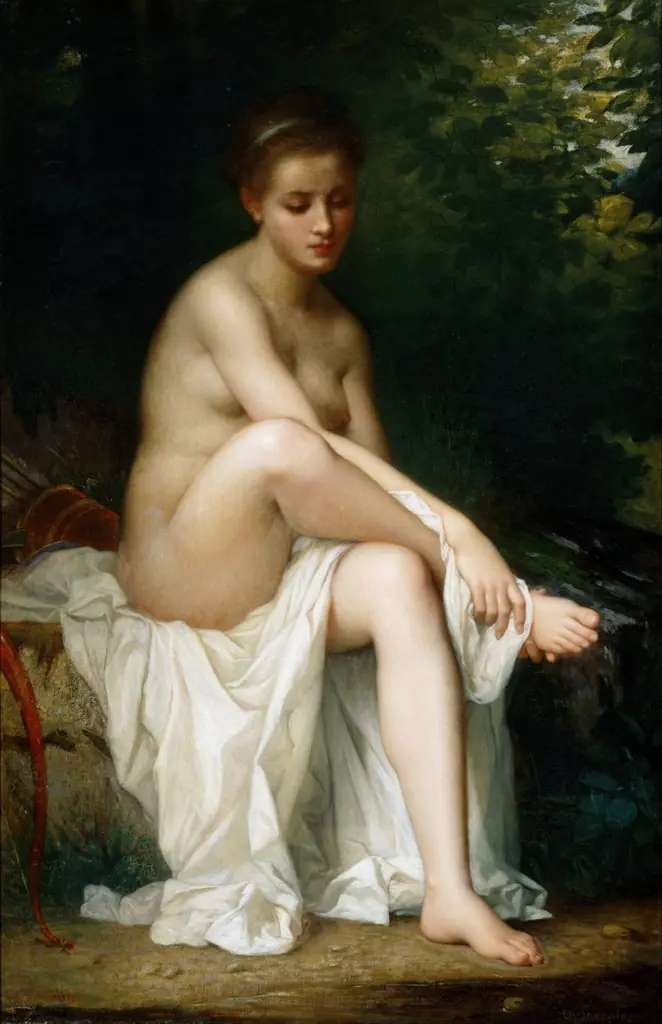
The Chaste Susannah
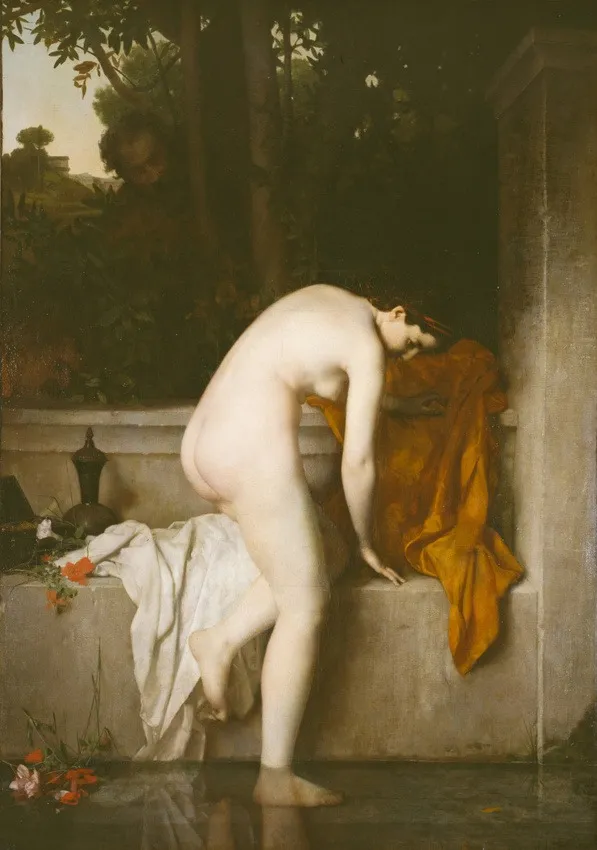
The Chaste Susannah is an oil painting by the Realist artist Jean-Jacques Henner. It dates from 1864 and is held in the collection of the Musée d'Orsay.
About this work
Subject & Meaning
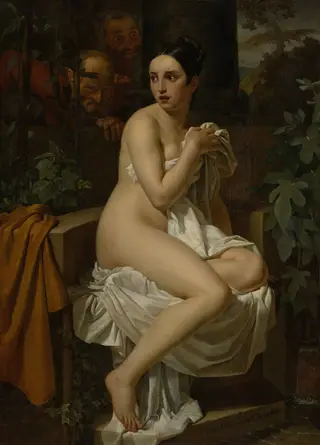
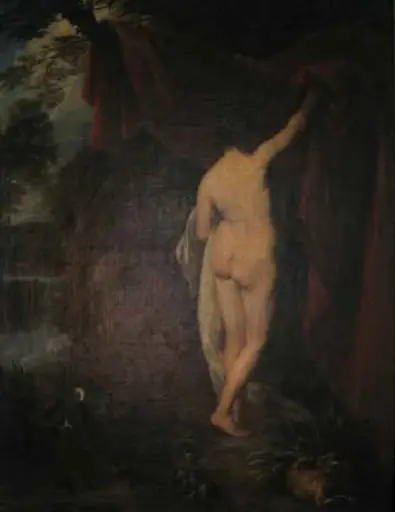
Henner’s painting renders Susanna nude from a three-quarter back view, standing on the edge of a pool with one foot in the water, surrounded by fallen flowers.
The work depicts the biblical episode of Susanna and the Elders from the Book of Daniel, in which Susanna, a virtuous woman, is surprised at her bath by two elderly judges who threaten to denounce her unless she yields to them. Henner’s painting renders Susanna nude from a three-quarter back view, standing on the edge of a pool with one foot in the water, surrounded by fallen flowers. The two voyeurs are concealed in the foliage behind her, emphasizing the tension between innocence and attempted seduction.
In Christian iconography, this scene traditionally symbolizes chastity triumphing over lust, offering artists a morally sanctioned pretext for depicting the female nude. The inclusion of classical landscape elements and the composition’s measured restraint align with mid-nineteenth-century academic treatment of religious narratives, underscoring the moral stakes of the episode.
Technique & Style
The Chaste Susannah is an oil painting on canvas, executed in a vertical format. Henner employed traditional oil technique to render the religious nude, showing Susanna three‑quarters back, right foot in water, supported by a low wall, with fallen flowers, a white and orange drapery, and a perfume vase on the edge. Behind her, vegetation hides the heads of the two elders, while a distant landscape with trees and a possible allusion to the Arch of Titus occupies the upper left. The work illustrates the story of Susanna and the Elders, a theme that permitted 19th‑century artists to depict a morally justified female nude.
History & Provenance
Jean-Jacques Henner painted *The Chaste Susannah* in 1864 during his final year as a pensionnaire at the Villa Médicis in Rome, where he had been since winning a scholarship in 1858. The work was executed as a required study demonstrating his artistic progress during the residency.
The painting was sent to Paris and exhibited at the Salon of 1865, where it was purchased by the French state. It was subsequently displayed at the Luxembourg Museum from 1867, entered the Louvre's collections in 1929, and was reassigned to the Musée d'Orsay in 1978, where it remains. The canvas is also known as *Suzanne au bain*.
Painted in 1864 during Jean-Jacques Henner's residency at the Villa Medici in Rome, The Chaste Susannah was first exhibited at the Paris Salon of 1865. Following its purchase by the French state at that event, the work entered the Luxembourg Museum in 1867 before transferring to the Louvre collections in 1929. Since 1978, the painting has been held by the Musée d'Orsay in Paris, where it is cataloged under the inventory number RF 94. Beyond its initial salon presentation, the artwork was displayed at the International Exposition of 1867 and the 1873 Vienna World's Fair.
Context
The Chaste Susannah was painted by Jean-Jacques Henner in 1864 during his final year as a pensionnaire at the French Academy in Rome, reflecting his engagement with classical subjects and academic figure drawing in that context. Henner's wider practice centered on religious and mythological themes rendered with a soft, atmospheric technique, positioning him within the academic tradition while anticipating Symbolist sensibilities. The work draws directly on the story of Susanna and the Elders from the Book of Daniel, a narrative that allowed artists to depict the female nude under the guise of moral justification, as noted in scholarly descriptions of its composition and iconography. It was first exhibited at the 1865 Salon, where it garnered attention for its ambitious scale and sensual realism, later entering the French state collection and eventually finding a permanent home at the Musée d'Orsay, where it remains part of the national collection.
Legacy
The painting La Chaste Suzanne, also titled Suzanne au bain, emerged as a significant work within 19th-century religious art, influencing discussions around the depiction of female nudity grounded in biblical narratives. Its exhibition at the 1865 Salon marked a pivotal moment in its reception, drawing attention to contemporary interpretations of the Susanna and the Elders story. The work's journey through institutional spaces, including the Luxembourg Museum, the Louvre, and later the Musée d'Orsay, underscores its enduring presence in public collections, with its acquisition by the French state in 1867 affirming its cultural value. Later scholarship, such as references in 19th-century French art literature, occasionally highlighted its technical and thematic innovations, particularly in compositions blending naturalistic detail with symbolic elements like floral motifs and architectural references to Roman landmarks.
Artist & collection

Artist
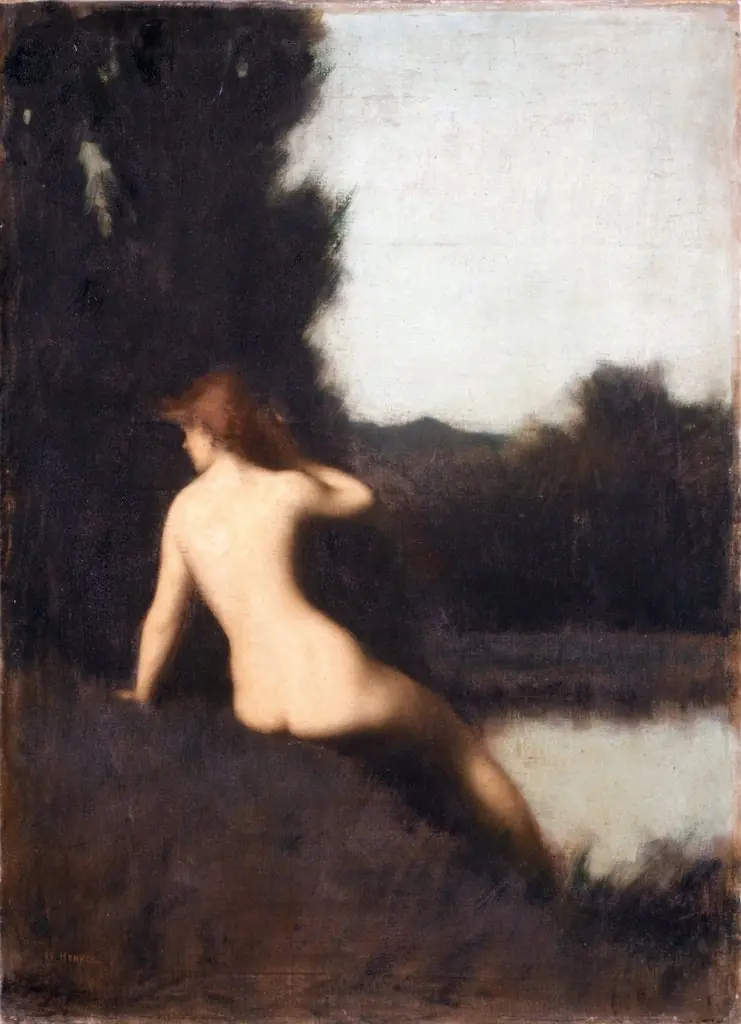
Jean-Jacques Henner (5 March 1829 – 23 July 1905) was a French painter, noted for his use of sfumato and chiaroscuro in painting nudes, religious subjects and portraits.