Artwork
Virgin and Child with Butterflies
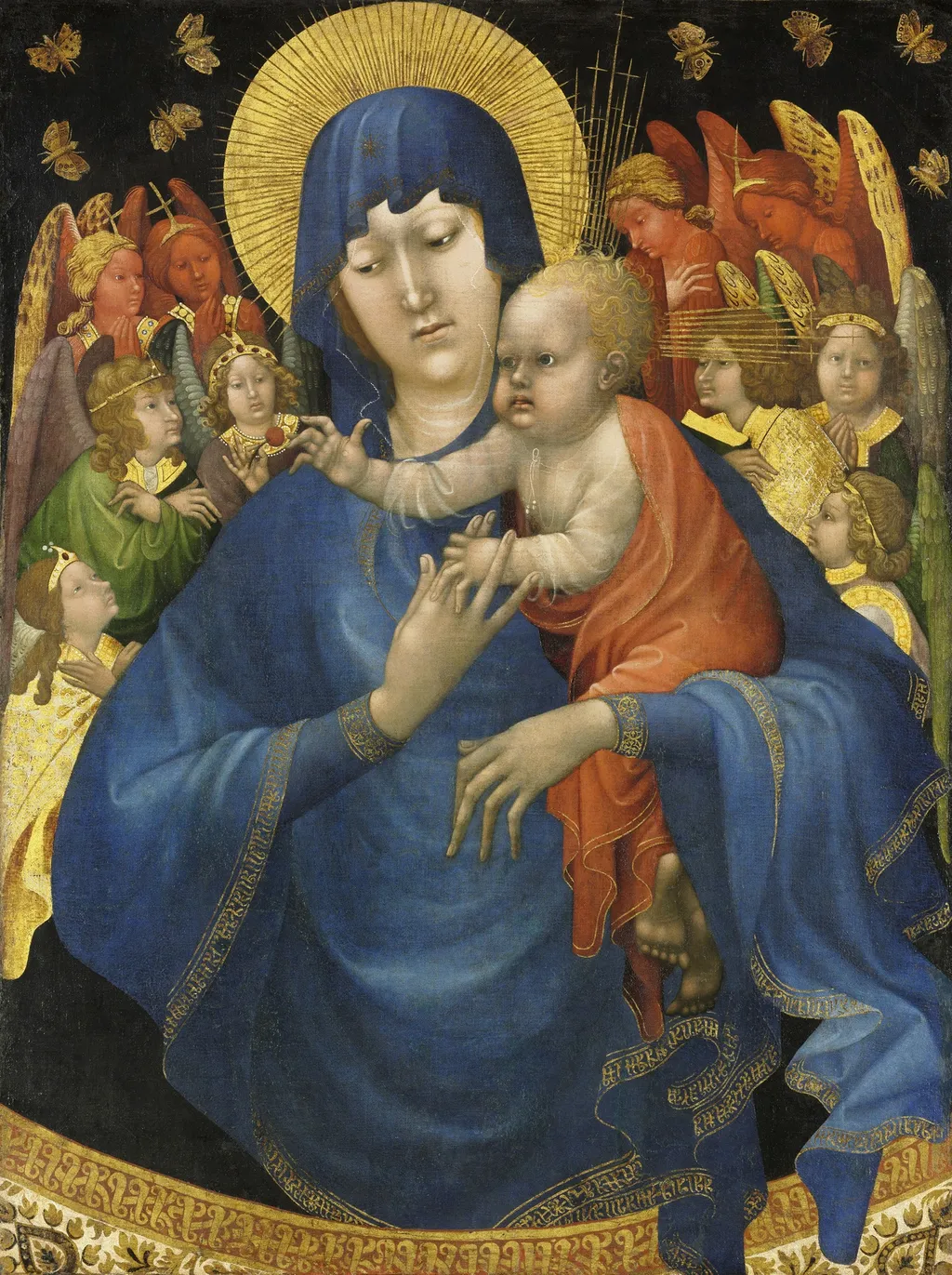
Virgin and Child with Butterflies is an unspecified painting by the Northern Renaissance artist Jean Malouel. It dates from 1415 and is held in the collection of the Gemäldegalerie Berlin.
About this work
Overview
The Virgin and Child with Butterflies is a religious painting by Jean Malouel, dated to around 1415, executed in oil on linen.
The Virgin and Child with Butterflies is a religious painting by Jean Malouel, dated to around 1415, executed in oil on linen. Measuring 107.5 by 80.9 centimetres, it is held in the Gemäldegalerie, Berlin. The work is significant as one of the earliest surviving paintings on canvas from France, and it exemplifies the refined courtly style of Burgundian painting at the transition from the International Gothic to the early Renaissance. Its unusual title derives from the golden butterflies that flutter above the heads of the attendant angels, a distinctive iconographic feature that has attracted scholarly attention since the painting became publicly known in 1957.
Subject & Meaning
The painting depicts the Virgin Mary holding the Christ Child, surrounded by ten angels gathered behind her. The Virgin wears a deep blue mantle with gold embroidered edges, while the infant, draped in red cloth, reaches toward the viewer with one hand and grasps his mother's fingers with the other. A radiant gold halo with linear rays encircles Mary's head against a dark background. The angels are individually differentiated through varied precious garments and diadems; the red angels among them are identifiable as seraphim, the highest order of angels, their colour signifying their nature as the 'burning ones'. One angel offers the Christ Child a cherry,, an emblem of the Garden of Eden. Most distinctively, several small butterfly-like insects with patterned wings fly across the upper dark background. These golden butterflies carry multivalent symbolism: traditionally they represent the soul or the Resurrection, drawing on classical imagery of the soul as a butterfly and the Christian parallel between Christ's resurrection and the metamorphosis of larva into butterfly. The figures rest above an ornate carpet with red and gold geometric patterns, and the entire group appears to float like an icon before a rich brocade fabric.
Technique & Style
The painting is executed on linen support, making it one of the earliest surviving canvas paintings from France. The medium is oil paint, applied with smooth, refined brushwork that shows subtle modelling of faces and drapery. Extensive gold leaf is used for the halos and decorative details. The composition is frontal and symmetrical, with the two central figures dominating the pictorial space, and light falls evenly across the scene, illuminating faces and the brilliant blue of the mantle. The handling of flesh tones has been compared to that in Henri Bellechose's Martyrdom of Saint Denis, suggesting close technical affinities within the Burgundian court workshop. The surface condition shows the refined finish characteristic of court production, with careful attention to textile textures and the luminous effects of precious materials.
History & Provenance
The painting's modern scholarly recognition began in 1957, when it became publicly known and was subsequently situated within a courtly context. Its attribution has involved both Jean Malouel and, in some accounts, Henri Bellechose as co-creator or successor in the workshop. Malouel, also known by his Netherlandish name Johan Maelwael, served as court painter to the Burgundian dukes from 1396 under Philip the Bold and from 1404 under John the Fearless, working in Dijon until his death in 1415. Henri Bellechose succeeded him in that same year. The painting is now held by the Gemäldegalerie, Berlin, under inventory number 87.1, having entered the Staatliche Museen collection. A proposal that the work formed part of a diptych together with a drawn portrait of John the Fearless has been advanced, though this reconstruction presents difficulties and the self-contained composition suggests the painting was conceived as an independent work.
Context
The Virgin and Child with Butterflies occupies a pivotal position in the history of northern European painting. Stylistic comparisons place it in close proximity to two works now in the Louvre: the Grande Pietà Ronde, probably by Malouel's hand, and the Martyrdom of Saint Denis altarpiece by Bellechose, created for the Chartreuse de Champmol near Dijon. This Carthusian monastery, founded by Philip the Bold, served as the burial place for the dukes of Burgundy and constituted a major centre of artistic patronage. The painting's resemblance to manuscript illuminations by the Limbourg Brothers for Jean, Duc de Berry, particularly the Très Riches Heures, initially suggested a courtly context, though closer affinities exist with works by the Limbourgs' uncle Malouel and his circle. The work exemplifies the International Gothic style as practised at the Burgundian court, combining Byzantine iconographic traditions, such as the half-length Madonna format derived from Sienese painting, with northern European attention to surface refinement and material splendour.
Legacy
Since its emergence into scholarly consciousness in 1957, the Virgin and Child with Butterflies has become a key monument in the study of early fifteenth-century French and Burgundian painting. Its status as one of the earliest surviving works on canvas has made it significant for technical studies of painting supports. The painting has contributed to understanding workshop practices at the Burgundian court, particularly the transition between Malouel's and Bellechose's tenures as court painter. Its influence can be traced in subsequent northern European devotional imagery, with comparable motifs appearing in works by Stefano da Verona and Michelino da Besozzo, whose compositions show direct influence from the Malouel workshop. The work remains on permanent display at the Gemäldegalerie, Berlin, where it continues to attract attention for its unusual iconography and its exceptional preservation of early fifteenth-century courtly refinement.
Own this work as a print
Artist & collection
Artist
Jean Malouel, or Jan Maelwael in his native Dutch, (c. 1365 – 1415) was a Dutch artist who was the court painter of Philip the Bold, Duke of Burgundy and his successor John the Fearless, working in the International Gothic style.

- Virgin and Child
 Madonna of the Pomegranate
 Madonna and Child
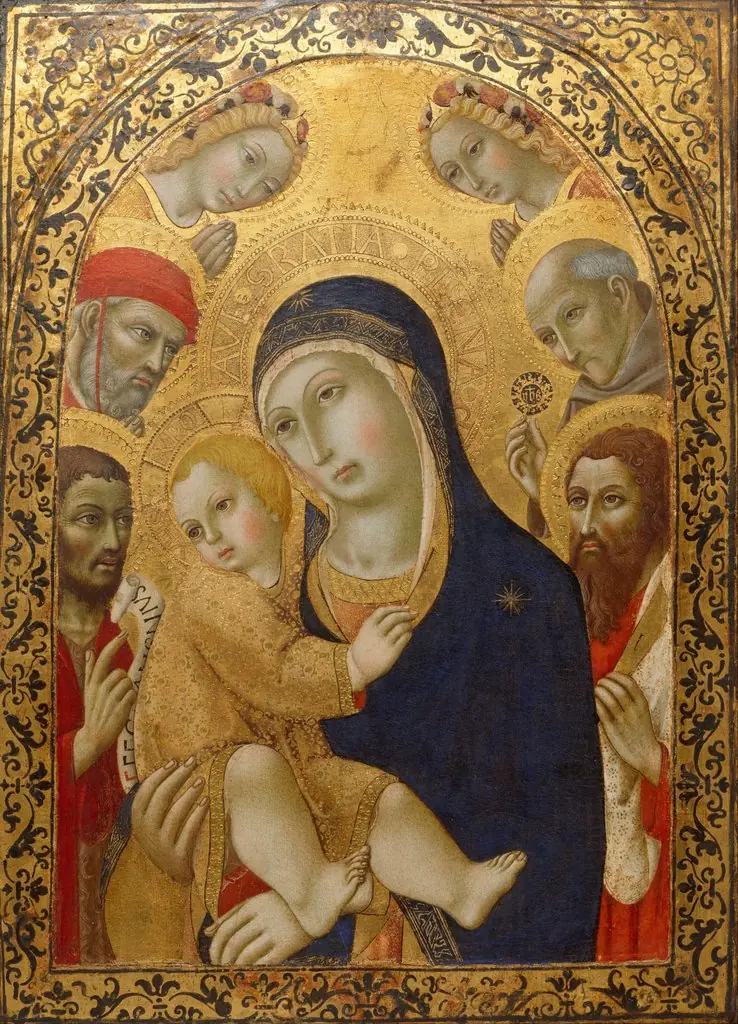 Madonna and Child with Saints Jerome, John the ...
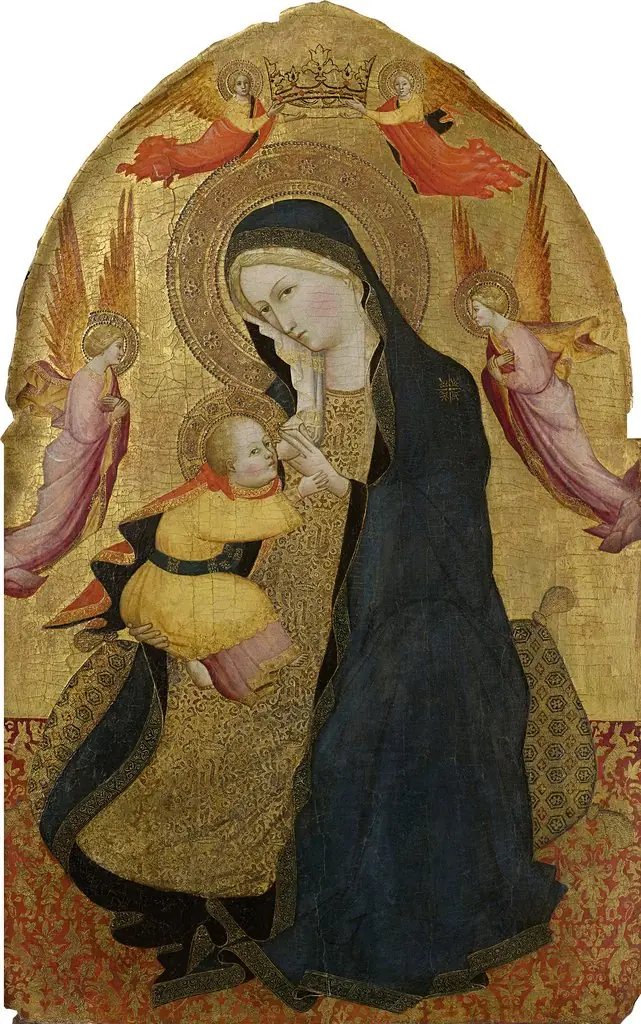 Madonna of Humility (Madonna dell'Umiltà)
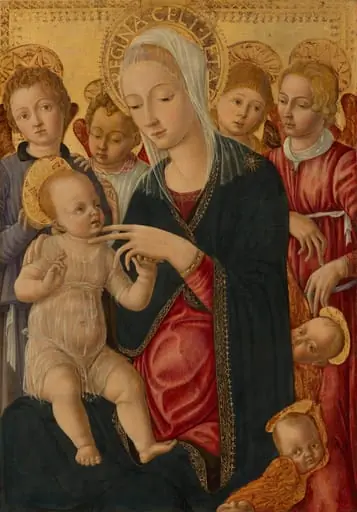 Madonna and Child with Angels and Cherubim
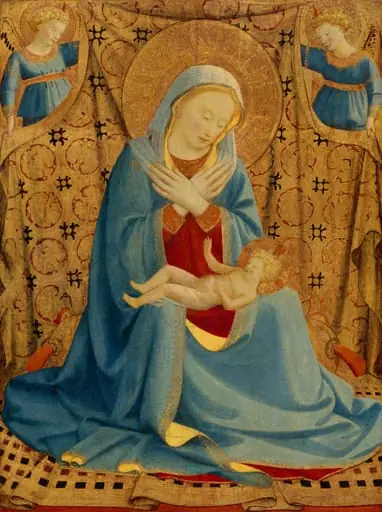 The Madonna of Humility
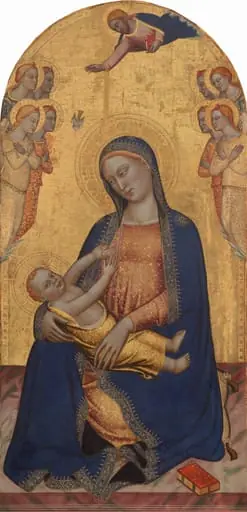 Madonna and Child with God the Father Blessing and Angels
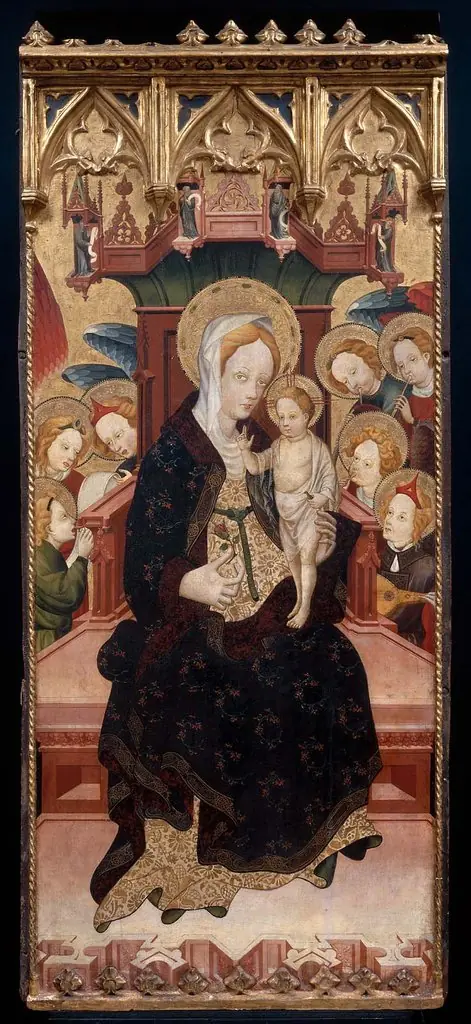 Virgin and Child Enthroned
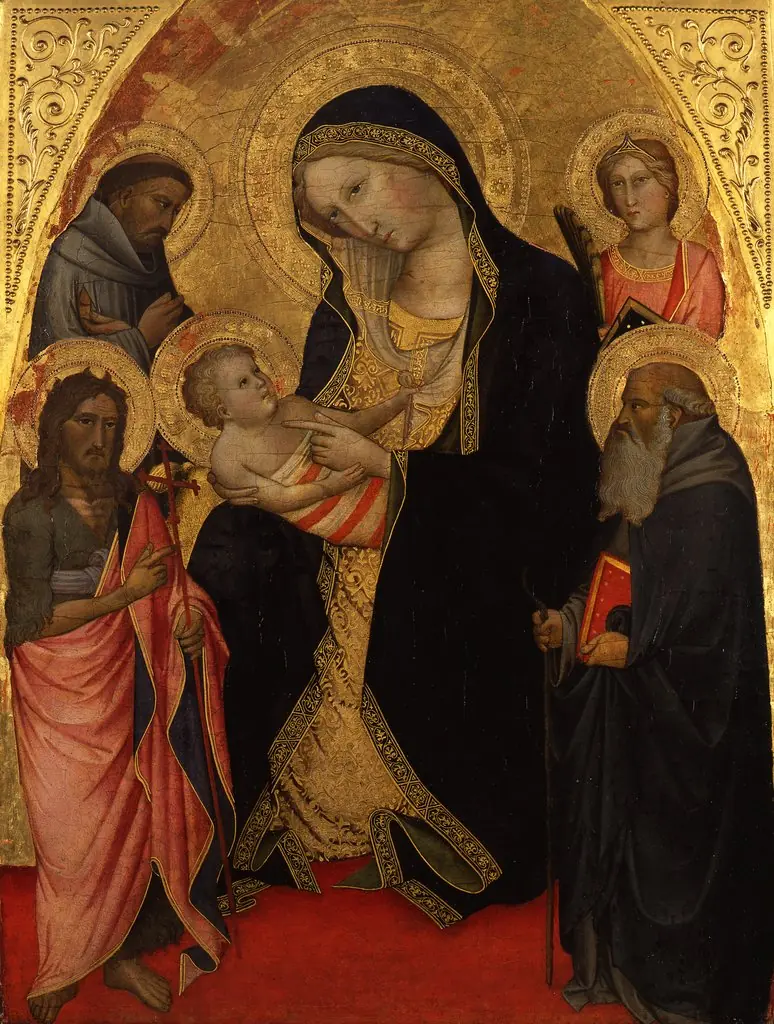 Madonna with the child, St. John the Baptist, St. Francis and St. Anthony and a martyr
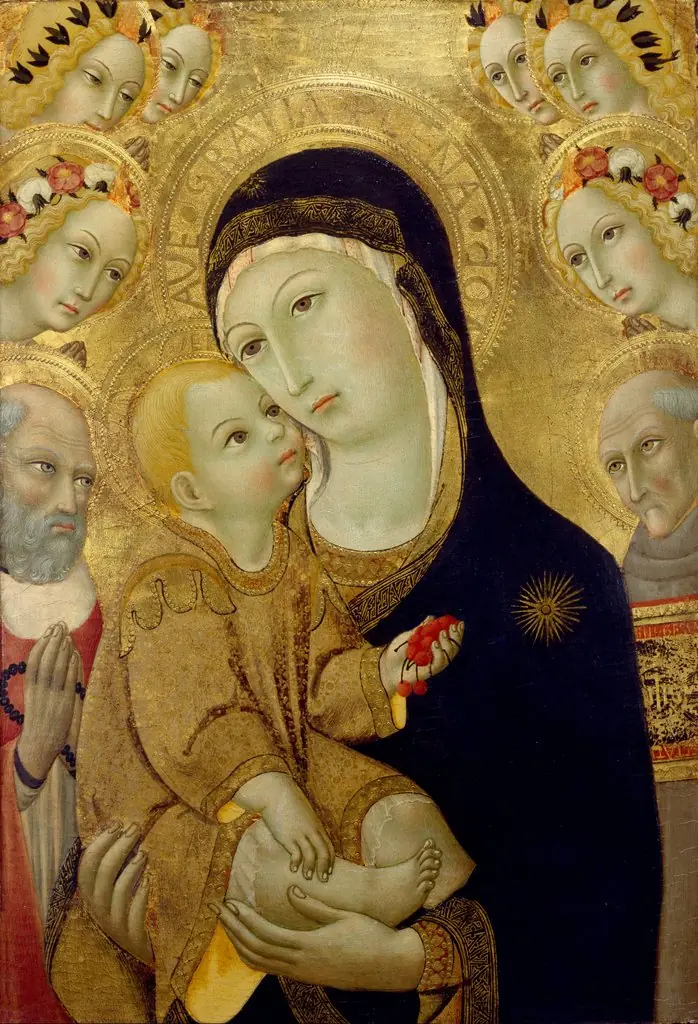 Virgin and Child with Saints Jerome and Bernardino of Siena and Six Angels
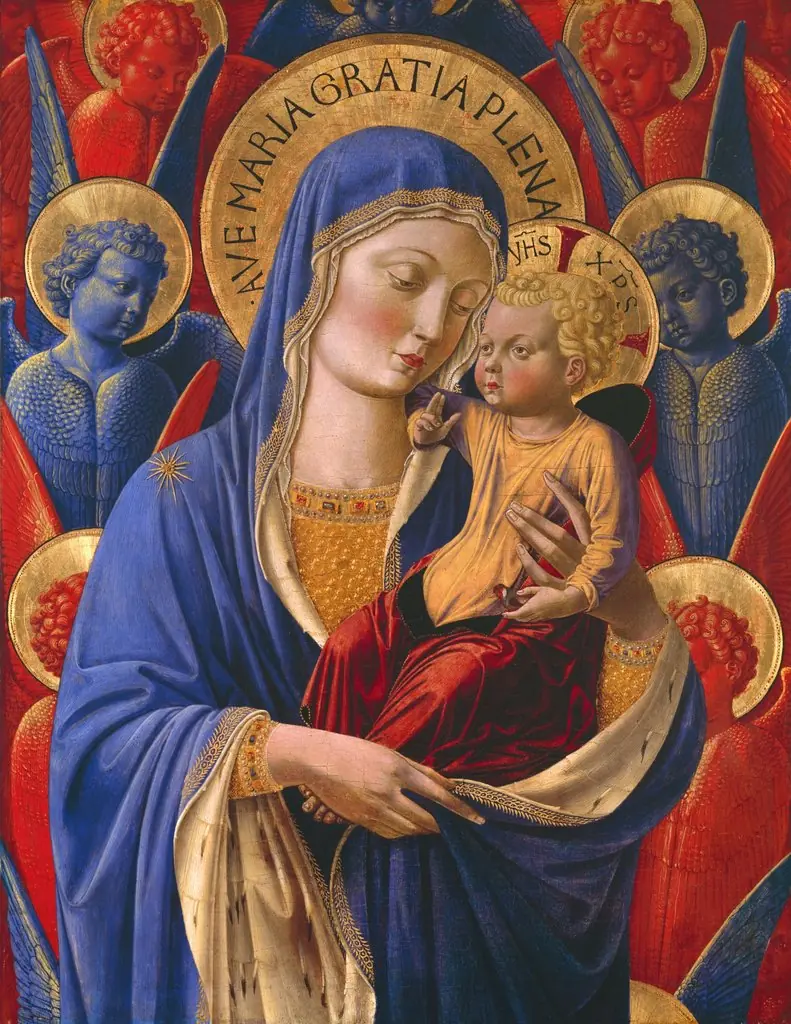 Virgin and Child with Angels