Artwork
Madonna of the Pomegranate
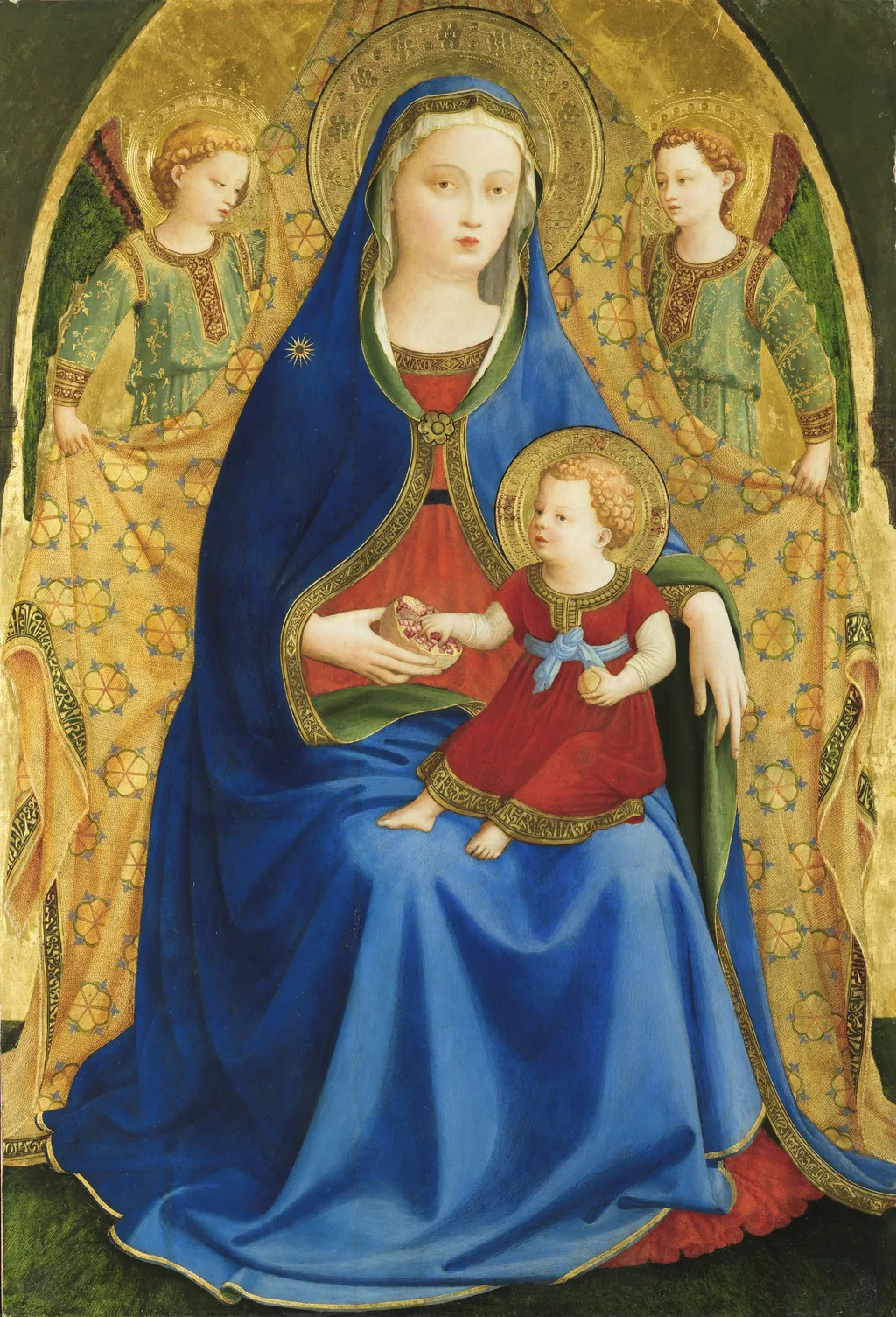
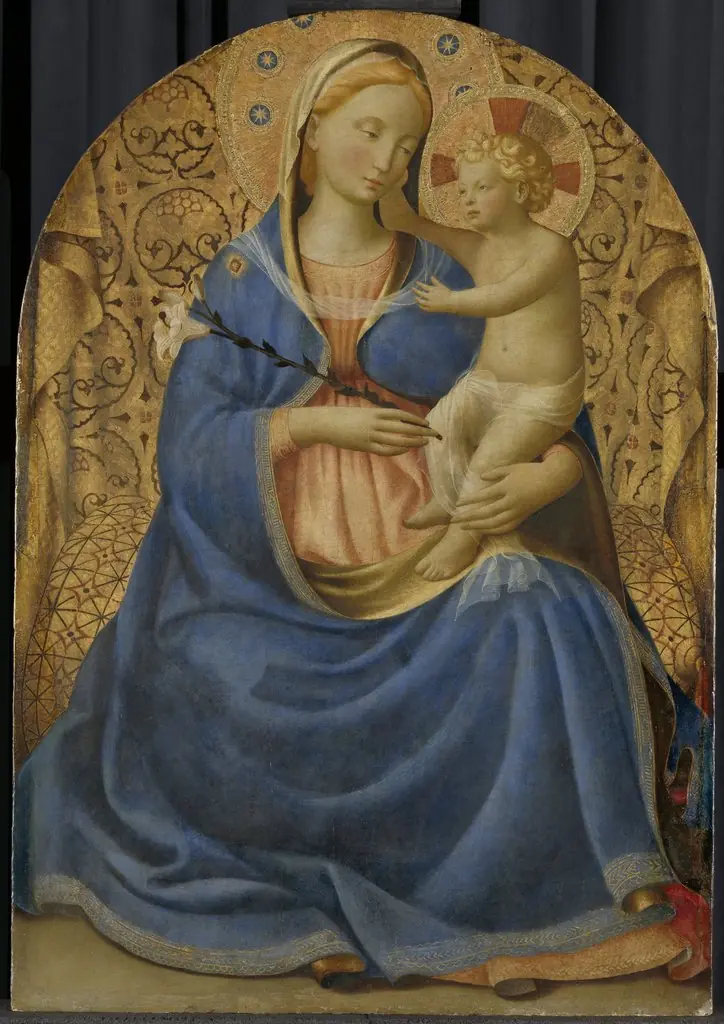
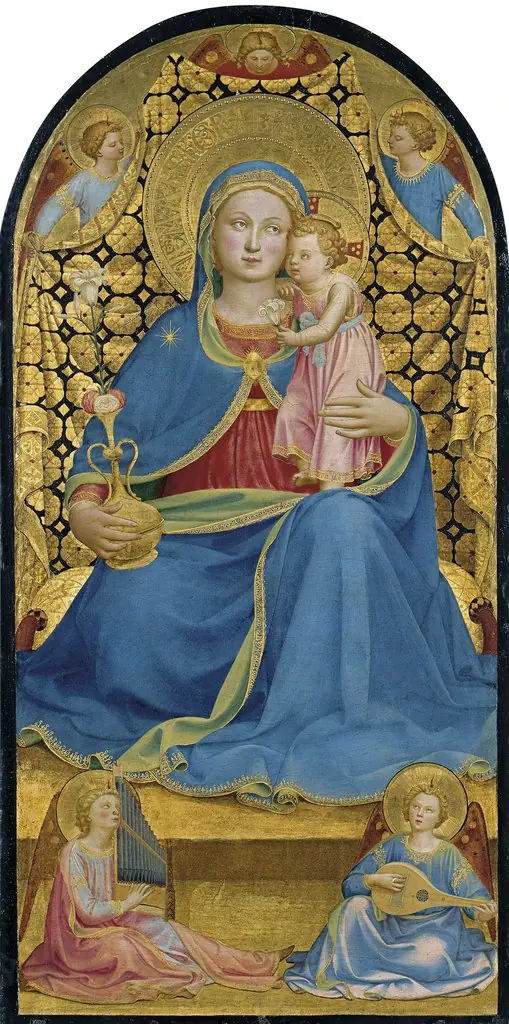
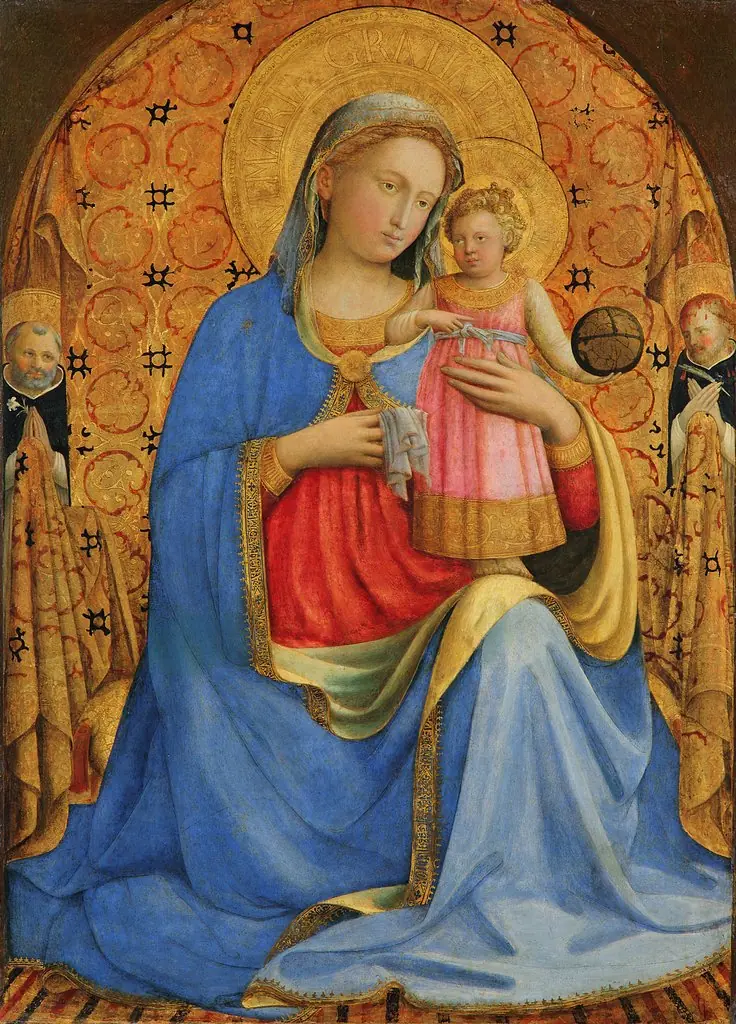
Madonna of the Pomegranate is a tempera painting by the Early Renaissance artist Fra Angelico. It dates from 1426 and is held in the collection of the Museo del Prado.
About this work
Subject & Meaning
This meaning is reinforced by the Christ Child placing his right hand upon the seeds, an gesture indicating his acceptance of his future sacrifice.
The painting depicts the Virgin Mary and the Christ Child accompanied by two angels. The central iconographic element is a pomegranate held by the Virgin, from which she and the Child share the arils with the surrounding angels. Within Christian symbolism, this fruit represents fecundity due to its numerous seeds and royalty because its calyx resembles a crown. It also signifies the Virgin's chastity.
The red seeds, resembling drops of blood, serve as a prefiguration of the Passion. This meaning is reinforced by the Christ Child placing his right hand upon the seeds, an gesture indicating his acceptance of his future sacrifice. Additionally, the fruit symbolizes the unity of the Church, illustrating how many distinct seeds remain united within a single skin.
Technique & Style
The work is executed in tempera on a wooden panel, measuring 87 cm in height and 59 cm in width, and is classified as a religious painting depicting the Madonna and Child with two angels and a pomegranate. The composition shows the Virgin holding the fruit while the Child reaches toward it, a motif that symbolizes fertility, royal authority, and the Passion through the fruit’s red seeds. The painting’s surface is largely intact, with only minor losses noted in the child’s halo, and it retains its original vertical format and largely autograph execution dating to 1426.
Its contemporary frame was added in the 1920s by the Madrid workshop Talleres Cano, reflecting a 15th‑century aesthetic. The iconography of the pomegranate underscores themes of divine motherhood, purity, and the unity of the Church, while the work’s provenance includes a series of high‑profile acquisitions and exhibitions, culminating in its 2016 purchase by the Museo del Prado for eighteen million euros.
History & Provenance
Fra Angelico painted the Madonna of the Pomegranate circa 1426 as an autograph tempera on panel work originally titled Madonna con Bambino e due angeli. The painting entered the collection of the Dukes of Alba in 1817 when Carlos Miguel Fitz-James Stuart y Silva purchased it in Florence for 448 francs, subsequently displaying it in the Salón Italiano of their Madrid palace, the Palacio de Liria. During the Spanish Civil War the work was temporarily moved to Geneva for protection and returned to Spain to be shown at the Museo del Prado while the palace was rebuilt.
It remained in the Alba family collection until 2016, when the Museo del Prado acquired it for eighteen million euros through contributions from the Ministry of Education, Culture and Sport, the Fundación Amigos del Museo del Prado, and the museum itself. The acquisition included a related predella panel attributed to Fra Angelico by Carl Brandon Strehlke. The work has only left the Prado for three recorded exhibitions: a 2012 showing at CentroCentro in Madrid, a 2015 showing at the Meadows Museum in Dallas, and a 1955 showing in Florence for a commemorative exhibition of the artist's fifth centenary.
The painting has been part of the collection of the Museo del Prado in Madrid since January 2016, following its acquisition from the House of Alba for eighteen million euros. Prior to this transfer, the work resided in the Italian Salon of the Liria Palace, the Madrid residence of the Dukes of Alba, having been purchased in Florence in 1817 by the 14th Duke.
The artwork has a limited exhibition history outside its private home. It was temporarily displayed at the Prado while the Liria Palace underwent reconstruction after the Spanish Civil War, during which time the painting had been moved to Geneva for safety. In 1955, it traveled to Florence for a exhibition marking the fifth centenary of Fra Angelico's death.
Later loans included appearances at CentroCentro in Madrid in 2012 and the Meadows Museum in Dallas in 2015, while a loan request from the Metropolitan Museum of Art in 2005 was declined.
Context
Dating to approximately 1426, the Madonna of the Pomegranate is regarded by former Metropolitan Museum director Philippe de Montebello as one of the most significant and best-preserved works by Fra Angelico. The painting is considered fully autograph, as the earliest known assistance in the artist's workshop did not occur until around 1430. Its iconography is deeply rooted in Christian symbolism, where the pomegranate represents fertility, royalty, and the unity of the Church, while its red seeds prefigure the Passion of Christ.
The work's historical trajectory reflects its high esteem; it was once misattributed to Masaccio before being recognized as a Fra Angelico. In 2016, the Museo del Prado acquired the piece for eighteen million euros, a transaction honored with the Apollo Acquisition of the Year Award. This acquisition was accompanied by the donation of a predella panel, the Funeral of Saint Anthony Abbot, which was recently attributed to the artist by conservator Carl Brandon Strehlke.
Legacy
The Madonna of the Pomegranate has been recognized as a pivotal work in Fra Angelico's oeuvre, influencing later religious painting through its compositional balance and symbolic use of the pomegranate. Its acquisition by the Museo del Prado in 2016, following a high-profile purchase at eighteen million euros, underscored its status as one of the artist's most important and well-preserved pieces, prompting renewed scholarly attention and exhibitions across Europe and the United States. The work's provenance, including its earlier ownership by the Dukes of Alba and its temporary loans to institutions such as the Metropolitan Museum of Art, further highlights its significance within both private and public collections.
Overview
Created in 1426 by the Dominican friar Fra Angelico, this tempera panel presents the Virgin Mary cradling the infant Jesus, flanked by two angels. The composition is set against a luminous gold backdrop adorned with delicate floral motifs, and the child clutches a red pomegranate, a focal point of the work.
Own this work as a print
Artist & collection

Artist
Fra Giovanni da Fiesole (born Guido di Pietro; c. 1395 – 18 February 1455), known posthumously as Fra Angelico ( FRAH an-JEL-ik-oh, Italian: ), was an Italian Dominican friar and painter active during the early…