Artwork
The Madonna of Humility
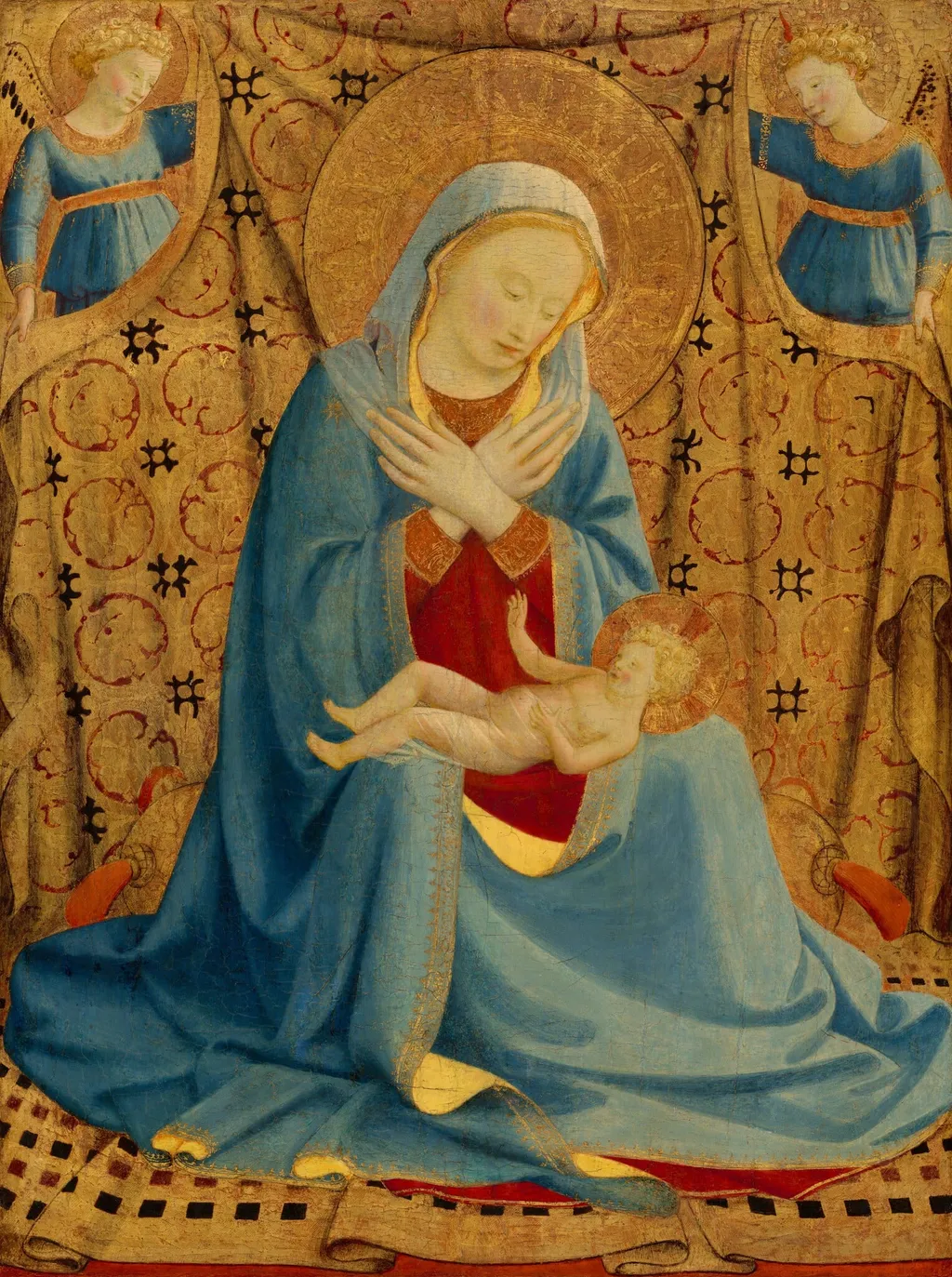
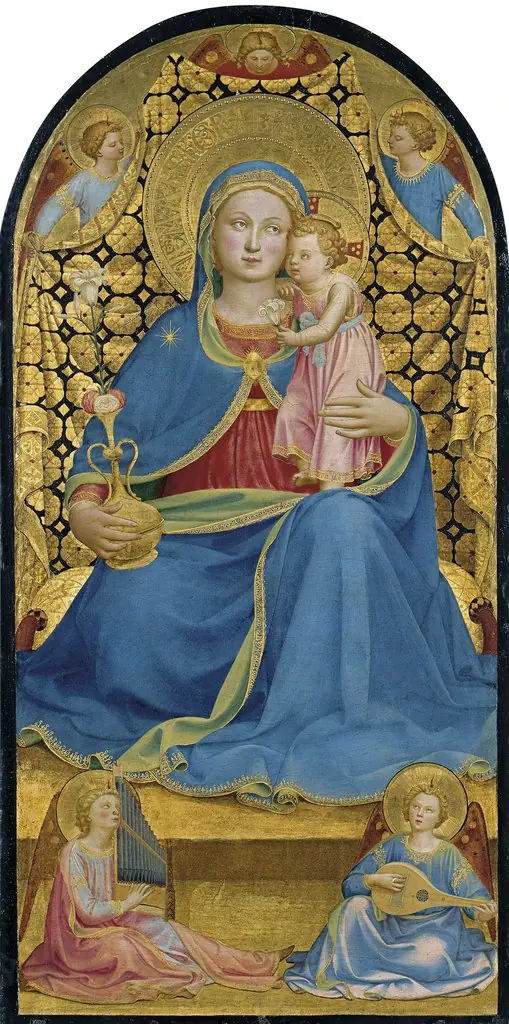
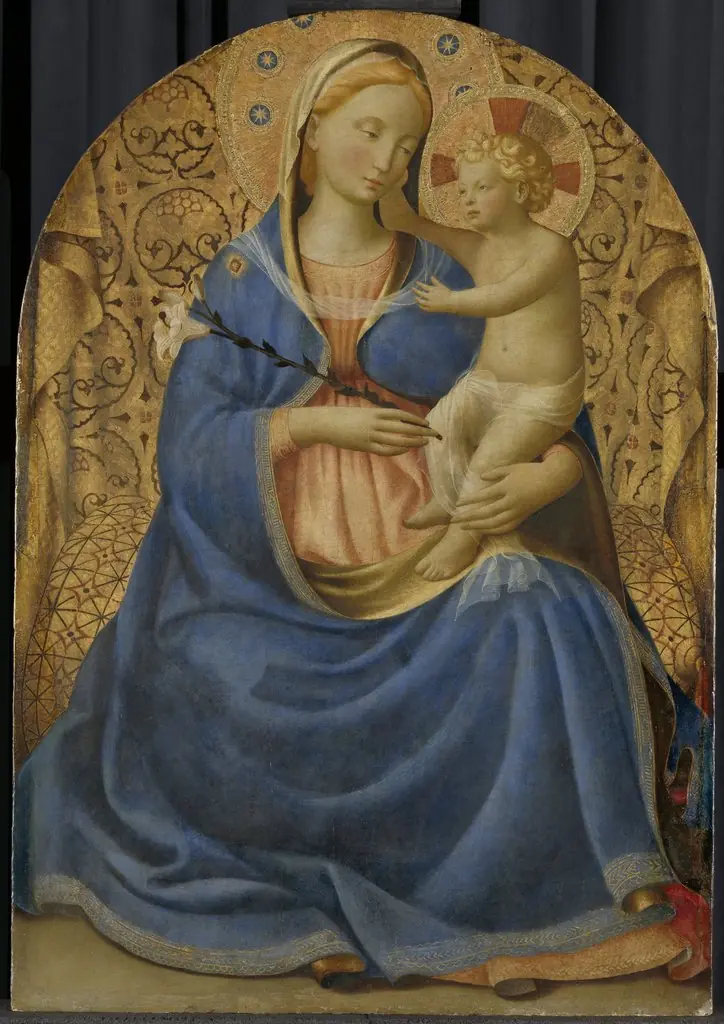
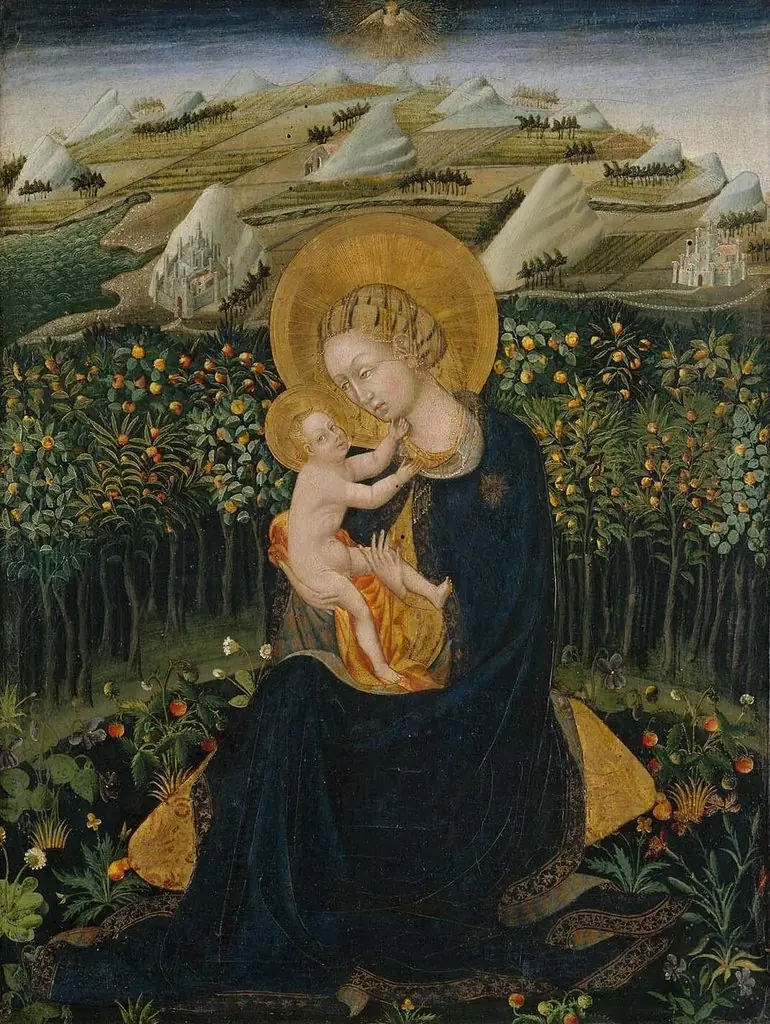
The Madonna of Humility is a tempera painting by the High Renaissance artist Fra Angelico. It dates from 1430 and is held in the collection of the National Gallery of Art.
- Inscription
- Inscribed:upper center in Virgin's halo: AVE MARIA GRATIA PLENA DO[MINVS TECVM] (Hail, Mary, full of grace, the Lord is with thee; from Luke 1:28)
About this work
Subject & Meaning
The Madonna of Humility by Fra Angelico depicts the Virgin Mary and the Christ Child, as identified in the work's main subject and iconographic classification.
The Madonna of Humility by Fra Angelico depicts the Virgin Mary and the Christ Child, as identified in the work's main subject and iconographic classification. The composition presents Mary seated on the ground rather than enthroned, embodying the "Madonna of Humility" devotional type in which the Virgin's lowliness is emphasized through her humble posture. The Christ Child is shown with her, completing the Madonna-and-Child pairing central to the painting's religious meaning.
Rendered in tempera on panel and dated 1430, the work belongs to the Italian Renaissance tradition of religious art, expressing Marian devotion through the visual contrast between sacred subject matter and the gesture of humility signified by Mary's seated-on-the-ground position.
Technique & Style
The Madonna of Humility is executed in tempera on panel, a standard technique for Fra Angelico's early-fifteenth-century devotional works. The panel measures approximately 62.8 by 47.2 centimeters, a modest vertical format suited to private worship. A mid-1930s provenance photograph preserved in the archives of the Museo di Castello Sforzesco in Milan documents the painting after it underwent a radical cleaning, during which it was subsequently repainted, indicating that the original painted surface had been abraded and that the work was restored before its 1936 acquisition.
The painting belongs stylistically to the Italian Renaissance and is classified as a religious work depicting the Madonna and Christ Child.
History & Provenance
Attributed to Fra Angelico and dated to 1430, this tempera panel originated in an anonymous Italian collection before its late nineteenth-century acquisition by Edward Steinkopff of Sussex. Upon Steinkopff's death, the work passed by inheritance to his daughter, Mary Margaret Stewart-Mackenzie, residing at Brahan Castle in Scotland. By 1935, the painting belonged to the family of the Barons of Castelmuro.
It subsequently entered the commercial market through Robert Frank, Ltd. in London and was held jointly by Rudolf Heinemann's Pinakos, Inc. and M. Knoedler & Co. The A.W. Mellon Educational and Charitable Trust purchased the piece on December 30, 1936, donating it to the National Gallery of Art in Washington, D.C., the following year.
The Madonna of Humility has been in the collection of the National Gallery of Art in Washington, D.C., since 1937, when it was given by The A.W. Mellon Educational and Charitable Trust of Pittsburgh. The Trust had purchased the panel on 30 December 1936, acquiring it through the New York and London firm M. Knoedler & Co. together with Rudolf Heinemann's Pinakos, Inc. of Lugano, with the work previously offered by Robert Frank, Ltd., in London. Earlier in the 1930s the painting passed through the family of the barons of Castelmuro, and before that it descended from Edward Steinkopff of Lydhurst, Waringlid, Haywards Heath, Sussex, who acquired it in Italy in the late nineteenth century, to his daughter Mary Margaret Steinkopff Stewart-Mackenzie, later Baroness Seaforth, at Brahan Castle in the Scottish Highlands.
Overview
Fra Angelico, also known as Fra Giovanni da Fiesole, created The Madonna of Humility around 1430. This tempera on panel painting exemplifies the early Florentine Renaissance's blend of spiritual devotion and emerging naturalism. It portrays the Virgin Mary holding the Christ Child, a common theme rendered with a focus on intimacy and a gentle, accessible quality, characteristic of the artist's religious output.
Context
As a Dominican friar working in Florence during the early 15th century, Fra Angelico dedicated his artistic practice almost exclusively to religious subjects. His work, including this painting, reflects the spiritual fervor of his order and the broader cultural shifts of the Renaissance. He often received commissions from prominent patrons, such as Cosimo de’ Medici, who supported the flourishing of art that served both civic and devotional purposes.
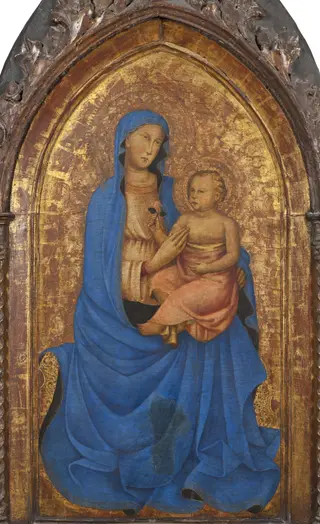
Own this work as a print
Artist & collection

Artist
Fra Giovanni da Fiesole (born Guido di Pietro; c. 1395 – 18 February 1455), known posthumously as Fra Angelico ( FRAH an-JEL-ik-oh, Italian: ), was an Italian Dominican friar and painter active during the early…

![Madonna of Humility, The Blessing Christ, Two Angels, and a Donor [obverse], by Andrea di Bartolo](https://artifactworldgallery.com/img/andrea-di-bartolo--madonna-of-humility-the-blessing-christ-two-angels-and-a-don--d37c382429905539-w320.webp)