Artwork
Woman in Blue Reading a Letter
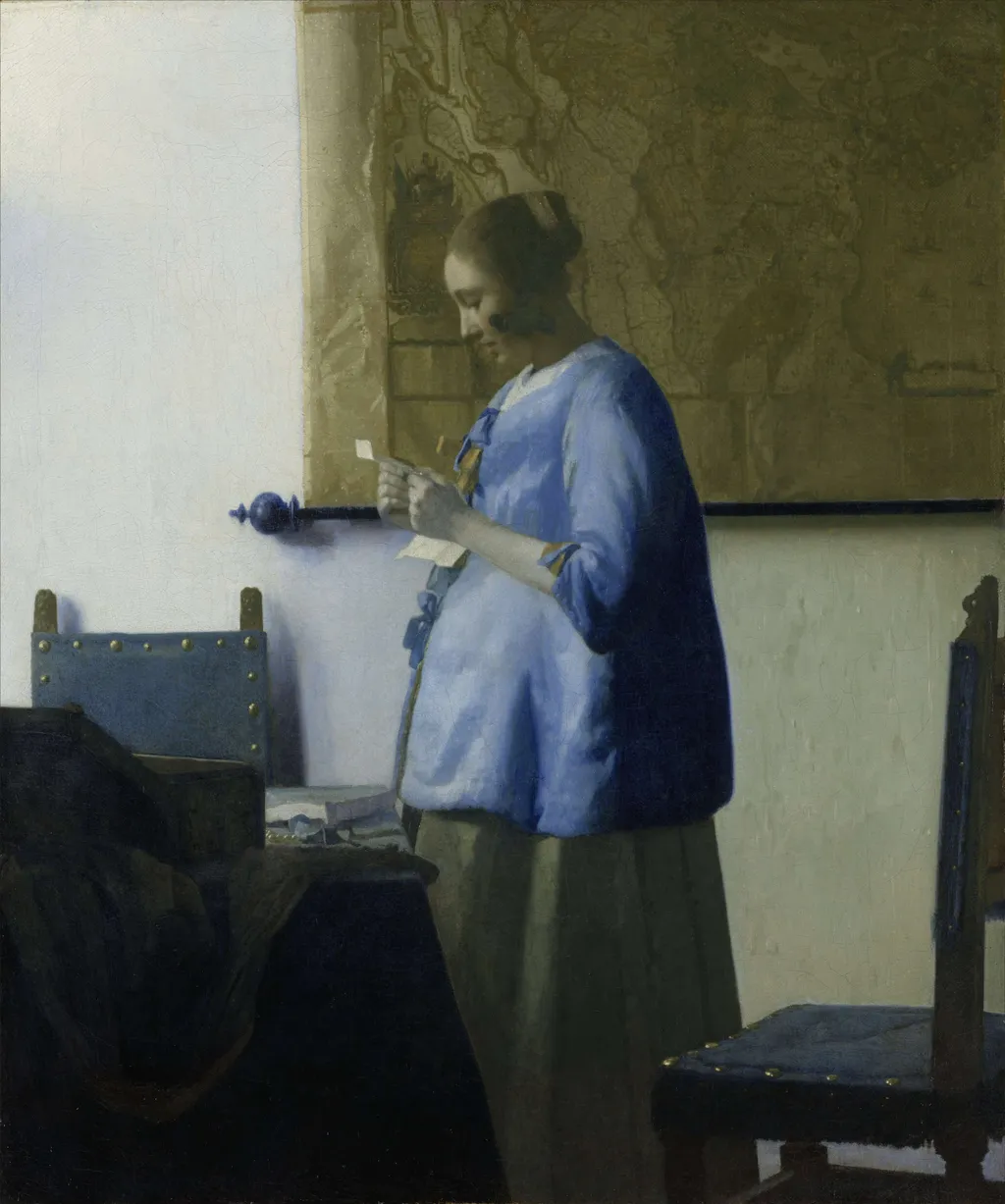
Woman in Blue Reading a Letter is an oil painting by the Dutch Golden Age artist Johannes Vermeer. It dates from 1664 and is held in the collection of the Rijksmuseum.
About this work
Subject & Meaning
The blue jacket and the map’s muted palette set a restrained mood, while the woman’s absorbed posture emphasizes private feeling over public display.
The painting depicts a woman absorbed in reading a letter, framed tightly to exclude floor and ceiling and focus attention on her solitary moment. Behind her hangs a monochromatic map of Holland and West Friesland, published in 1620 by Balthasar Florisz. van Berckenrode and reprinted by Willem Blaeu in 1621; its presence has been read as signaling a traveling spouse or distant communication, while the pearls and jewelry box on the table have been interpreted as vanitas symbols of vanity and worldly pride.
Vermeer’s composition suppresses narrative closure, leaving the letter’s contents and the woman’s identity unspecified. The blue jacket and the map’s muted palette set a restrained mood, while the woman’s absorbed posture emphasizes private feeling over public display. Critics note that in Dutch Golden Age genre scenes, a letter-reading woman often signified love or longing, a convention Vermeer invokes without resolving into explicit meaning.
Technique & Style
Executed in oil on canvas around 1662–1664, the painting measures 46.6 cm in height and 39.1 cm in width.
The composition centers on a standing woman in a blue satin bedjacket reading a letter, her figure sharply silhouetted against a plain wall. A monochrome map of Holland and West Friesland hangs behind her, its subdued tones echoing the muted palette of browns and blues that dominate the scene. A table in the foreground carries a pearl necklace, an open box, and a folded cloth, all rendered with delicate highlights that define their textures.
Vermeer’s handling is restrained: broad, smooth areas of color contrast with finely observed details such as the pearls and the letter’s crisp edge. Light enters from the left, casting subtle shadows and heightening the planar compression of the room.
History & Provenance
Johannes Vermeer created this oil painting circa 1663, with some scholarship narrowing the date to between 1662 and 1664. The work's provenance possibly begins with a 1712 Amsterdam auction for Pieter van der Lip, followed by a confirmed sale for Moses de Chaves in 1772. Subsequent owners included Ph. van der Schley in 1793 and Herman ten Kate in 1801, before the painting appeared in Paris auctions in 1809 and 1825.
Dealer John Smith likely sold the piece in London around 1839 to the Amsterdam collector Adriaan van der Hoop.
In 1854, Van der Hoop bequeathed his collection to the City of Amsterdam. The painting was subsequently housed in the Museum Van der Hoop until 1885, when it transferred to the Rijksmuseum upon that institution's opening, becoming its first acquired Vermeer.
The painting is held in the Rijksmuseum, Amsterdam, accessioned as part of the City of Amsterdam’s collection. It entered the museum in 1885 as a bequest from Adriaan van der Hoop.
It was first publicly documented at the Amsterdam sale of Pieter van der Lip on 14 June 1712, and again at the Moses de Chaves sale in Amsterdam on 30 November 1772. It later appeared in Paris sales in 1809 and 1825 before being acquired by Van der Hoop by 1839. The painting was shown in the short-lived Museum Van der Hoop from 1864 until 1885, when it moved to the Rijksmuseum as the institution’s first Vermeer.
Context
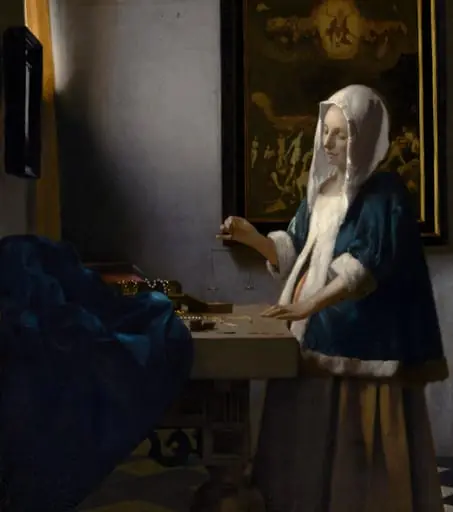
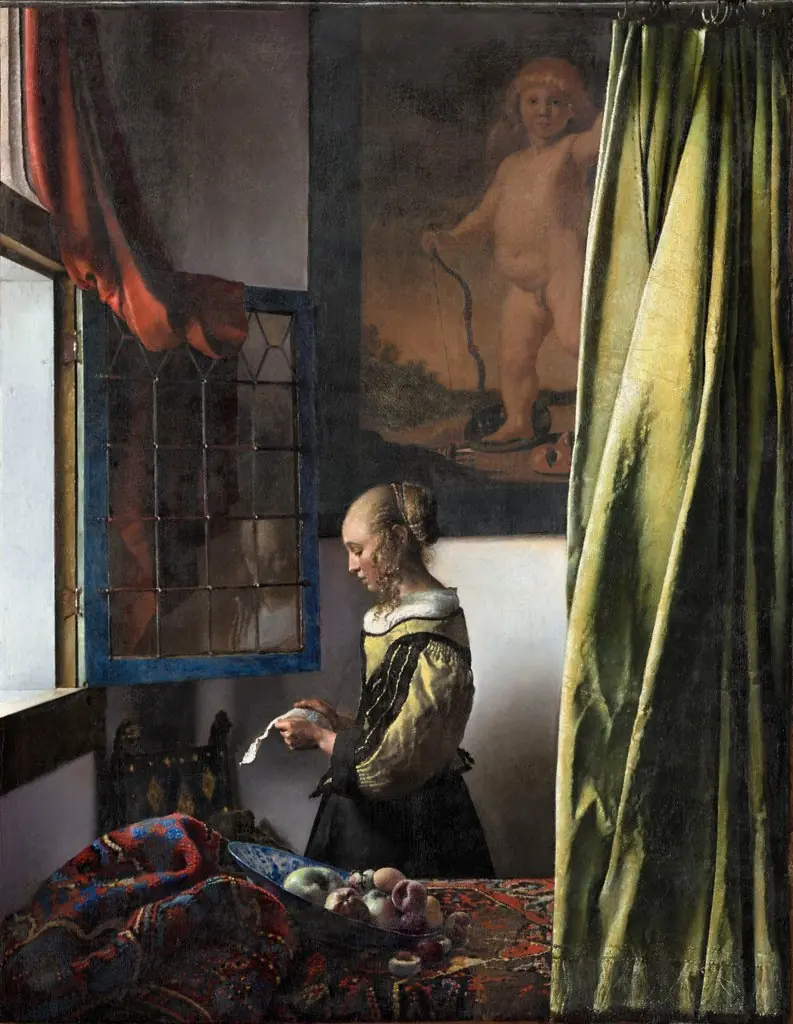
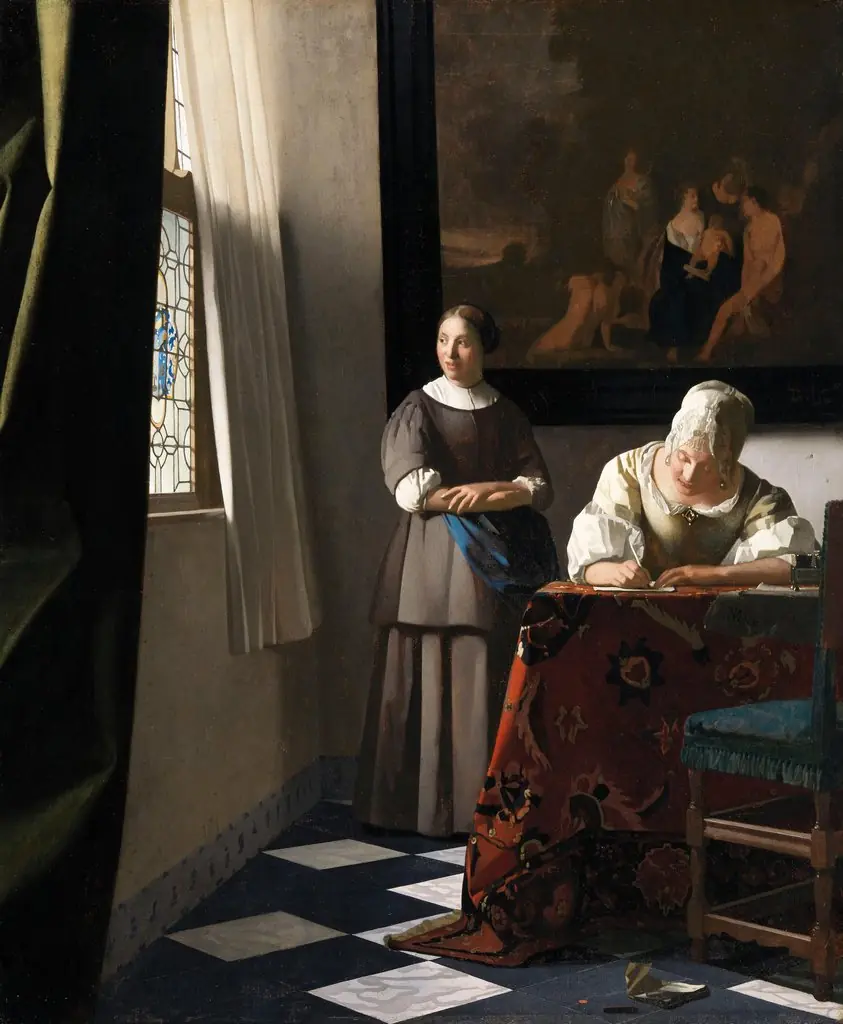
Scholarly discussion of Woman in Blue Reading a Letter situates the work within Vermeer’s mid-1660s interior genre, where private acts become carriers of broader human meaning. The painting’s compressed, vertical composition and absence of architectural cues focus attention on the absorbed reader, a device Vermeer repeats in closely related canvases such as Woman with a Pearl Necklace and Woman Holding a Balance.
The map of Holland and West Friesland behind the figure has been read alternately as a sign of a traveling spouse or as a neutral backdrop; its monochrome rendering distinguishes it from the polychromatic cartography in Officer and Laughing Girl, underscoring Vermeer’s deliberate choice of tonality. Critical attention has also lingered on the pearl box and ribbon, objects freighted with vanitas associations that complicate any simple narrative of domestic virtue.
Legacy
The painting holds the distinction of being the first work by Johannes Vermeer acquired by the Rijksmuseum in Amsterdam, entering the collection in 1885 as part of the Adriaan van der Hoop bequest. Its presence in the museum notably influenced Vincent van Gogh, who viewed the work there and subsequently wrote to Émile Bernard about Vermeer. The artwork is frequently linked to Vermeer's other mid-1660s paintings, such as Woman with a Pearl Necklace and Woman Holding a Balance, due to shared compositional elements and motifs like the pearl necklace and specific furniture.
Art historians also note its unique status among Vermeer's interiors for omitting visible floor, ceiling, or corner fragments, creating a distinct spatial isolation.
Overview
Johannes Vermeer painted Woman in Blue Reading a Letter in 1664. Executed in oil on canvas, the work depicts a solitary figure in a domestic interior, characteristic of the artist’s focus on everyday middle‑class life during the Dutch Golden Age. The painting is part of the Rijksmuseum’s collection in Amsterdam.
Own this work as a print
Artist & collection
Artist
Johannes Vermeer ( vər-MEER, vər-MAIR, Dutch:; see below; also known as Jan Vermeer; October 1632 – 15 December 1675) was a Dutch painter who specialized in domestic interior scenes of middle-class life.