Artwork
God the Father painting the Immaculate Conception
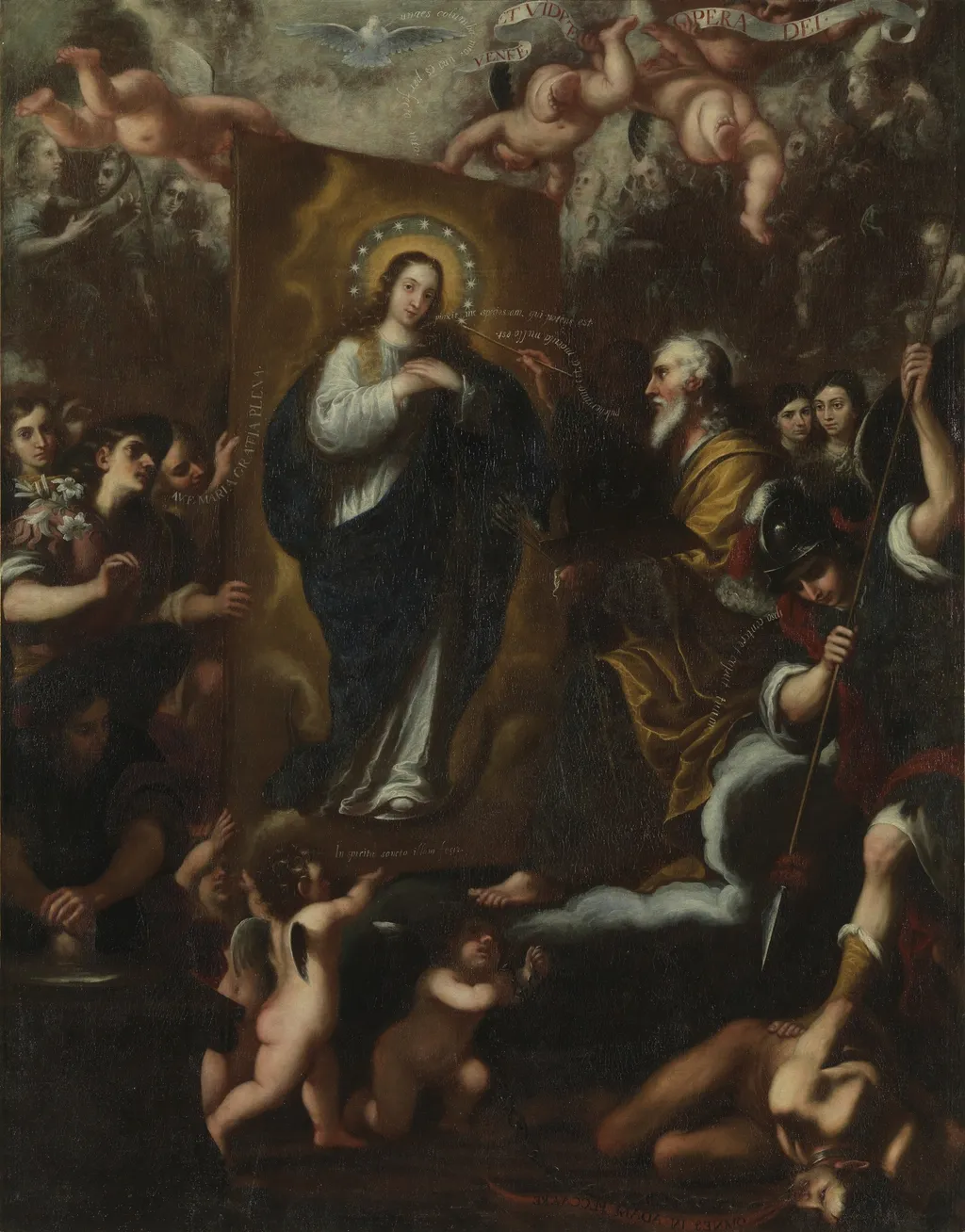
God the Father painting the Immaculate Conception is an oil painting by the Early Baroque Italian artist José García Hidalgo. It dates from 1696 and is held in the collection of the Museo del Prado.
About this work
Subject & Meaning
The painting presents a religious subject in which God the Father is depicted actively engaged in painting the Immaculate Conception.
The painting presents a religious subject in which God the Father is depicted actively engaged in painting the Immaculate Conception. The composition unites divine authorship with the act of artistic creation, presenting the Immaculate Conception as a sacred image literally being produced by God himself.
According to the Wikidata record, the work depicts a combat helmet, a spear, a palette, a paintbrush, and a painting itself. These attributes situate the figure of God the Father as both a divine person and a painter at work: the helmet and spear identify him in his traditional role as a warrior or sovereign deity, while the palette, paintbrush, and the canvas he holds identify him in the role of an artist. The pairing of martial and painterly attributes frames the act of painting the Immaculate Conception as an authoritative, creative divine gesture, presenting Mary’s immaculate nature as an image whose ultimate origin lies with God.
The work is classified as religious art, and its subject reflects late seventeenth-century Spanish devotional imagery in which the Immaculate Conception was a central theme.
Technique & Style
The work is executed in oil on canvas, a standard support for 17th‑century Spanish religious painting. José García Hidalgo applied the oil paint directly onto a stretched canvas, using fine brushwork to render the figure of God the Father in the act of creating the Immaculate Conception. The painting measures 185 cm in height by 146 cm in width and dates to 1690, as recorded in contemporary documentation.
Its composition includes symbolic attributes such as a combat helmet, spear, palette and paintbrush, which identify the divine artist within the sacred narrative. The piece belongs to the collection of the Museo del Prado in Madrid.
History & Provenance
Created by José García Hidalgo in 1690, this oil-on-canvas painting depicts God the Father painting the Immaculate Conception. The work was executed during the late 17th century and measures 185 cm in height and 146 cm in width. It is currently held within the collection of the Museo del Prado in Madrid.
The painting features religious iconography, including the depiction of a palette and paintbrushes alongside traditional symbols such as a combat helmet and spear. As a significant religious artwork from the Spanish Baroque period, it remains a key piece in the museum's holdings.
The painting God the Father painting the Immaculate Conception by José García Hidalgo is held in the collection of the Museo del Prado in Madrid. Created in 1690, the oil on canvas work measures 185 cm in height and 146 cm in width. The provided sources confirm its current location and physical attributes but do not contain specific inventory numbers or details regarding its exhibition history.
Context
The painting titled “God the Father painting the Immaculate Conception” was executed in 1690 by José García Hidalgo, a Spanish artist primarily known for religious subjects. It is part of the Museo del Prado’s collection in Madrid, where it is displayed as an oil on canvas work measuring 185 cm in height and 146 cm in width. The composition includes symbolic items, a combat helmet, spear, palette, and paintbrush, that associate the divine figure with the act of creation.
As a late‑17th‑century Spanish Baroque piece, it exemplifies the era’s devotional emphasis and the theological discourse around the Immaculate Conception.
Overview
José García Hidalgo, known as El Castellano, completed God the Father painting the Immaculate Conception in 1696. This oil painting presents a religious narrative, depicting the divine creator actively engaged in the artistic process. The work is executed in an early Baroque Italian manner, characterized by its dramatic composition and lighting. It is currently housed within the collection of the Museo del Prado in Madrid.
Own this work as a print
Artist & collection
Artist
José García Hidalgo (1645 or 1646 – 1717 or 1719) was a Spanish painter, who wrote notes of his life, but omitted to state where and when he was born.