Artwork
Liber Studiorum: Aesacus and Hesperie
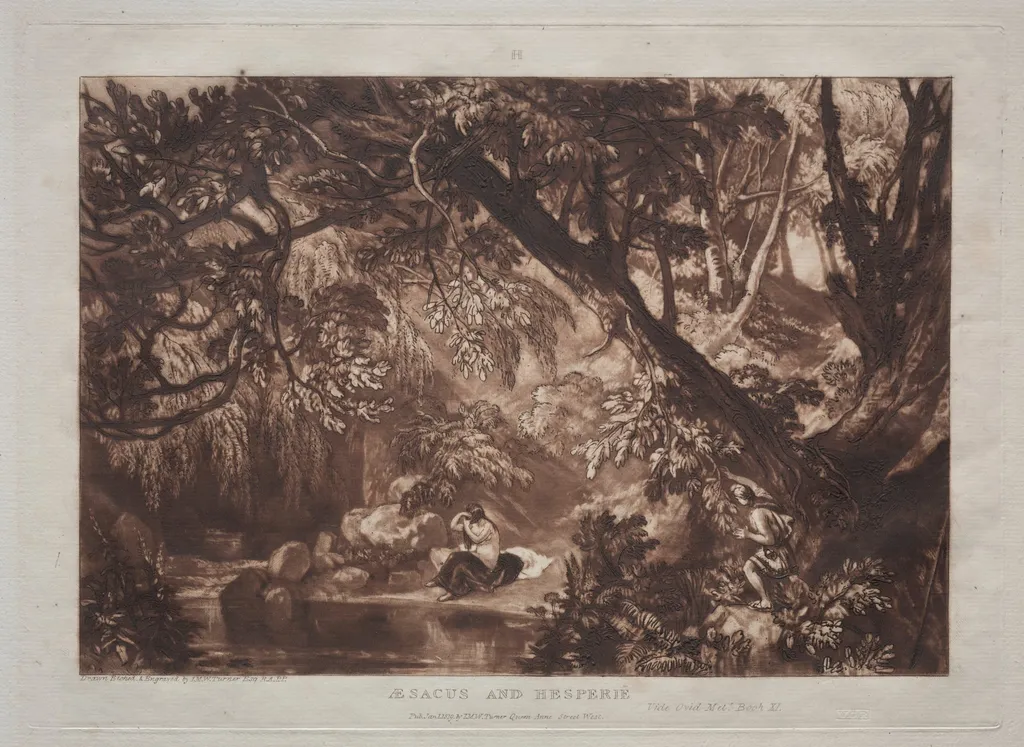
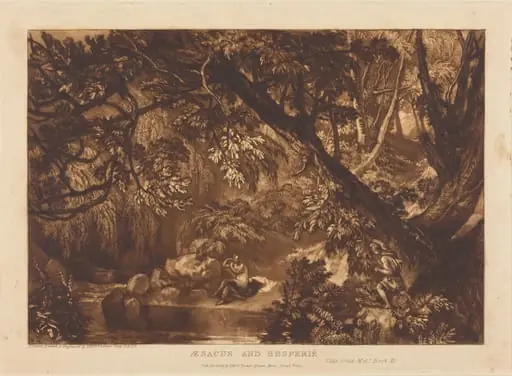
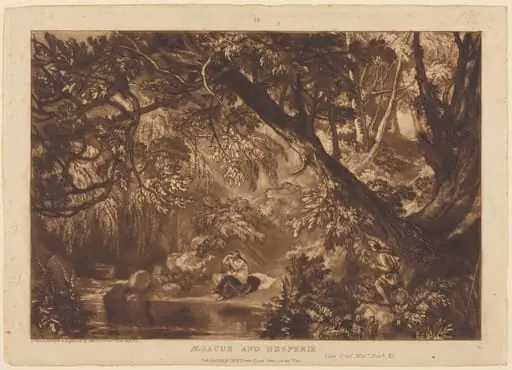
Liber Studiorum: Aesacus and Hesperie is a print by Joseph Mallord William Turner. It dates from 1823 and is held in the collection of the Cleveland Museum of Art.
- Accession no.
- 1919.164
About this work
Overview
Turner, known for his atmospheric watercolors and innovative printmaking, used this project to explore the relationship between nature and classical narrative.
Created around 1823, Liber Studiorum: Aesacus and Hesperie is a mezzotint print by Joseph Mallord William Turner, part of a larger series intended to classify and elevate landscape art through compositional types. Turner, known for his atmospheric watercolors and innovative printmaking, used this project to explore the relationship between nature and classical narrative. The print reflects his ambition to elevate landscape beyond mere scenery into a vehicle for poetic and historical resonance.
Subject & Meaning
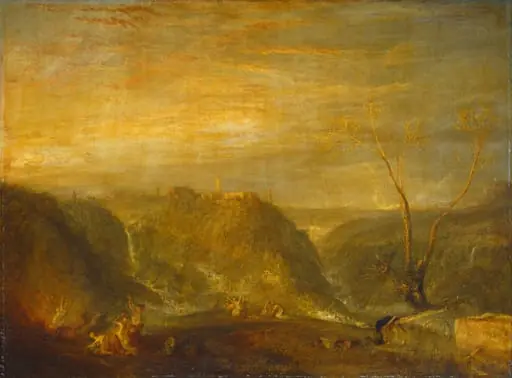
The scene depicts figures from Ovid’s myth of Aesacus, a Trojan prince transformed into a diving bird after his beloved Hesperie’s death. Here, the two figures, likely Aesacus and Hesperie, appear in a tranquil woodland near water, their postures suggesting quiet mourning or reflection. Turner avoids dramatic action, instead evoking melancholy through stillness and isolation. The mythological reference is subtle, inviting contemplation rather than narration.
Technique & Style
Turner employed mezzotint to achieve subtle gradations of light and shadow, using fine dot work and burnishing to model forms with delicate precision. The dense, dark foliage contrasts with patches of diffused light filtering through the canopy, creating a sense of depth and mystery. This use of chiaroscuro enhances the emotional tone, grounding the myth in a tangible, atmospheric world rather than idealized antiquity.
History & Provenance
The Liber Studiorum series was conceived by Turner as a personal artistic manifesto, published in parts between 1807 and 1819, with additional plates added later, including this one from around 1823. Originally intended for subscription, the prints circulated among artists and collectors, influencing British printmaking. This particular plate was likely produced for inclusion in later editions, reflecting Turner’s ongoing refinement of his vision.
Context
Turner’s Liber Studiorum emerged during a period when landscape art was gaining intellectual legitimacy in Britain. By pairing classical themes with observed naturalism, he challenged the hierarchy that privileged history painting. The series responded to contemporary debates about artistic purpose, positioning landscape as a medium capable of moral and emotional complexity, not just decorative beauty.
Legacy
Turner’s experimental approach to light, atmosphere, and composition in the Liber Studiorum series laid groundwork for later movements, particularly Impressionism. His willingness to dissolve form in favor of mood and light influenced artists seeking to capture transient effects. Though not widely recognized in his lifetime, the series became a touchstone for 19th-century reformers of landscape art and a model for integrating narrative with sensory experience.
Own this work as a print
Artist & collection
Artist
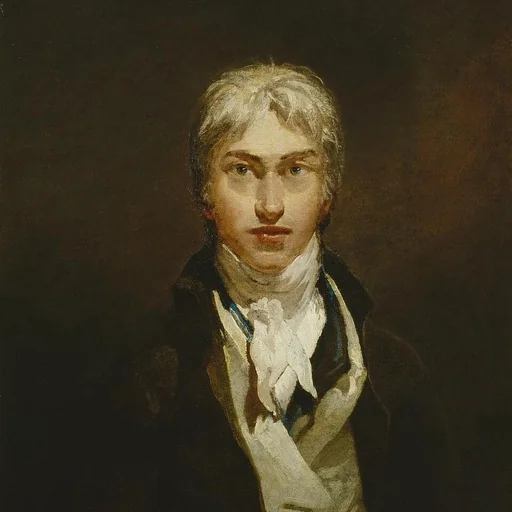
Joseph Mallord William Turner was born in 1775 at Maiden Lane, Covent Garden, where his father kept a barber and wig-making shop.