Artwork
Crucifixion of Christ
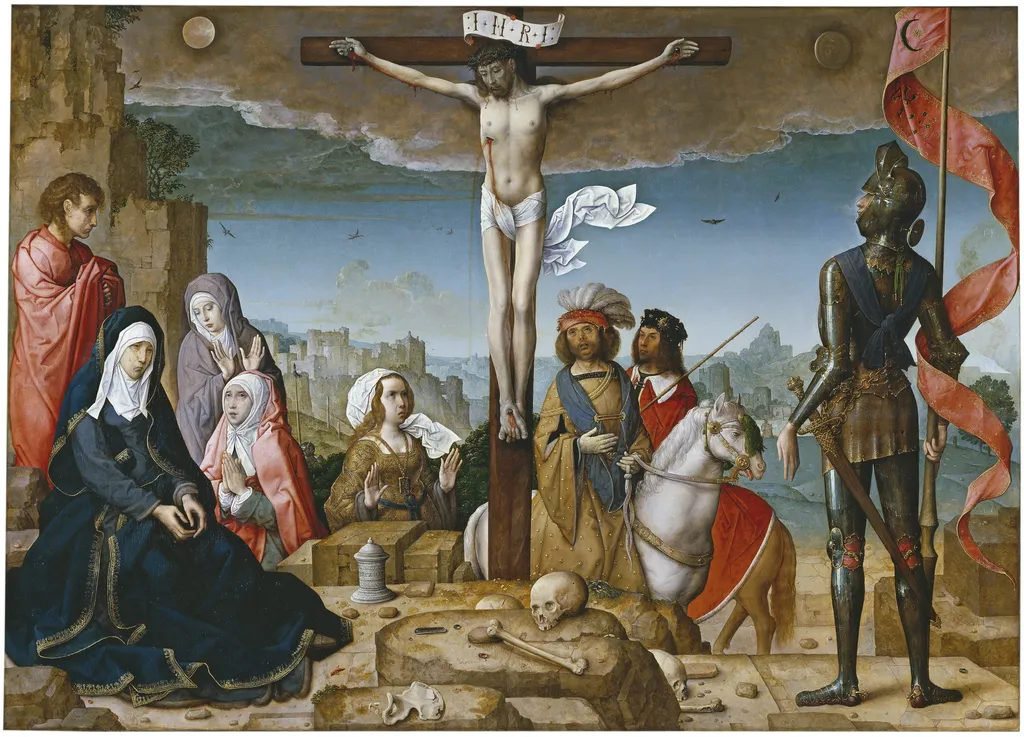
Crucifixion of Christ is an oil painting by the Early Renaissance artist Juan de Flandes. It dates from 1509 and is held in the collection of the Museo del Prado.
About this work
Subject & Meaning
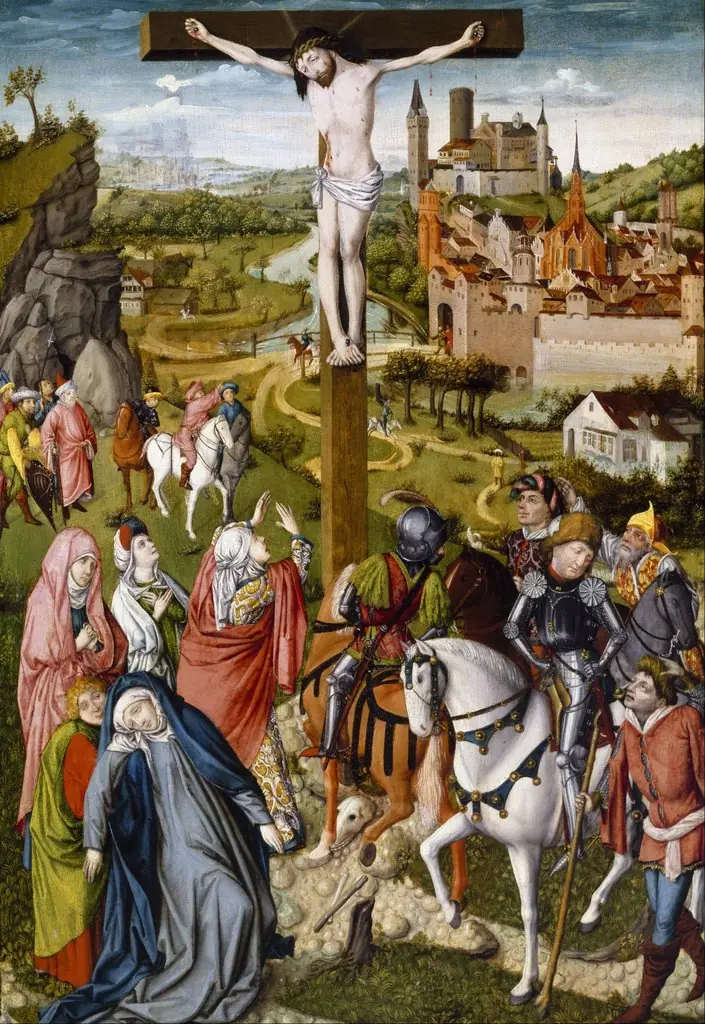
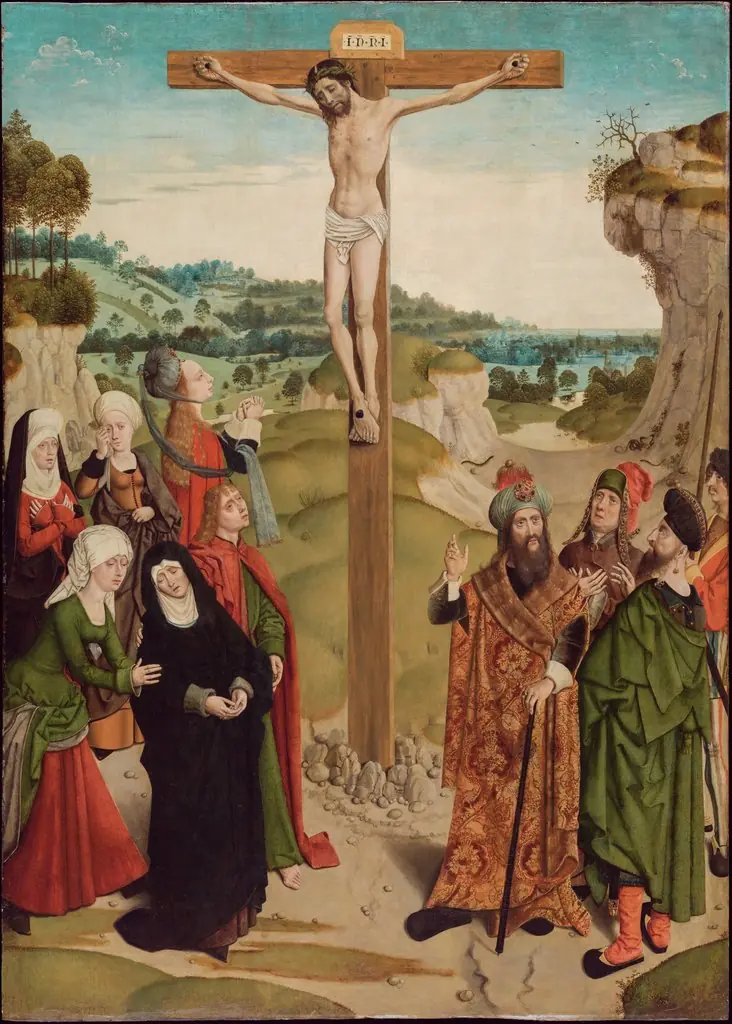
The painting depicts the Crucifixion of Jesus Christ, with the cross as the central compositional element around which the figures are arranged in a semicircle.
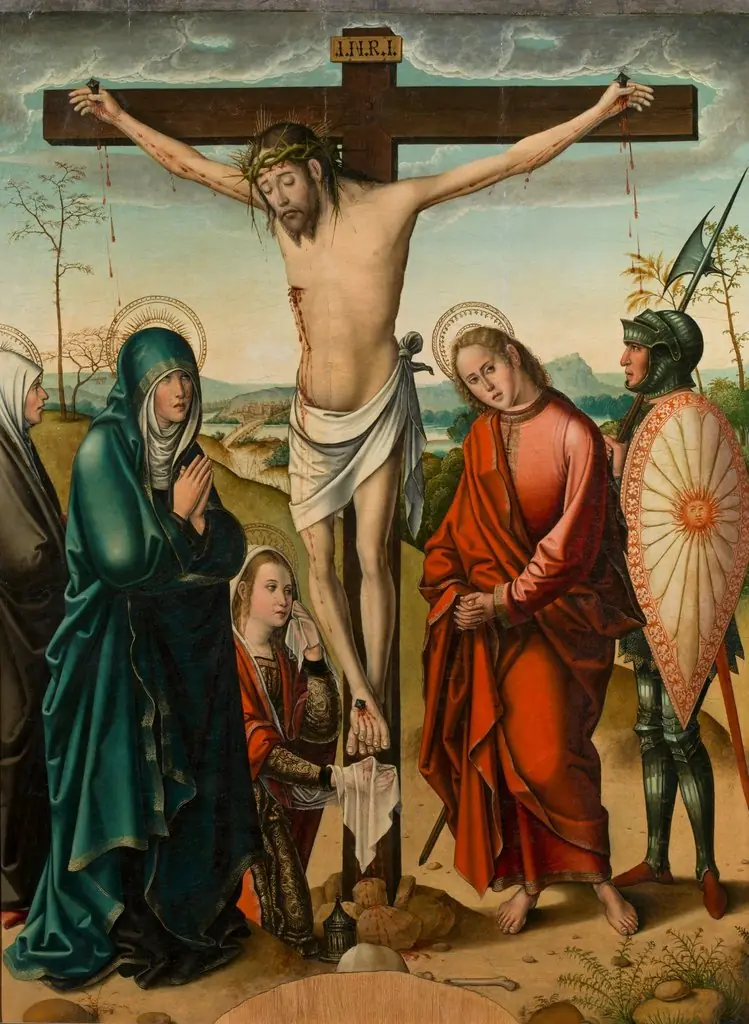
The painting depicts the Crucifixion of Jesus Christ, with the cross as the central compositional element around which the figures are arranged in a semicircle. On the left side stand the Virgin Mary, the apostle John, Mary of Cleopas, and Mary Salome, while on the right a soldier in armor is shown from behind in the foreground. Behind the cross, on a lower plane, appear Mary Magdalene and two men on horseback.
The work is rich in symbolic detail placed on the rocky foreground platform: an ointment jar alluding to redemption through Christ, precious stones evoking Paradise opened by his sacrifice, and a skull and bones referring to Golgotha, the site of the Crucifixion, where tradition also located Adam's tomb. The dry landscape, reminiscent of the Castilian plains, carries further allusions drawn from the Gospel accounts of Christ's death, including a dark cloud, birds, and the simultaneous presence of sun and moon. The monumental scale of the cross and the low viewpoint reinforce the sacred gravity of the event.
Technique & Style
Executed in oil on panel, this work measures 123 cm in height and 169 cm in width. The composition utilizes a horizontal format to emphasize the dominance of the cross, around which figures are arranged in a semicircle. Juan de Flandes employs a low viewpoint and a predominance of straight lines to create a monumental effect reminiscent of Mantegna's Italian style.
The foreground features a rocky platform displaying symbolic elements, including an ointment jar, precious stones, and a skull with bones referencing Golgotha. The background depicts a dry landscape characteristic of the Castilian plains, incorporating dark clouds, birds, and the simultaneous presence of the sun and moon. The painting demonstrates significant technical mastery, particularly in the detailed rendering of jewelry and armor.
History & Provenance
The Crucifixion of Christ by Juan de Flandes was executed in 1509 as the central panel for the high altarpiece of Palencia Cathedral, commissioned by Bishop Juan Rodríguez de Fonseca. The work remained in the cathedral until 1559, when it was replaced by a sculpture of Saint Antolín and subsequently moved to the Chapter House, where it is recorded in a 1668 inventory.
In 1944 the painting was acquired by Manuel Arburúa and entered his family’s private collection. In 2005 the Spanish construction group Ferrovial purchased it from the Arburúa heirs and transferred ownership to the Museo del Prado through a tax-for-debt arrangement valued at seven million euros, resulting in the work’s installation in Madrid in May 2005.
The painting is currently held by the Museo del Prado in Madrid, where it has resided since May 2005. It entered the museum's collection when the construction group Ferrovial transferred the work to the state in settlement of a seven-million-euro tax debt. Prior to this acquisition, the panel remained in the private collection of the Arburúa family, having been purchased in 1944 by Manuel Arburúa.
The work originally served as the central panel of the high altarpiece for Palencia Cathedral, commissioned by Bishop Juan Rodríguez de Fonseca, and remained there until 1559. Following its replacement by a sculpture of Saint Antolín, a 1668 inventory confirms the painting was kept in the cathedral's Chapter House.
Context
Juan de Flandes painted Crucifixion of Christ in 1509 for the high altar of Palencia Cathedral, commissioned by Bishop Juan Rodríguez de Fonseca; the work remained there until 1559, when it was replaced by a statue of Saint Anthony, and was later documented in the 1668 inventory of the Chapter Hall, acquired in 1944 by Manuel Arburúa, then purchased by Ferrovial in 2005 and transferred to the Museo del Prado as tax payment, where it has been on display since May 2005, reflecting its significance within the religious art of the Iberian Renaissance and the broader context of Juan de Flandes' output. The painting exemplifies the artist's synthesis of Flemish technique and Italian compositional influence, particularly evident in its low viewpoint, linear emphasis, and monumental scale reminiscent of Mantegna, while its symbolic details, such as the crucifix, mourning figures, and landscape elements, reinforce its devotional function within the cathedral's liturgical space, establishing it as a key example of early 16th-century Spanish religious painting and underscoring its role in scholarly discussions of artistic exchange between the Iberian Peninsula and the Low Countries.
Legacy
The Crucifixion of Christ by Juan de Flandes has had a lasting impact on religious art and scholarly discourse, particularly through its compositional innovations and symbolic depth. Art historians note its influence on later depictions of the Passion, citing its dramatic perspective and the way it integrates narrative elements with theological symbolism. The work's journey from its original location in the Cathedral of Palencia to its acquisition by the Museo del Prado in 2005 underscores its cultural significance and the complex history of preservation and ownership.
Its stylistic connections to Italian masters such as Mantegna have been highlighted in studies of cross-cultural artistic exchange during the early 16th century.
The painting's provenance reflects broader patterns in Spanish art history, including the use of dation as a mechanism for transferring cultural heritage to public institutions. Since its integration into the Museo del Prado's collection, it has been the subject of conservation efforts and academic exhibitions that examine its technique, iconography, and historical context. The work continues to be referenced in scholarship on Iberian Renaissance art and the transmission of devotional imagery across Europe.
Overview
Painted by Juan de Flandes around 1509, this oil on panel depicts the Crucifixion of Christ with a composition characteristic of the artist's late Flemish-influenced style. The scene centers on the figure of Christ on the cross, set against a landscape that transitions from a dark, stormy sky to a distant horizon. At the foot of the cross, the Virgin Mary and two other women kneel in grief, their dark robes contrasting with the pale skin of the central figure.
To the right, Roman soldiers on horseback observe the event; one is clad in armor while the other wears vibrant red and gold garments, adding a note of courtly elegance to the violent scene. A skull and scattered bones lie in the foreground, referencing Golgotha, the Place of the Skull. This work exemplifies Juan de Flandes's role as a court painter in Castile, where he synthesized Northern European attention to detail and texture with Spanish devotional intensity.
Created during the height of his career in Valladolid, the painting reflects the religious fervor of the early 16th century and the artist's mastery in rendering complex emotional states within a structured, narrative framework.
Own this work as a print
Artist & collection