Artwork
The Resurrection of Lazarus
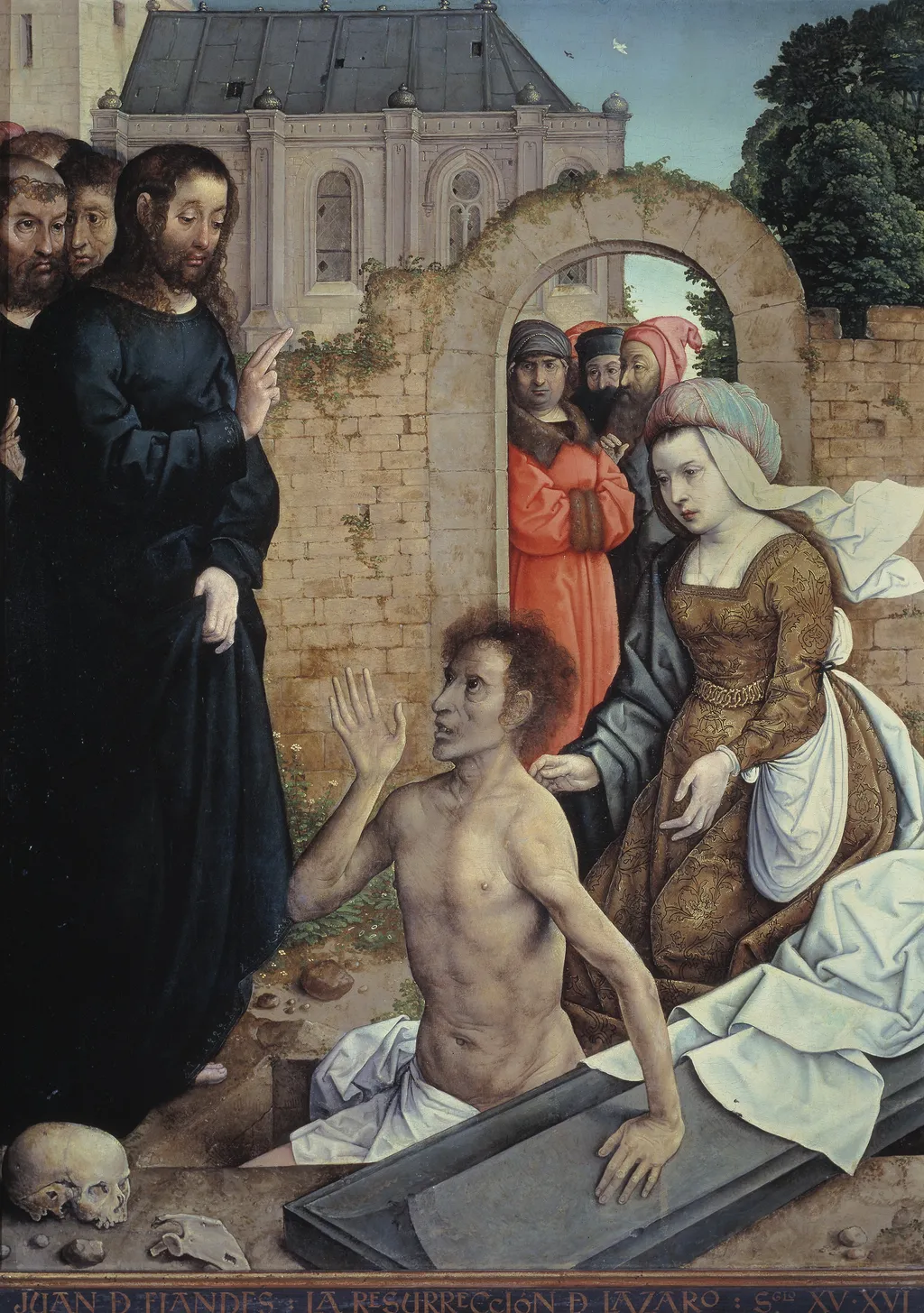
The Resurrection of Lazarus is an oil painting by the Early Renaissance artist Juan de Flandes. It dates from 1510 and is held in the collection of the Museo del Prado.
About this work
Subject & Meaning
The contrast between Mary's contemporary finery and Lazarus's funerary wrappings heightens the theological drama of death yielding to divine command.
The painting depicts the Raising of Lazarus, one of the most frequently represented subjects in Christian art and the most significant of the three resurrections attributed to Jesus in the Bible. The scene shows Christ commanding Lazarus to rise, with Lazarus appearing shrouded, pale, and decayed, while one of his sisters, Mary, stands beside him dressed in richly adorned garments characteristic of the era of the Catholic Monarchs. The contrast between Mary's contemporary finery and Lazarus's funerary wrappings heightens the theological drama of death yielding to divine command.
Lazarus of Bethany is a New Testament figure, brother of Mary and Martha, whom Jesus raised from the dead according to the Gospel of John. The panel originally formed part of an altarpiece for the Church of San Lázaro in Palencia, commissioned in connection with Isabel the Catholic until her death in 1504. The work's classification as religious art and its main subject of the Raising of Lazarus are confirmed in the catalogue record.
Technique & Style
Juan de Flandes executed this religious scene using oil paint on a wooden panel. The work measures 110 cm in height and 84 cm in width. Stylistically, the painting reflects Northern Renaissance conventions, particularly in its depiction of contemporary Flemish architecture within the background structures.
The artist contrasts the pale, shrouded figure of Lazarus with the richly adorned garments of Mary, who is dressed in attire characteristic of the era of the Catholic Monarchs. This panel originally formed part of a larger altarpiece commissioned for the Church of San Lázaro in Palencia before the ensemble was dismantled.
History & Provenance
Painted between 1510 and 1518, The Resurrection of Lazarus was commissioned for the altarpiece of the Church of San Lázaro in Palencia under an order placed by Queen Isabella I of Castile, which remained incomplete at her death in 1504.
After the dismantling of the altarpiece, the panel was acquired by the Samuel H. Kress Foundation and subsequently four of its dispersed scenes, including this one, were donated to the Museo del Prado; the work has been in the Prado’s collection since that transfer.
The Resurrection of Lazarus by Juan de Flandes is held by the Museo del Prado in Madrid, where it is one of six works by the artist in the collection as of 2013.
The panel originally belonged to a larger altarpiece commissioned for the Church of San Lázaro in Palencia. After the altarpiece was dismantled, it was acquired by the Samuel H. Kress Foundation, which subsequently ceded four of its panels to the Prado. The Resurrection of Lazarus was one of those four transferred panels, alongside Pentecost, The Agony in the Garden, and The Ascension.
Context
Juan de Flandes painted The Resurrection of Lazarus around 1510, an oil on panel work that forms part of the Museo del Prado's collection and was originally part of a retable for the Church of San Lázaro in Palencia; the painting depicts Christ commanding Lazarus to rise while his sister Mary, clothed in contemporary Castilian dress, witnesses the miracle, a composition that aligns with the broader Renaissance interest in the biblical scene of Lazarus's resurrection and is one of six works by the artist held by the Prado as of 2013
The subject draws on the Gospel of John's account of Lazarus of Bethany, brother of Mary and Martha, whom Jesus raises from the dead, and it belongs to a long tradition of visualising this miracle, appearing in works by Giotto, Duccio, van Ouwater, Froment, and later Caravaggio; the Prado's version is among the few surviving panels from the original retable, alongside Pentecost, The Agony in the Garden, and The Ascension
Overview
The Resurrection of Lazarus is an oil painting by Juan de Flandes, created in 1510. It is a representation of a biblical scene and is currently held at the Museo del Prado.
Own this work as a print
Artist & collection