Artwork
江戸の花 娘浄瑠璃|A Woman Playing with a Young Boy
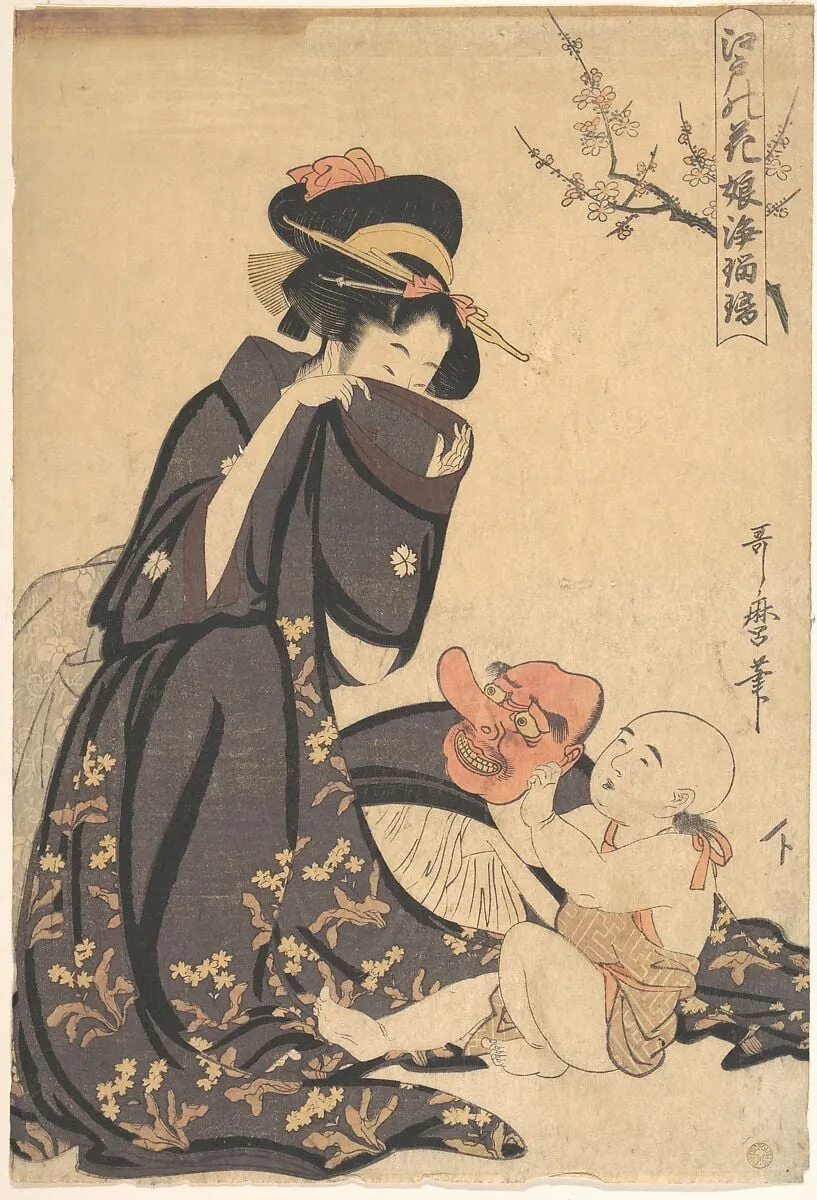
江戸の花 娘浄瑠璃|A Woman Playing with a Young Boy is an ink print by the Romanticist artist Kitagawa Utamaro. It dates from 1804 and is held in the collection of the Metropolitan Museum of Art.
- Accession no.
- JP555
- Credit line
- Purchase, Joseph Pulitzer Bequest, 1918
About this work
Subject & Meaning
The print shows a woman entertaining a young child with a papier-mâché mask, a motif linked to the popular Edo-period game hyakubiki or mask-guessing.
The print shows a woman entertaining a young child with a papier-mâché mask, a motif linked to the popular Edo-period game hyakubiki or mask-guessing. Her gesture and the child’s attention focus on the mask, suggesting play rather than ritual. The pairing of adult and child within an interior setting aligns with bijin-ga conventions, yet the inclusion of the mask subtly evokes broader Edo amusements and seasonal pastimes.
The scene likely represents a moment of light-hearted diversion rather than a specific narrative, capturing the cultural practice of mask play as a pastime associated with childhood and festive diversion in late Edo urban life.
Technique & Style
Created in 1804, this work is a woodblock print executed with ink and color on paper. It belongs to the ukiyo-e tradition, specifically classified as a nishiki-e (brocade print) and bijin-ga (picture of beautiful women). The piece functions as a portrait depicting a woman playing with a young boy, who is shown alongside a mask.
As a nishiki-e, the image utilizes a multi-block printing process to achieve its polychrome result, a hallmark of the genre.
History & Provenance
The woodblock print titled A Woman Playing with a Young Boy (also known as Edo no hana: Musume jōruri) was created by the ukiyo-e artist Kitagawa Utamaro in 1804. This work, classified as a nishiki-e bijin-ga, depicts a woman and a boy engaged in play, with the boy holding a mask. The piece is currently held in the collection of the Metropolitan Museum of Art.
No specific details regarding the original commission, the chain of ownership prior to its museum acquisition, or the precise circumstances of its creation are provided in the available records.
The woodblock print is held in the collection of the Metropolitan Museum of Art, as recorded in its Wikidata entry. No specific inventory or accession number is provided in the available sources, and no exhibition history is documented for this work.
The print, dated to 1804, is catalogued as part of the museum's prints holdings and is classified as an ukiyo-e nishiki-e bijin-ga depicting a woman, a boy, a mask, and the act of playing.
Overview
Kitagawa Utamaro’s woodblock print, dated around 1804, portrays an intimate domestic scene. A woman in a patterned kimono leans toward a young boy, assisting him in placing a mask over his face while his feet dangle above the floor. The composition captures a fleeting moment of play rather than a staged narrative.
Context
During the Edo period, woodblock prints served both as popular entertainment and as documentation of contemporary customs. The inclusion of the hyottoko mask links the scene to the era’s theatrical traditions, while the domestic setting underscores the growing market for images of ordinary urban experiences.
Legacy
Utamaro’s focus on subtle, personal interactions influenced later ukiyo‑e artists and contributed to the genre’s shift toward more intimate, observational subjects. The print continues to be cited as an example of how everyday play can reveal cultural practices within visual art.
Artist & collection


 Untitled
 Untitled
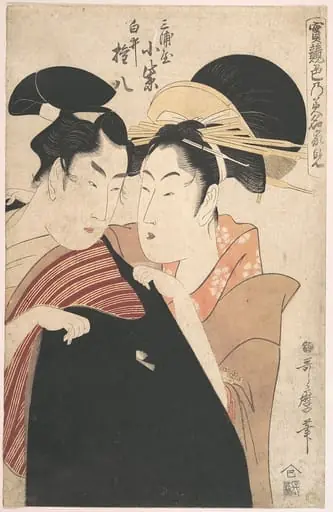 実競色乃美名家見 三浦屋小紫 白井権八|The Lovers Miura-ya Komurasaki and Shirai Gonpachi.
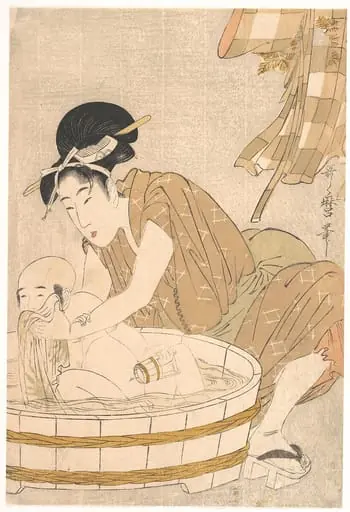 行水|Bathtime (Gyōzui)
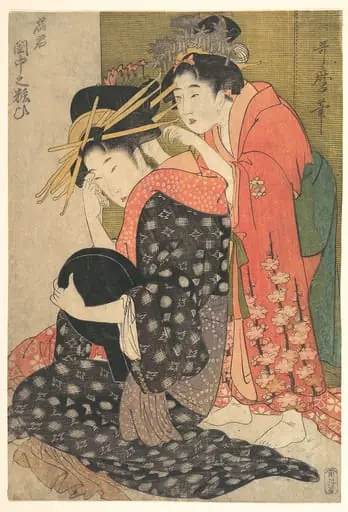 名君 閨中の粧ひ|The Oiran Yoso-oi Seated at Her Toilet
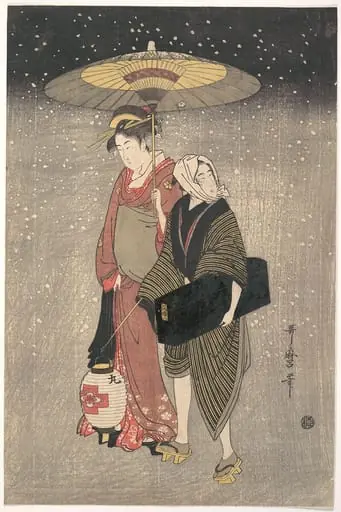 Untitled
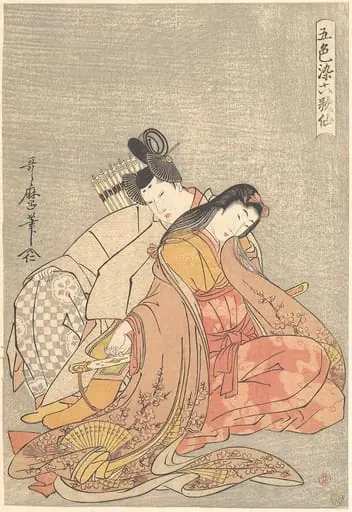 『五色染六歌仙』 在原業平と小野小町|“The Poet Ariwara no Narihira (825–880) and Ono no Komachi,” from the series Five Colors of Love for the Six Poetic Immortals (Goshiki-zome rokkasen)
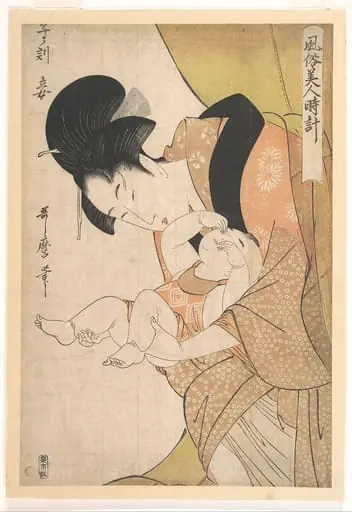 風俗美人時計 子ノ刻 妾|Midnight: Mother and Sleepy Child
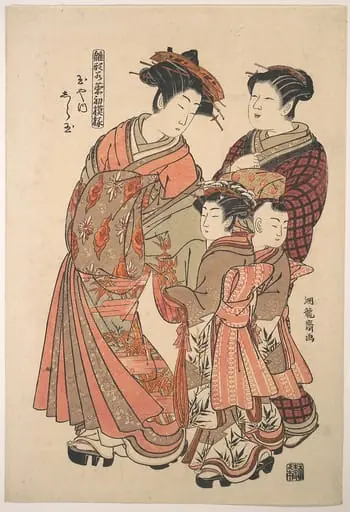 『雛形若菜初模様 玉や内 しら玉』|The Courtesan Shiratama of the Tamaya Brothel, from the series “A Pat-tern Book of the Year’s First Designs, Fresh as Spring Herbs” (“Hinagata wakana hatsu moyō”)
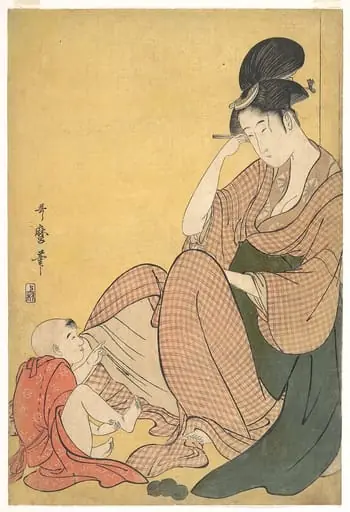 Untitled
 Untitled
 Prayers for Rain, from the series Seven Elegant Komachi
 Untitled
 Fond of Things from the series Eight Views of Favorite Things of Today's World