Artwork
The Old Musician
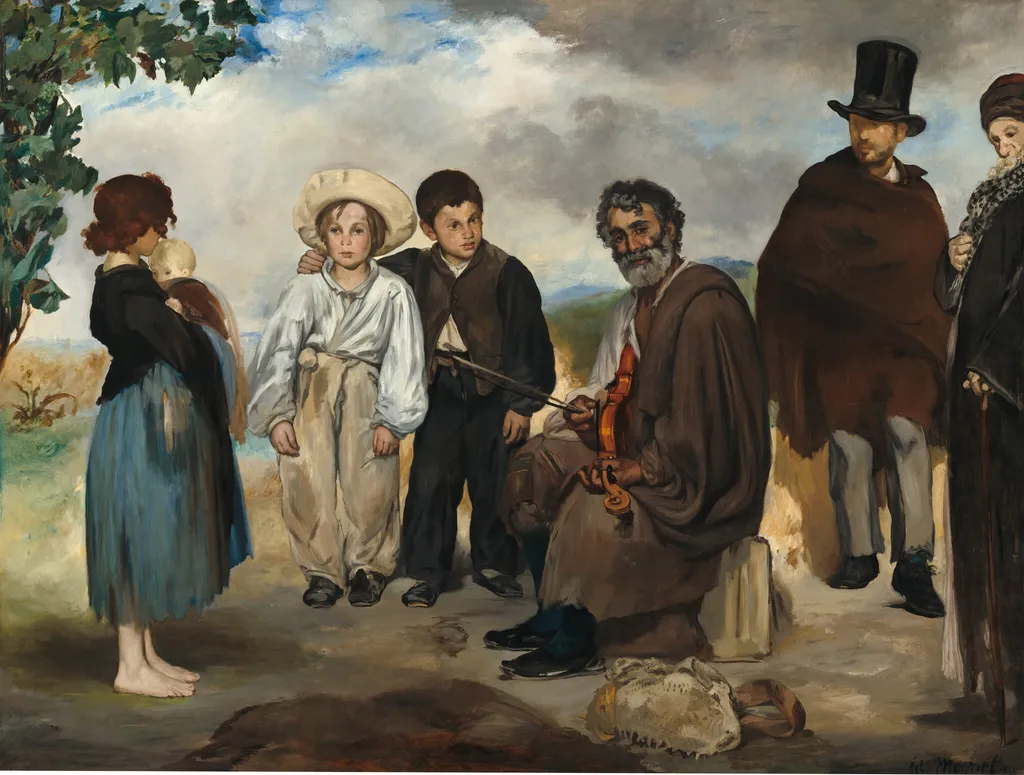
The Old Musician is an oil painting by the Impressionist artist Édouard Manet. It dates from 1862 and is held in the collection of the National Gallery of Art.
- Inscription
- Inscribed:lower right: ed. Manet 1862
About this work
Around him gather a ragpicker in a top hat, a young woman with a baby, and a man cast as the wandering Jew, all pressed into a narrow foreground.
Jean Lagrene sits with his violin on bare ground in Petite Pologne, a poor neighborhood near Manet's studio. Around him gather a ragpicker in a top hat, a young woman with a baby, and a man cast as the wandering Jew, all pressed into a narrow foreground. Painted in 1862, it is one of Manet's largest canvases. The figures never meet each other's eyes, a blankness that struck viewers as strikingly modern.
Subject & Meaning
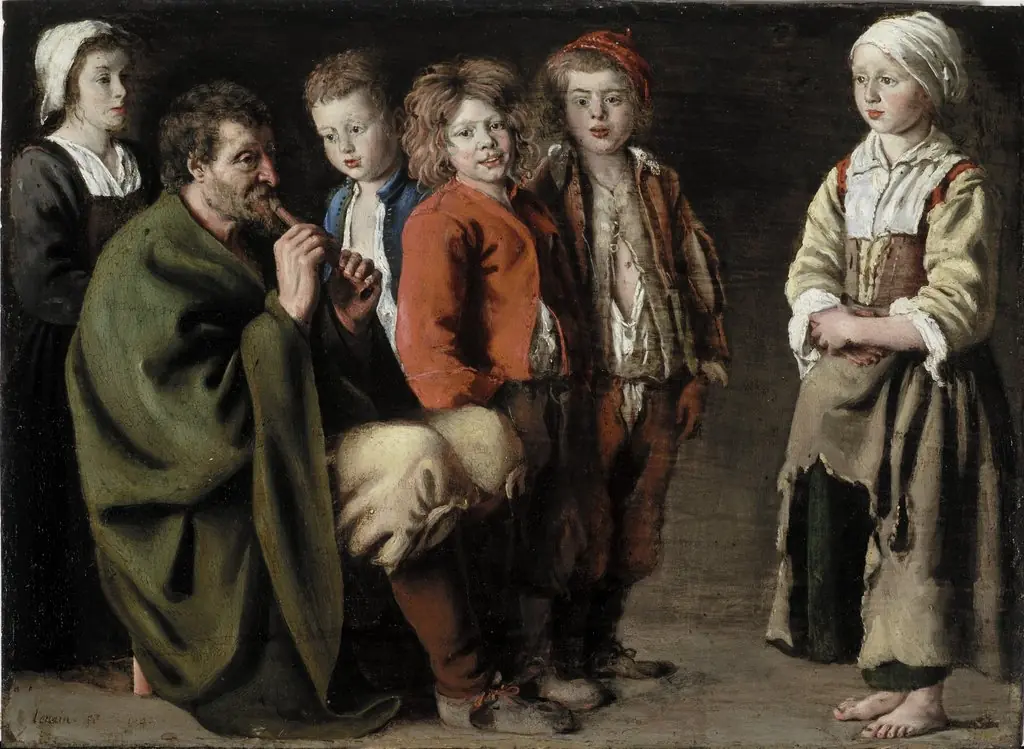
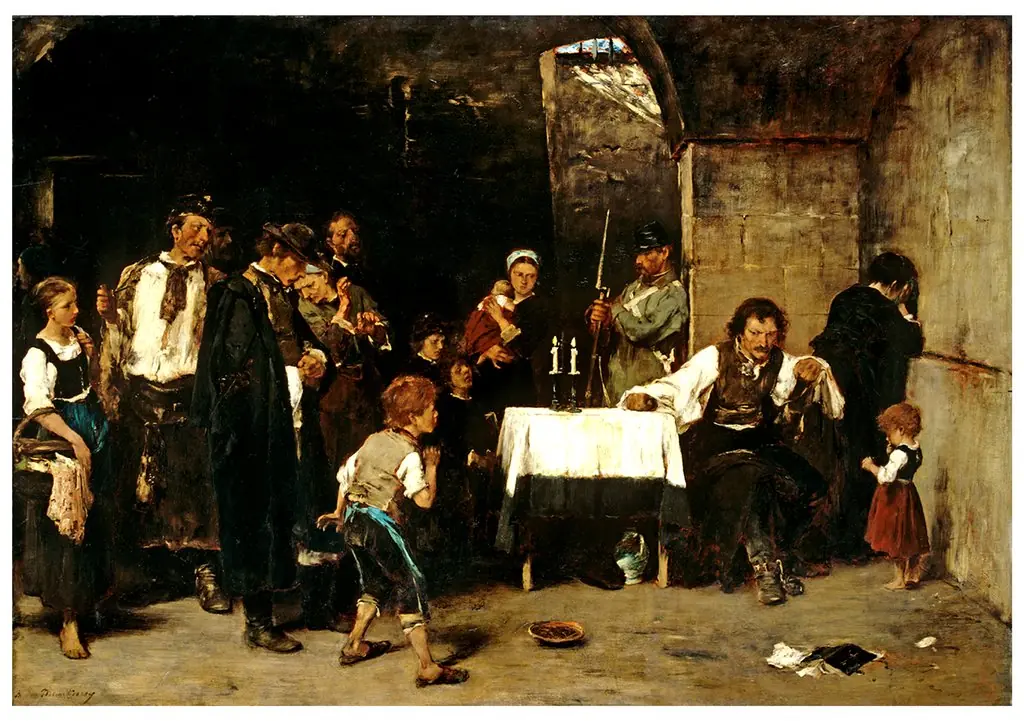
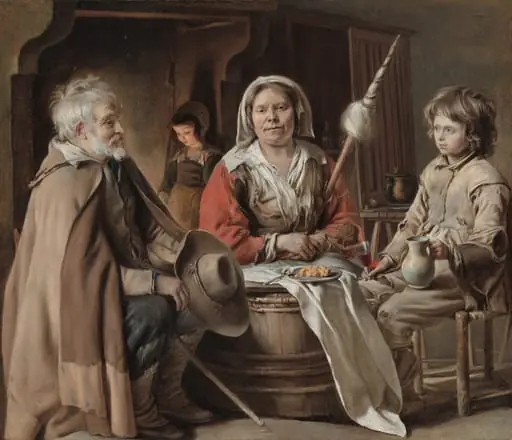
The painting depicts seven figures in a landscape, centered on Jean Lagrène, an elderly violinist and leader of a local Romani band in Paris's Batignolles district, preparing to play. To his left stand a barefoot young girl holding a baby and two young boys; behind him, the rag-picker and ironmonger Colardet appears in a top hat, while at the right edge the bearded Guéroult, dressed in Oriental robes and turban, represents the "wandering Jew", his marginal placement underscoring his outsider status. The figures' attitudes and clothing draw on Spanish Baroque models by Diego Velázquez and Louis Le Nain.
Manet embeds art-historical quotations: Colardet recurs from the artist's earlier Absinthe Drinker, and the straw-hatted boy derives from Antoine Watteau's Pierrot. Rather than sentimentalizing poverty, the composition presents an emotionally detached, seemingly spontaneous urban moment, reflecting the displacement of the urban underclass during Haussmann's renovation of Paris. The musician's vacant stare into space contributes to the work's modern, alienated atmosphere.
Technique & Style
The Old Musician is an oil painting on canvas executed by Édouard Manet in 1862 and ranks among his largest works, measuring 187.4 cm in height and 248.2–248.3 cm in width. Painted during a period when Manet was strongly influenced by Spanish art, the work also betrays the influence of Gustave Courbet. The composition arranges seven figures in a landscape, with attitudes and clothing of the characters seemingly inspired by Diego Velázquez or Louis Le Nain.
Specific allusions include the man in the top hat, who reappears from Manet's earlier Absinthe Drinker, and the young boy in a straw hat, who is explicitly inspired by Antoine Watteau's Pierrot. The bearded central figure has also been compared to Velázquez's Menippus. The painting is described as having been carefully composed despite its modern, unsentimental appearance, functioning almost as a series of independent pictorial quotations on a single canvas.
History & Provenance
Édouard Manet painted The Old Musician in 1862, retaining it until his death. At the Manet estate sale on 4 February 1884 (Hôtel Drouot, lot 9), the family withdrew the work. It then passed to collector Gaston-Alexandre Camentron in Paris.
Dealer Paul Durand-Ruel acquired it around 1897, lending it to a 1904 Dublin exhibition organized by Hugh Lane. On 27 January 1906, Durand-Ruel sold it through Adrien-Aurélien Hébrard to Alexandre Berthier, 4th Prince de Wagram. By 1912 it was with P.R. Pearson, Paris.
The Österreichische Staatsgalerie (now Belvedere) purchased it from Galerie Arnot, Vienna, in 1913, but released it in 1923 in exchange for two paintings, possibly through Galérie Barbazanges. After passing through Hodebert, Paris, Galerie Étienne Bignou acquired it in Germany in 1930 for Alex Reid & Lefèvre, London, selling it that year to Chester Dale, New York. Dale bequeathed it to the National Gallery of Art, Washington, in 1963.
The Old Musician has been held at the National Gallery of Art in Washington, D.C., since 1963, when it entered the collection as part of the bequest of collector Chester Dale. Dale had acquired the painting in 1930 through Galerie Étienne Bignou in Paris and Alex Reid & Lefèvre in London. Earlier, the canvas had been held by the Österreichische Staatsgalerie (now Österreichische Galerie Belvedere) in Vienna from 1913, after being released in 1923 in exchange for two other paintings and passing through Galerie Barbazanges-Hodebert in Paris.
Prior Viennese and French owners included P. R. Pearson (by 1912) and Alexandre Berthier, 4th Prince de Wagram, who acquired it in 1906 through Adrien-Aurélien Hébrard from Durand-Ruel, the dealer who had purchased it in 1897 from Camentron in Paris. The work had originally been listed at the Manet sale in Paris on 4 February 1884 (lot 9) but was withdrawn. Exhibition history includes a 1904 Dublin exhibition organized by Hugh Lane, where Durand-Ruel lent the painting, and the 1928 Manet exhibition at Galerie Matthiesen in Berlin, where Hodebert, Paris, was recorded as lender.
Context
Painted in 1862, The Old Musician represents a pivotal moment in Édouard Manet's early career, reflecting his engagement with Spanish art and the influence of Gustave Courbet. The work is one of Manet's largest and most complex early compositions. Scholars have identified its carefully constructed references to multiple artists: the figures' attitudes and clothing evoke Diego Velázquez and Louis Le Nain, while the boy in the straw hat explicitly quotes Antoine Watteau's Pierrot.
The painting's modernity lies in its unsentimental depiction of urban marginality, Jean Lagrène, the central musician, leads a Romani band in the Batignolles district, positioning Manet among the first to represent the city's impoverished classes rather than rural peasants. The reappearance of the top-hatted figure from Manet's earlier The Absinthe Drinker, now without narrative connection, exemplifies what scholars describe as the work's emotional emptiness and collage-like assembly of artistic quotations. This approach to composition, treating the canvas as a field of intertextual references, has been interpreted as anticipating modernist practices and contributing to the painting's perception as 'too modern' for its time.
Overview
Édouard Manet's 1862 oil on canvas, The Old Musician, depicts a group of individuals gathered in a landscape. This work is among the artist's most substantial paintings in size. It features a central figure, Jean Lagrène, with his violin, surrounded by other figures who appear detached from one another. The painting is currently housed at the National Gallery of Art in Washington, DC.
Own this work as a print
Artist & collection
Artist
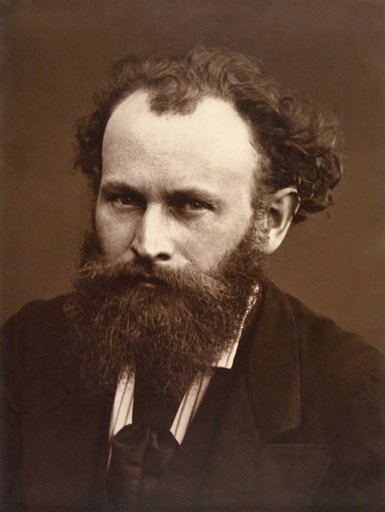
Édouard Manet was a French modernist painter. He was one of the first 19th-century artists to paint modern life, as well as a pivotal figure in the transition from Realism to Impressionism.