Artwork
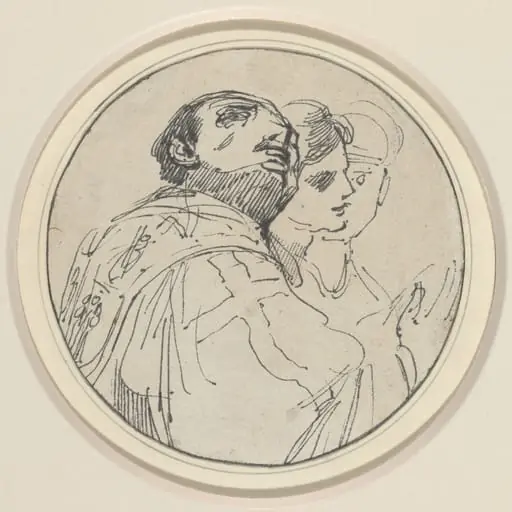
Two Cardinals
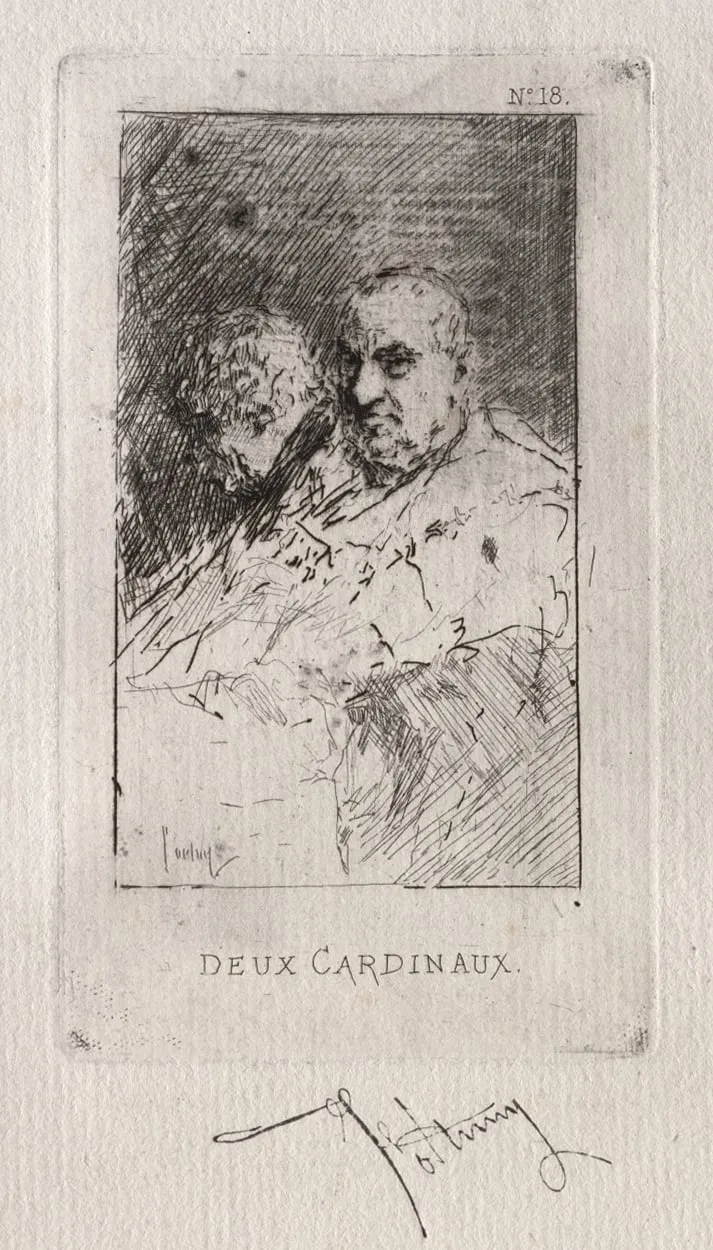
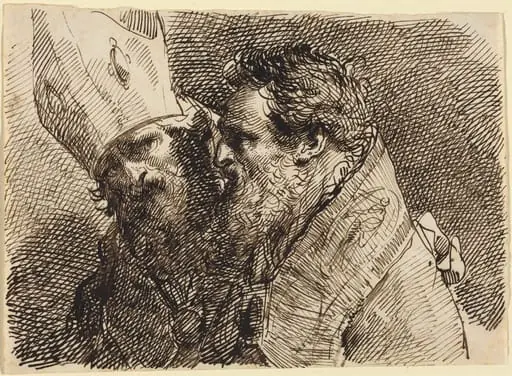
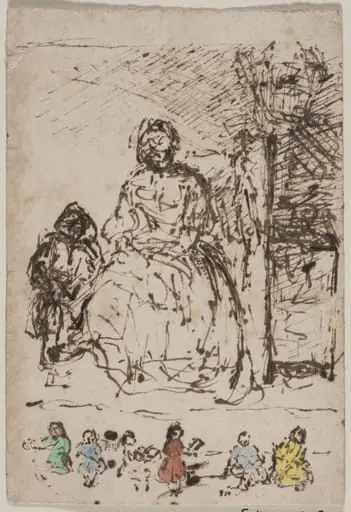
Two Cardinals is a print by the Impressionist artist Mariano Fortuny Marsal. It dates from 1865 and is held in the collection of the Cleveland Museum of Art.
- Accession no.
- 1921.293
About this work
Overview
Created around 1865 by Spanish artist Mariano Fortuny, Two Cardinals is a charcoal or ink sketch depicting two clerical figures in richly draped robes.
Created around 1865 by Spanish artist Mariano Fortuny, Two Cardinals is a charcoal or ink sketch depicting two clerical figures in richly draped robes. Though often associated with finished oil paintings, this work reflects Fortuny’s interest in rapid, observational drawing. Its informal quality suggests it was made as a study rather than a final composition, capturing fleeting gestures and expressions with minimal detail.
Subject & Meaning
The two figures are identified as cardinals, high-ranking members of the Catholic Church, likely representing the Church’s enduring presence in 19th-century Spanish society. Their somber expressions and close physical proximity suggest a moment of private deliberation. The work does not idealize its subjects but instead presents them with quiet gravity, hinting at the weight of ecclesiastical authority without overt symbolism.
Technique & Style
Fortuny employed loose, energetic lines to suggest form and texture, favoring immediacy over polish. The faces are partially shadowed, with light falling unevenly to emphasize depth and mood. The robes are rendered with fluid strokes that imply volume without precise contouring. This approach aligns with Romantic-era sketching practices, valuing emotional resonance and spontaneous observation over academic finish.
History & Provenance
The drawing entered the collection of The Cleveland Museum of Art, where it remains part of its holdings of 19th-century European works. While its exact provenance before acquisition is not widely documented, its presence in the museum reflects broader interest in Fortuny’s drawings as windows into his creative process. It was likely acquired as part of a larger group of his studies and preparatory works.
Context
In mid-19th century Spain, the Catholic Church remained a central institution, and religious figures were frequent subjects in art. Fortuny, influenced by his travels and exposure to Orientalist aesthetics, often blended realism with dramatic lighting. This sketch fits within a broader trend of artists documenting religious and historical figures with psychological nuance, moving away from purely ceremonial portrayals.
Legacy
Though less known than his finished paintings, Fortuny’s sketches like this one reveal his commitment to capturing human presence with economy and sensitivity. They influenced later generations of artists who valued preparatory work as expressive in its own right. The drawing endures as a quiet testament to his ability to convey dignity and tension in minimal strokes.
Artist & collection
Artist
Mariano Fortuny y Marsal (Catalan: Marià Fortuny i Marsal, pronounced; June 11, 1838 – November 21, 1874) was a Spanish painter known for works focusing on Romantic fascination with Orientalist themes, historicist genre…

![Bust of Madame Cezanne [verso], by Paul Cézanne](https://artifactworldgallery.com/img/paul-cezanne--bust-of-madame-cezanne-verso--8686f7640dae3212-w320.webp)