Artwork
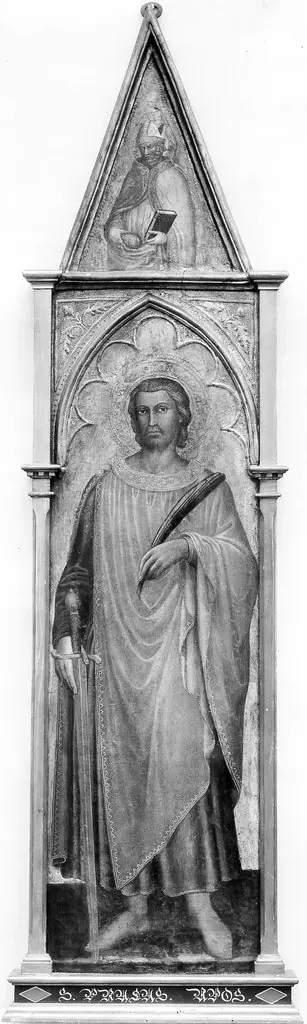
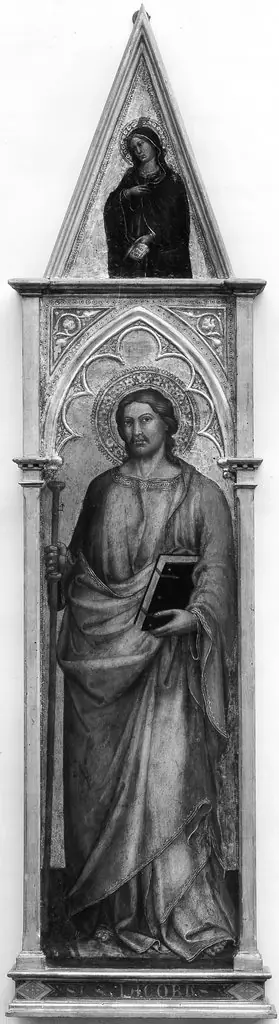
Deacon Saint, with Saint Anthony Abbot [right panel]
![Deacon Saint, with Saint Anthony Abbot [right panel], by Martino di Bartolomeo, tempera, 1418](https://artifactworldgallery.com/img/martino-di-bartolomeo--deacon-saint-with-saint-anthony-abbot-right-panel--2a458c4f3eacee3b-w1024.webp)
Deacon Saint, with Saint Anthony Abbot [right panel] is a tempera painting by the Early Renaissance artist Martino di Bartolomeo. It dates from 1418 and is held in the collection of the National Gallery of Art.
About this work
Technique & Style
The work is executed in tempera on panel, a medium typical for early fifteenth-century Italian panel painting.
The work is executed in tempera on panel, a medium typical for early fifteenth-century Italian panel painting. As a religious panel painting by Martino di Bartolomeo, it belongs to the devotional tradition of his oeuvre. The sources do not provide details about the artist's handling, brushwork, or the painting's current condition, nor do they elaborate on its formal or stylistic qualities beyond its religious genre and date of 1418.
History & Provenance
The right panel of Deacon Saint, with Saint Anthony Abbot was painted by Martino di Bartolomeo in 1418, as consistently documented in scholarly and institutional sources. The work originated as a tempera-on-panel devotional painting, likely commissioned for private or ecclesiastical use, though specific commissioning details remain unrecorded.
By 1924, the panel resided in a private collection in London, where connoisseur Robert Langton Douglas, or a similarly connected figure, owned it. Art historian F. Mason Perkins referenced this collection in a 1924 article, noting the owner's role in proposing the attribution to Martino di Bartolomeo. The work later entered the collection of Samuel L. Fuller (1875–1963) in New York, who gifted it to the National Gallery of Art, Washington, D.C., in 1950.
Legacy
The panel entered the National Gallery of Art in Washington, D.C., in 1950 after being in the Samuel L. Fuller collection, marking its institutional recognition.
Scholars such as F. Mason Perkins (1924) and Ellis Waterhouse noted its significance, using archival photographs to support its attribution.
Its inclusion in major catalogues and exhibition histories contributed to a reassessment of Martino di Bartolomeo's early Renaissance output, establishing the work as a reference point for studies of 15th-century Sienese painting.
The panel's provenance and attribution remain cited in subsequent literature on the artist's legacy.
Overview
This tempera painting, titled Deacon Saint, with Saint Anthony Abbot [right panel], was created by Martino di Bartolomeo around 1418. As a religious work, it depicts two prominent figures, likely part of a larger altarpiece or devotional ensemble. The use of tempera on panel, a common technique of the period, contributes to its distinct visual qualities and enduring presence.
Subject & Meaning
The central figure, identified as a Deacon Saint, is rendered with a focused expression, clad in a vibrant red robe adorned with gold trim. He holds a long, yellow-wrapped green staff and a small book or scroll, traditional attributes for such a holy figure. A smaller, blue-robed figure engaged in reading appears above, set against an ornate gold background featuring an arch, reinforcing the sacred context of the depiction.
![Saint Catherine of Alexandria, with an Angel [right panel]](https://artifactworldgallery.com/img/pietro-lorenzetti--saint-catherine-of-alexandria-with-an-angel-right-panel--8acb359f1d360041-w320.webp)
Artist & collection


 Saint Julian the Hospitaler (with Saint Nicholas of Bari)
![Saint Peter, with Saint James Major [left panel], by Martino di Bartolomeo](https://artifactworldgallery.com/img/martino-di-bartolomeo--saint-peter-with-saint-james-major-left-panel--20178831b0b297bc-w320.webp) Saint Peter, with Saint James Major [left panel]
Saint Peter, with Saint James Major [left panel]![Madonna and Child with the Blessing Christ, and Saints Peter, James Major, Anthony Abbott, and a Deacon Saint [entire triptych], by Martino di Bartolomeo](https://artifactworldgallery.com/img/martino-di-bartolomeo--madonna-and-child-with-the-blessing-christ-and-saints-peter--2c53e26d577a363b-w320.webp) Madonna and Child with the Blessing Christ, and Saints Peter, James Major, Anthony Abbott, and a Deacon Saint [entire triptych]
Madonna and Child with the Blessing Christ, and Saints Peter, James Major, Anthony Abbott, and a Deacon Saint [entire triptych]![Madonna and Child, with the Blessing Christ [middle panel], by Martino di Bartolomeo](https://artifactworldgallery.com/img/martino-di-bartolomeo--madonna-and-child-with-the-blessing-christ-middle-panel--9e7ebbf6d3ba8295-w320.webp) Madonna and Child, with the Blessing Christ [middle panel]
Madonna and Child, with the Blessing Christ [middle panel]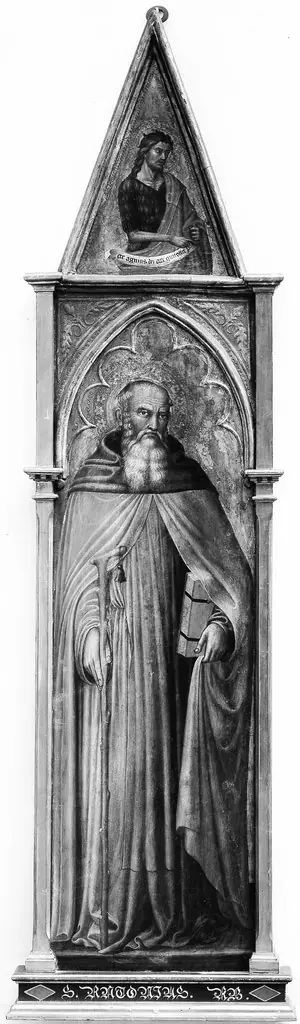 Saint Anthony Abbot (with Saint John the Baptist)
 Saint James the Greater (with the Virgin of the Annunciation)