Artwork
Madonna Casini
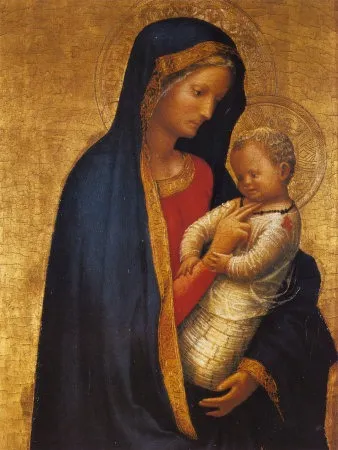
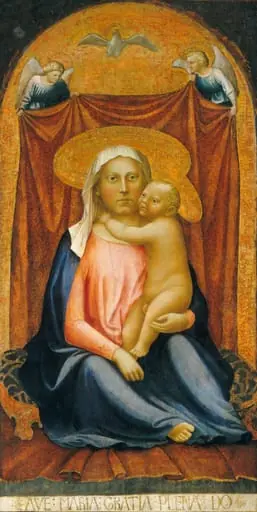
Madonna Casini is a tempera painting by the High Renaissance artist Masaccio. It is held in the collection of the Uffizi Gallery.
About this work
Overview
The painting is currently housed in the Uffizi Gallery in Florence, where it has been part of the collection since 1988.
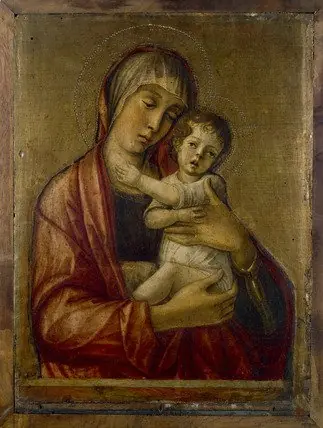
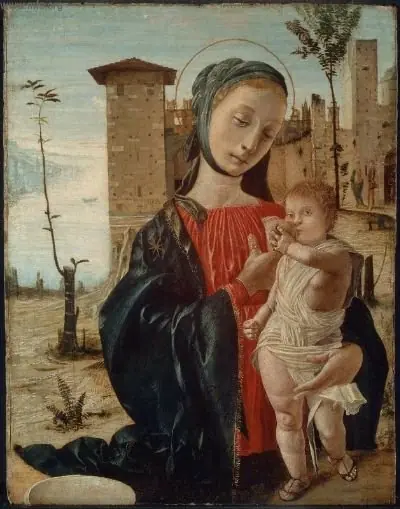
The Madonna Casini, also known as the Madonna del Solletico, is a small-scale religious painting by the Italian Renaissance artist Masaccio, dated to 1426 or 1426-1427. Executed in tempera and gold leaf on a wooden panel, the work measures 24.50 by 18.20 centimeters. It depicts the Virgin Mary holding the Christ Child against a flat gold background. The painting is currently housed in the Uffizi Gallery in Florence, where it has been part of the collection since 1988. The panel is an important example of early Renaissance private devotional art, notable for its innovative spatial construction and intimate, unconventional iconography that blends hieratic tradition with naturalistic observation.
Subject & Meaning
The painting presents an unconventional depiction of the Madonna and Child. The Virgin holds the swaddled Christ Child and raises two fingers of her right hand, a gesture of blessing that transforms into a familiar, playful action, perhaps tickling the child under his chin. This prompts the Christ Child to grasp his mother's wrist with his small hands. Despite the child's animated response, Mary's face remains solemn, adhering to traditional iconography that implied her foreknowledge of Christ's tragic fate. The Christ Child wears a red coral pendant, an ancient apotropaic amulet believed to ward off the evil eye. In Christian context, the red coral also symbolized the blood of Christ, referencing the Crucifixion and underscoring the dual human and divine nature of the child. The interlocking halos and the specific gestures emphasize both the intimate physical connection and the weight of future sacrifice.
Technique & Style
Masaccio applied tempera on a gold-ground panel, employing a palette of deep blue, vermilion red, creamy white, and extensive gold leaf. The surface shows fine craquelure and features smooth, precise brushwork that yields a polished, enamel-like finish. While the unmodulated gold background and flat, finely incised halos retain a medieval character, the construction of the figures is highly innovative. The group is rotated three-quarters and offset from the center, suggesting a sense of passage through space. No prior work features such a pronounced rotation of the shoulders, lending the composition an unprecedented naturalism. Natural light falls from the left, casting soft shadows and leaving parts of the faces in shadow, a departure from even, traditional illumination. The Virgin's left hand, which supports the weight of the child, is broadly sketched but highly expressive. Her dark blue mantle features a gold-trimmed edge with pseudo-Kufic characters that conform to the volume of her body, enhancing the sense of sculptural mass. The richness of detail, distinct from the essentiality of the Brancacci Chapel, suits the small format and invites close contemplation.
History & Provenance
The panel was almost certainly commissioned for private devotion by Antonio Casini, a Sienese cardinal, jurist, and canonist. His coat of arms, accompanied by a cardinal's hat, is painted on the reverse, suggesting the work dates to or shortly after his appointment as cardinal on May 26, 1426. Casini likely chose Masaccio after the painter Masolino departed for Hungary. The early history of the painting remains unknown. It was discovered in 1947 by Rodolfo Siviero, who recovered it among masterpieces looted by the Germans during World War II. Later, while on display in the Loeser collection at Palazzo Vecchio, the panel was stolen in 1971. Siviero recovered it again two years later, in 1973. The painting entered the Uffizi Gallery collection in 1988.
Context
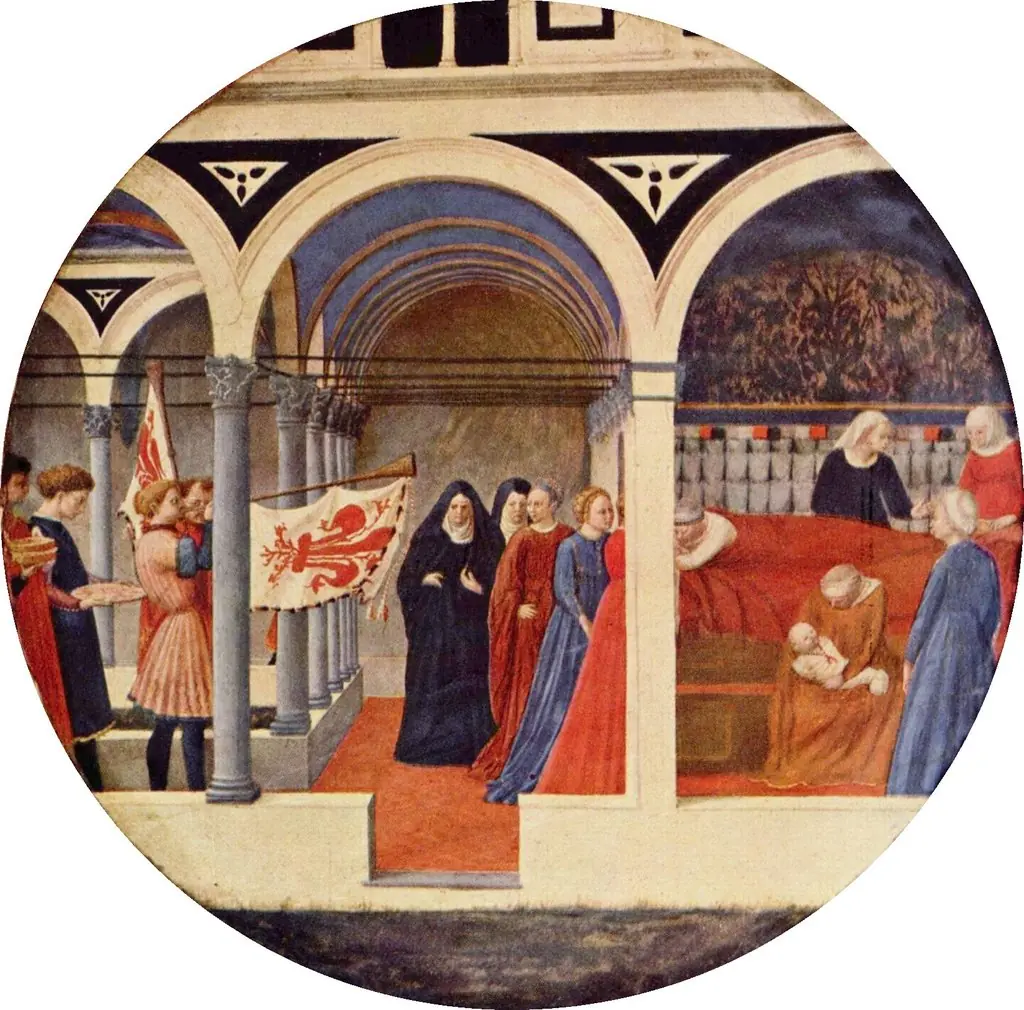
The attribution of the Madonna Casini to Masaccio was first proposed by Roberto Longhi in 1950, who connected the work stylistically to Masaccio's Desco da parto, another private commission featuring a similarly plump and lively child. While some scholars initially disputed this attribution, the publication of Franco Berti's Masaccio catalog in 1954 secured its widespread acceptance. The painting reflects the milieu of its patron, the cultured Cardinal Casini, who was connected to humanists and figures like Branda Castiglione. The unusual iconography, which had a precedent in Andrea Pisano's lunette on Giotto's campanile, was permissible in the context of private devotion, where conventional restraints were relaxed. The work stands as a key monument in Masaccio's oeuvre, bridging the medieval gold-ground tradition and the revolutionary spatial and volumetric developments of the early Italian Renaissance.
Artist & collection