Artwork
The Holy Kinship
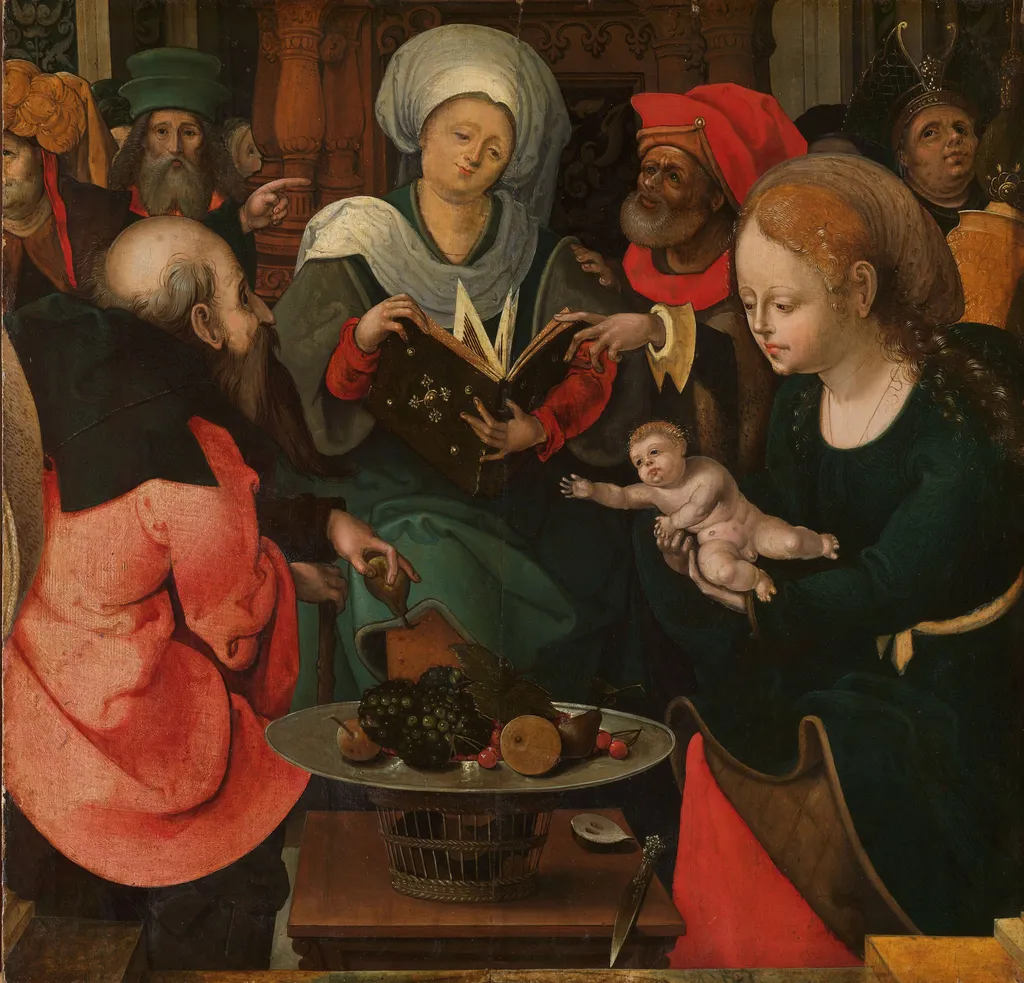
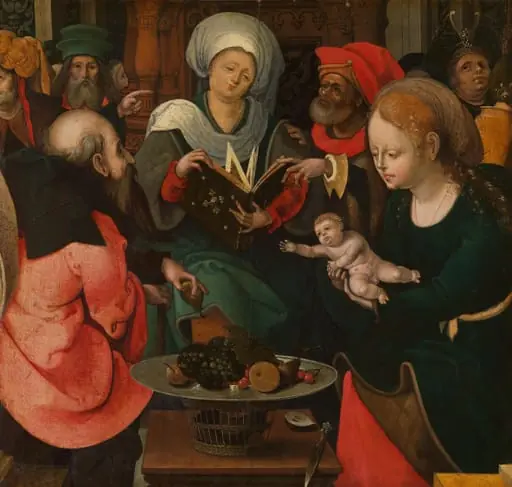
The Holy Kinship is an oil painting by the Northern Renaissance artist Master of the Lille Adoration. It dates from 1525 and is held in the collection of the Rijksmuseum. Created in 1525, this oil on panel presents a domestic gathering centered on a newborn infant.
About this work
Subject & Meaning
The piece functions not merely as a portrait group but as a didactic tool reinforcing the legitimacy and divine nature of the Holy Family's broader genealogy.
Executed in 1525 by the Master of the Lille Adoration, this oil painting on panel depicts the Holy Kinship, a complex religious subject illustrating the extended family of Jesus Christ. The work serves as a visual representation of the lineage connecting the Virgin Mary to her relatives, a theme particularly venerated in Northern European devotion during the early sixteenth century. By grouping these sacred figures within a single composition, the artist emphasizes the theological importance of Christ's human ancestry and the sanctity of familial bonds within the Christian narrative.
The piece functions not merely as a portrait group but as a didactic tool reinforcing the legitimacy and divine nature of the Holy Family's broader genealogy.
Technique & Style
The painting is executed in oil on wood panel, measuring 40.8 cm in height and 42 cm in width. The Master of the Lille Adoration employed fine brushwork to render the intimate grouping of the Holy Kinship with rich color modulation and delicate modeling of drapery, characteristic of early Netherlandish religious imagery. The work retains its original panel support without visible damage, and the surface layer remains largely intact with only minor craquelure observed across the composition.
Stylistically, the piece reflects the transition from late Gothic spatial arrangement to the emerging naturalism of the Renaissance, evident in the individualized facial expressions and the subtle spatial recession of the figures. The formal treatment emphasizes hieratic symmetry while allowing naturalistic interaction among the figures, creating a devotional focus through careful arrangement and material handling.
History & Provenance
The Holy Kinship was created in 1525 by the Master of the Lille Adoration, executed in oil paint on panel. The work was at one time owned by Adriaan van der Willigen Pz., a Dutch collector, before entering the holdings of the Rijksmuseum, where it is currently held. The painting's documented ownership chain therefore runs from its 1525 creation through Van der Willigen Pz. to its present institutional home.
No record of an original commission survives in the available sources, and no further intermediate owners between the artist and Van der Willigen Pz. are documented.
The Holy Kinship is held in the collection of the Rijksmuseum in Amsterdam. The painting, created by the Master of the Lille Adoration in 1525, was previously owned by Adriaan van der Willigen Pz. before entering the museum's holdings. The source material does not provide a specific inventory or accession number for the work, nor does it list any exhibition history or past displays.
Overview
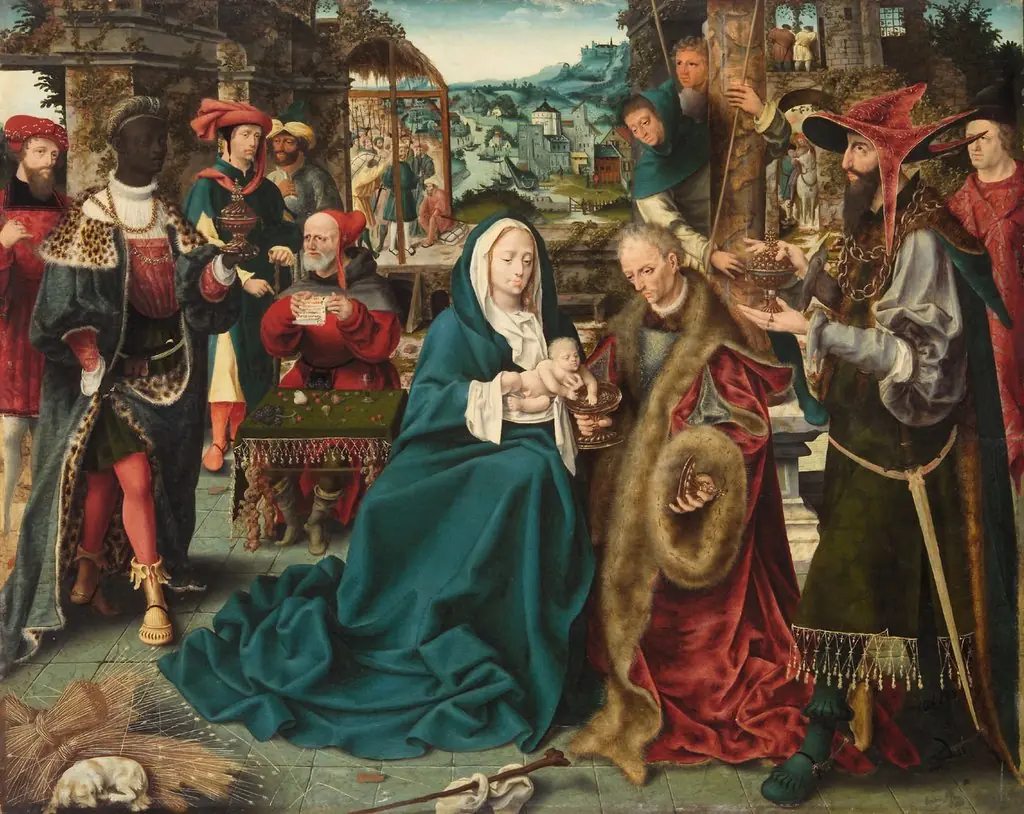
Created in 1525, this oil on panel presents a domestic gathering centered on a newborn infant. The figures, arranged around a low table laden with a bowl of fruit, are dressed in the modest, richly textured attire typical of early‑sixteenth‑century Antwerp. Muted earth tones dominate the palette, lending the scene a restrained, contemplative atmosphere.
Context
The painting reflects the religious climate of early 1500s Flanders, when devotional images for private contemplation were in demand. Its domestic setting and emphasis on lineage align with contemporary theological interests in the Holy Family’s genealogy, while the detailed rendering of material culture offers insight into Antwerp’s middle‑class aesthetics of the period.
Own this work as a print
Artist & collection
Artist
The Master of the Lille Adoration (active c. 1510–1530), was an Early Netherlandish painter active in Antwerp, as one of the Antwerp Mannerists. He was first suggested as a distinct but unknown figure in 1995 in an…