Artwork
Christ in the garden of olives at Gethsemane
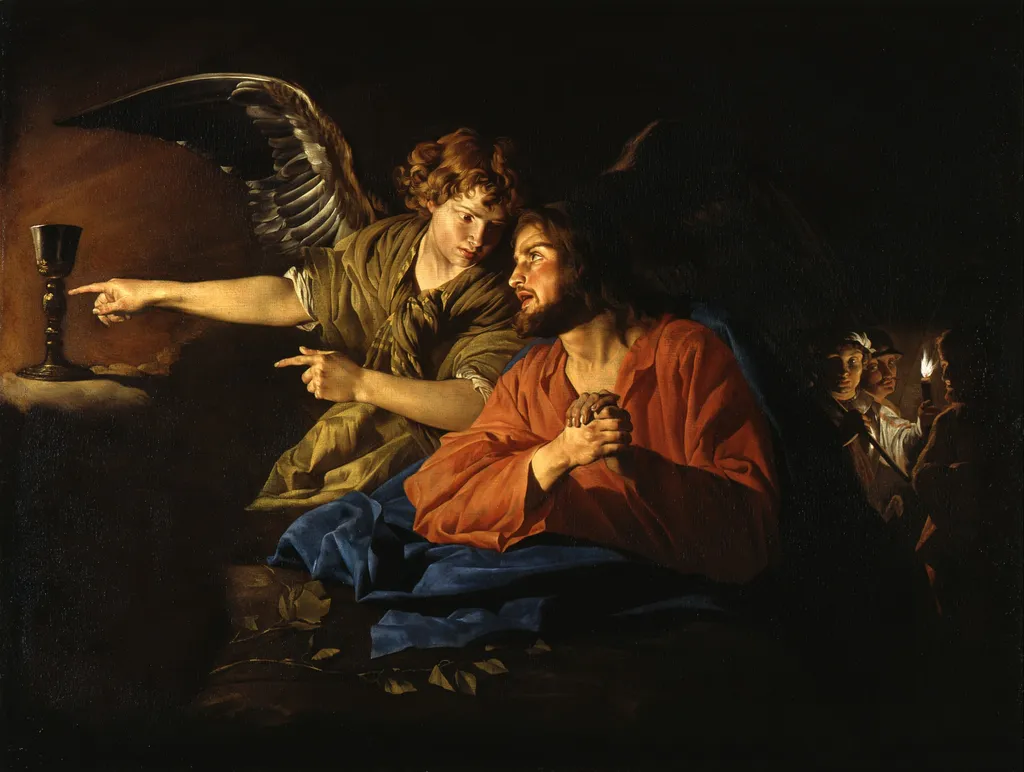
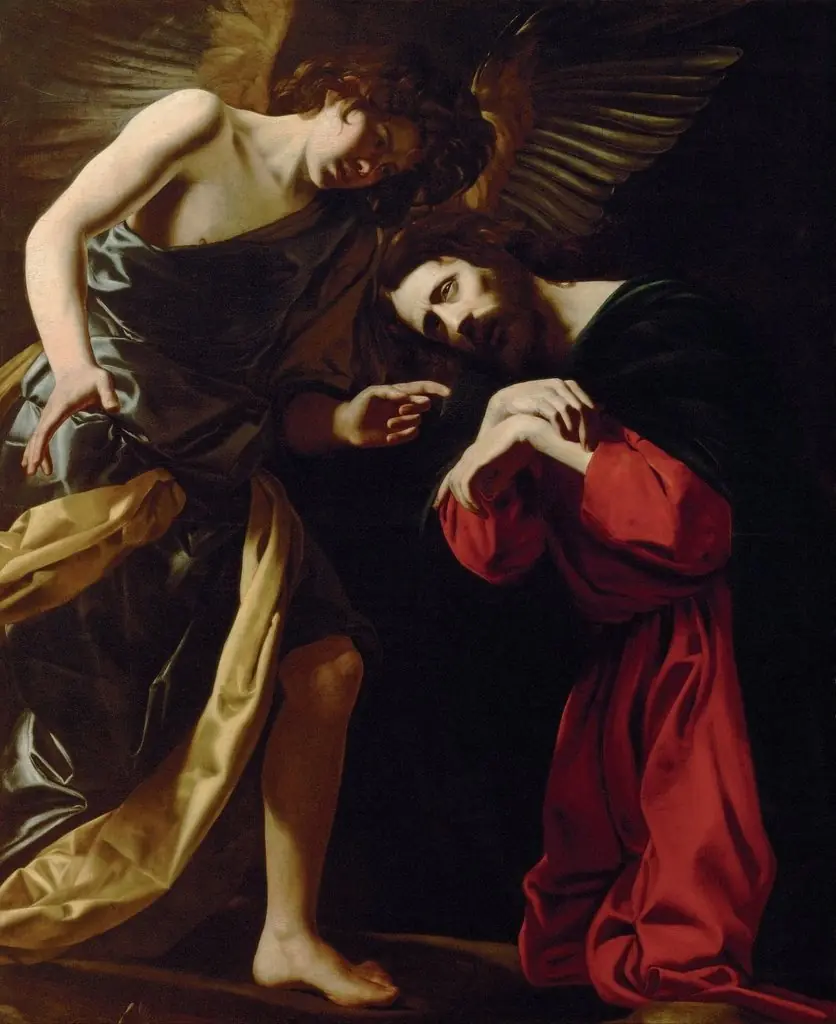
Christ in the garden of olives at Gethsemane is an oil painting by the Early Baroque Italian artist Matthias Stom. It dates from 1631 and is held in the collection of the Gemäldegalerie Berlin.
About this work
Subject & Meaning
Christ kneels at a stone table, hands clasped in fervent prayer, his head turned upward with mouth open in anguished supplication.
The painting depicts the Agony in the Garden, the moment after the Last Supper when Christ prays in the Garden of Gethsemane and an angel appears to strengthen him before his Passion. Stom radically condenses the traditional narrative, eliminating subsidiary scenes and the sleeping disciples to focus on the intimate confrontation between Christ and the angel. Christ kneels at a stone table, hands clasped in fervent prayer, his head turned upward with mouth open in anguished supplication. The angel leans over him from behind, both arms extended in a sweeping gesture that directs attention to a golden chalice glowing on a stone ledge at the left, the mystically illuminated vessel symbolizing the sacrificial blood Christ is about to accept. The scattered leaves or blossoms on the rocky ground below introduce a further symbolic layer, suggesting fallen innocence or the fragility of life in the face of impending suffering. At the far right, a small group of men emerges from darkness, one holding a flame that casts flickering light on their faces, identifying the approach of Judas and the soldiers who will arrest Christ. This background group, with its stylized, threatening features, anchors the spiritual crisis in historical narrative while underscoring the imminence of betrayal. The composition's spiritual center lies in the concentrated exchange between the two principal figures, their inclined heads and expressive faces forming the emotional nucleus of the work.
Technique & Style
Stom executed the painting in oil on canvas, employing a technique of strong chiaroscuro that models forms through dramatic contrasts of light and shadow. Light enters from the left, striking the faces, hands, and garments of the central figures against a near-black background, isolating them in a shallow, compressed space. The brushwork is smooth and polished, with careful attention to the texture of drapery and the delicate rendering of the angel's feathers. The palette is dominated by deep browns and blacks, punctuated by the ... Christ's vibrant orange-red cloak over deep blue fabric and the angel's olive-green drapery. The composition draws the eye diagonally from the chalice through the pointing arm to the interaction of the two main figures, while the angel's wings span almost the entire width of the picture, creating a formal and spiritual center. The half-length format and the reduction of the narrative to essential figures reflect Stom's dependence on Caravaggio's example, filtered through Neapolitan masters such as Jusepe de Ribera, yet the clear and intense approach to color and the poetic, painterly treatment of heavy garments with their rich folds reveal a highly individual sensibility. The supernatural light that bathes the main figures intensifies the drama of the nocturnal setting, while the plastic, expressive quality of the heads continues through their gestures and the volumetric folds of their clothing.
History & Provenance
The painting is dated 1631, placing it within Stom's Neapolitan period, which followed his arrival in Rome by the late 1620s and preceded his later activity in Sicily. Scholarly consensus, supported by the Gemäldegalerie's research, identifies the work as presumably part of a Passion sequence painted for S. Efrem Nuovo in Naples around 1631. This ecclesiastical commission aligns with Stom's documented production of large-scale religious works for devotional contexts in Southern Italy. The painting's provenance before its acquisition by the Gemäldegalerie is not detailed in the available sources, though works by Stom circulated widely among religious confraternities and private patrons in Naples, Messina, and Palermo. The canvas is now held in the Gemäldegalerie, Berlin, where it is catalogued under the title Christ in the garden of olives at Gethsemane. Its accession number and precise acquisition date are not specified in the provided documentation, though the museum's collection database serves as the authoritative source for its current holding. The painting has been featured in museum guides and digital exhibitions, including representation on Google Arts & Culture, reflecting its status as a significant work within the Gemäldegalerie's holdings of Caravaggist painting.
Context
Matthias Stom, born in Amersfoort around 1600 and active until approximately 1652, stands as one of the most distinctive Northern followers of Caravaggio. His training remains obscure, though his work demonstrates clear awareness of the Utrecht Caravaggisti, particularly Gerrit van Honthorst, whom scholarship now acknowledges him to have surpassed in importance. From about 1630 until his death, Stom worked exclusively in Rome, Naples, and Sicily, producing works that adapted Caravaggesque naturalism to local devotional requirements. The Berlin painting emerges from a critical period in Stom's career, when he had fully absorbed the lessons of Caravaggio and Neapolitan masters and was producing his most ambitious compositions. Critical reception of Stom has shifted significantly in recent decades, as detailed research into his work has elevated his standing among scholars. Previously overshadowed by better-documented contemporaries, he is now recognized as one of the most interesting exponents of Dutch painting influenced by Caravaggio, his importance extending beyond that of his Utrecht teacher. The Gemäldegalerie canvas exemplifies this reassessment, demonstrating how Stom combined Caravaggio's poignantly realistic figure-style with a personal clarity and intensity of color that distinguishes him from mere imitation. Within the broader context of seventeenth-century European art, the painting occupies a significant position in the transmission of Caravaggesque principles northward and their adaptation in Protestant as well as Catholic contexts, despite Stom's own exclusively Southern Italian late career.
Legacy
Stom's works circulated widely in Southern Italy during his lifetime and exerted a lasting influence on Sicilian painting of the seventeenth century, establishing a legacy that extended beyond his immediate circle to shape regional artistic development. The Berlin canvas, as a major product of his Neapolitan period, contributes to this narrative of dissemination, representing the point at which Northern European training met Italian Baroque innovation to produce a distinctive hybrid style. The painting's afterlife in the modern era reflects broader patterns in the reception of Caravaggist art, with scholarly attention to Stom intensifying only in recent decades as art historians have reevaluated the so-called minor followers of Caravaggio. Its inclusion in the Gemäldegalerie's collection and its presence on digital platforms such as Google Arts & Culture ensure continued visibility, while its reproduction and study contribute to ongoing debates about the nature of artistic influence, the mobility of painters in the seventeenth century, and the global Baroque as a category of analysis. The work remains a touchstone for understanding how Caravaggio's radical naturalism was transformed, transmitted, and adapted by Northern painters working in Italian contexts, and how those adaptations in turn influenced local traditions of religious art in Naples and Sicily across the seventeenth century.
Own this work as a print
Artist & collection
Artist
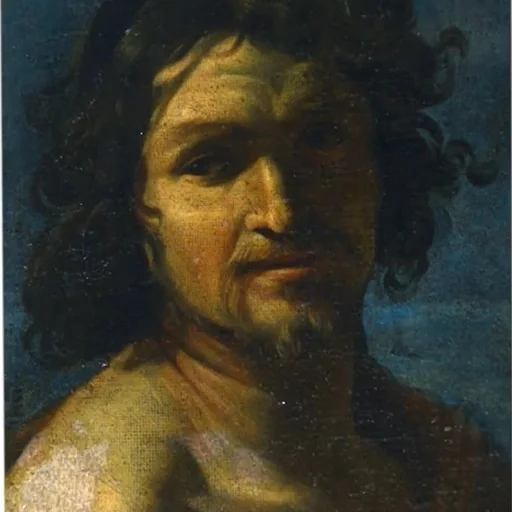
Matthias Stom or Matthias Stomer (c. 1600 – after 1652) was a Dutch, or possibly Flemish, painter who is only known for the works he produced during his residence in Italy. He was influenced by the work of non-Italian…