Artwork
Women's Bath
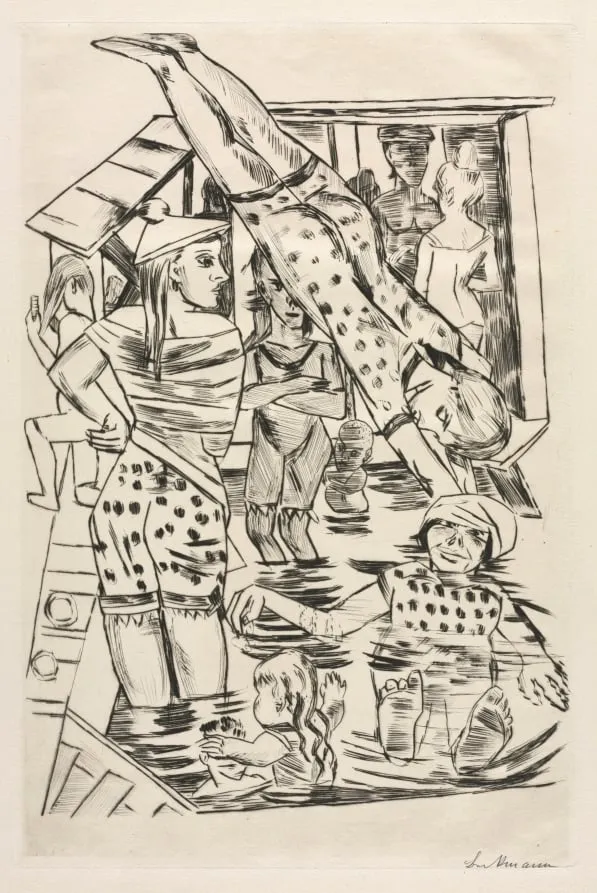
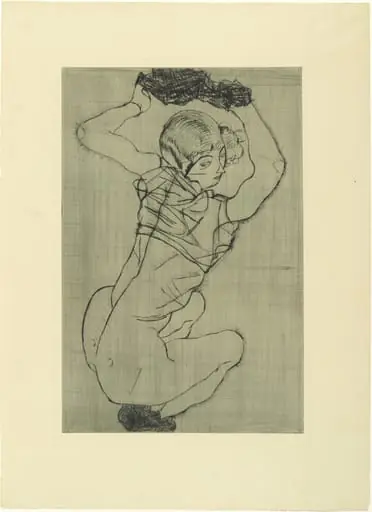
Women's Bath is a print by Max Beckmann. It dates from 1922 and is held in the collection of the Cleveland Museum of Art.
- Accession no.
- 1959.293
- Credit line
- Anonymous gift in memory of Paul O. Cartun
About this work
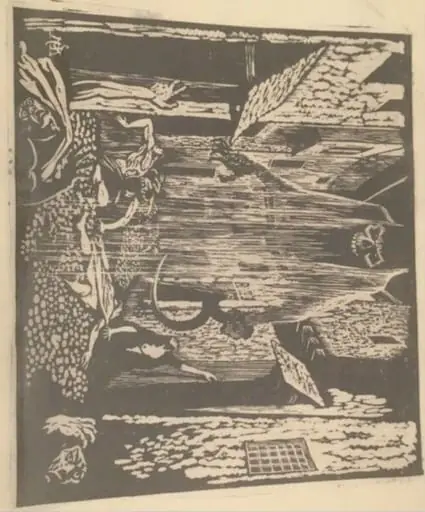
You see a crowded women’s bathhouse with bodies packed close. One woman stretches to dive from above. The space feels flat and tense, like a stage.
This isn’t about romance. It shows people stuck together in a city’s daily grind. Beckmann painted it after World War I, when life felt heavy and strange.
Look up another work by Max Beckmann (German, 1884–1950).
Overview
Max Beckmann’s print 'Women's Bath' captures a crowded public bathhouse in Berlin, rendered with compressed perspective and angular forms.
Max Beckmann’s print 'Women's Bath' captures a crowded public bathhouse in Berlin, rendered with compressed perspective and angular forms. Rather than idealizing the scene, Beckmann presents it as a tense, claustrophobic space where bodies press against one another. The composition avoids sensuality, instead emphasizing the physical and psychological weight of urban coexistence in the postwar era.
Subject & Meaning
The scene depicts women in various states of undress and motion, but not as objects of desire. One figure leaps from above, her gesture unnaturally elongated, suggesting a surreal disruption. The bathhouse becomes a metaphor for societal strain, individuals trapped in close quarters, performing routines under pressure. Beckmann transforms a mundane setting into a stage for human isolation within collective life.
Technique & Style
Executed in drypoint and etching, the print uses sharp, incised lines to define rigid, overlapping forms. Space is flattened and distorted, with no clear horizon or depth, enhancing the sense of confinement. Figures are rendered with angular contours and exaggerated postures, aligning with Beckmann’s postwar expressionist style, emotional intensity conveyed through structural distortion rather than naturalism.
History & Provenance
Created in 1921, the print emerged after Beckmann’s service in World War I and a subsequent psychological collapse in 1915. His return to art involved a shift toward printmaking, which allowed for greater control and introspection. 'Women's Bath' belongs to a series of works reflecting his preoccupation with human vulnerability and the fractured social fabric of Weimar Germany.
Context
In early 1920s Berlin, public baths were common gathering spaces for working-class women, offering rare moments of privacy. Beckmann’s depiction diverges from romanticized portrayals, instead highlighting the awkwardness and tension of shared intimacy. The work reflects broader cultural anxieties, urban overcrowding, gender roles, and the lingering trauma of war, rendered through a distinctly modernist lens.
Legacy
The print contributed to Beckmann’s reputation as a chronicler of psychological and social dislocation in interwar Europe. Its unflinching portrayal of everyday life influenced later artists exploring alienation and institutional spaces. Though not widely exhibited during his lifetime, 'Women's Bath' remains a key example of how printmaking could convey complex emotional landscapes with minimal means.
Artist & collection
Artist
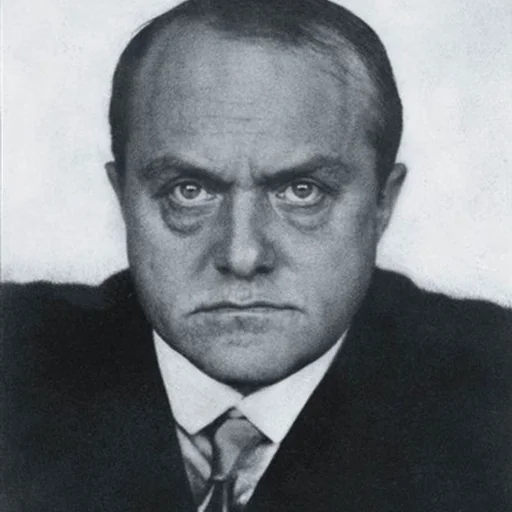
Max Carl Friedrich Beckmann (February 12, 1884 – December 27, 1950) was a German painter, draftsman, printmaker, sculptor, and writer.