Artwork
Green River Cliffs, Wyoming
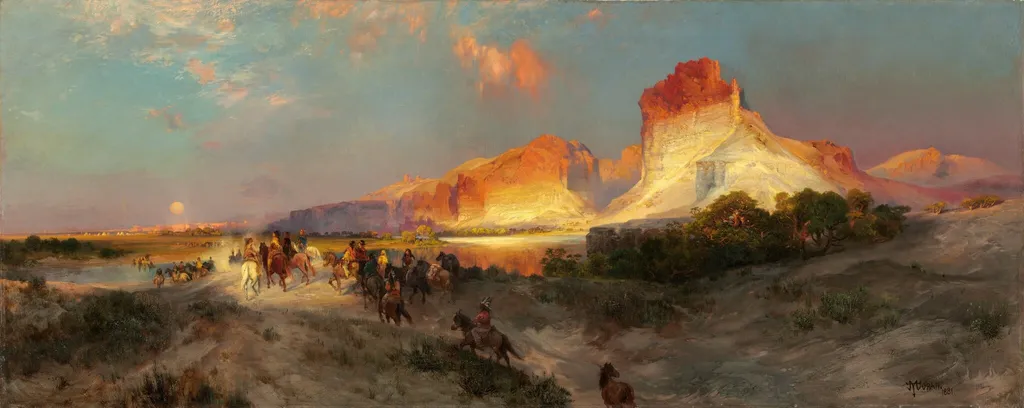
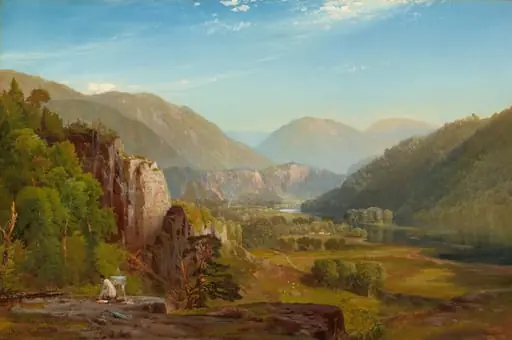
Green River Cliffs, Wyoming is an oil painting by the Hudson River School artist Thomas Moran. It dates from 1881 and is held in the collection of the National Gallery of Art.
- Inscription
- Inscribed:lower right, the letters T, Y (for Yellowstone), and M in monogram: TYMORAN. / 1881.
About this work
Technique & Style
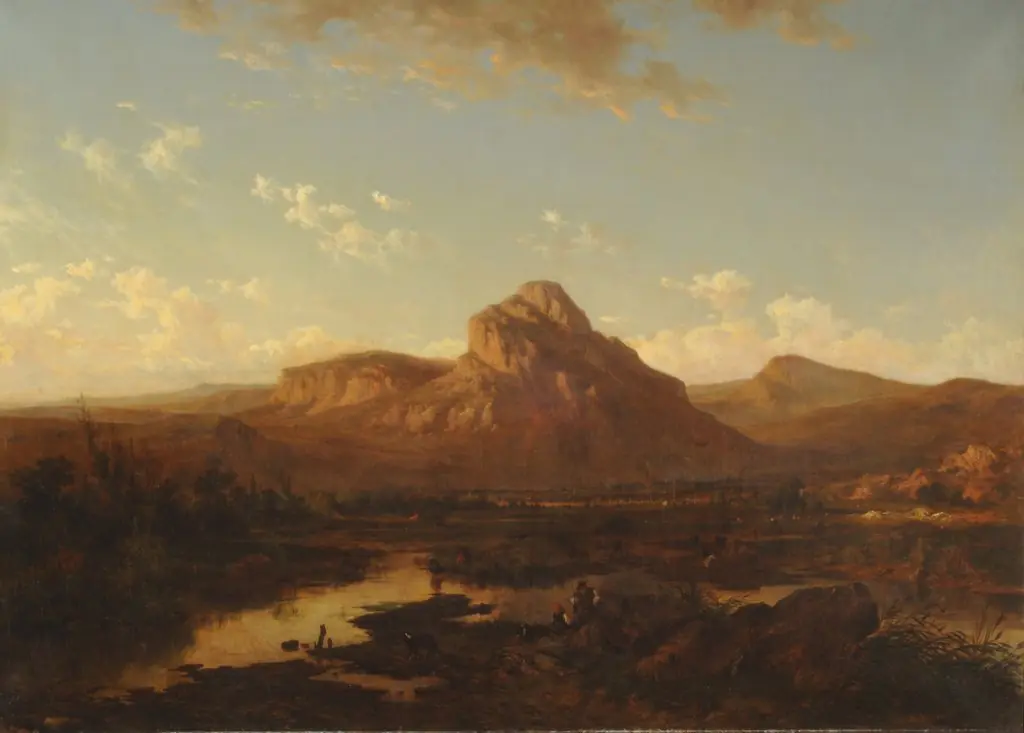
The horizontal format emphasizes the vastness of the Green River valley, with meticulous attention to the striated rock formations and distant peaks.
Executed in 1881, Thomas Moran’s oil on canvas employs layered, translucent glazes to render the stratified cliffs and atmospheric recession, a method characteristic of his mature style. The horizontal format emphasizes the vastness of the Green River valley, with meticulous attention to the striated rock formations and distant peaks. The handling balances broad, atmospheric washes with fine detailing in the foreground vegetation, while the overall tonality favors warm ochers and muted greens under a luminous sky.
The canvas support measures 63.5 × 157.5 cm, allowing for an expansive panoramic composition that underscores Moran’s Romantic landscape tradition.
History & Provenance
Thomas Moran created the oil-on-canvas landscape Green River Cliffs, Wyoming in 1881. The work's early ownership is recorded in a 1994 sale catalogue and Thomas Moran Papers, which identify Mr. Clapp or Dr. Williams of Chicago as initial owners, followed by the Julien Levy Gallery in New York. Frank Glenn of Kansas City subsequently owned the piece before Frederick W. Allsopp of Little Rock purchased it.
Allsopp gifted the painting to the Museum of Fine Arts, Little Rock (now the Arkansas Arts Center) in 1937. The institution de-accessioned the work in 1983, selling it through Ira Spanierman Gallery to William I. Koch. After a Christie's auction in New York on November 30, 1994, the painting entered the collection of Vern Milligan of Denver.
Milligan and his children donated the work to the National Gallery of Art in Washington, D.C., in 2011.
Green River Cliffs, Wyoming is held by the National Gallery of Art in Washington, D.C. It entered the NGA in 2011 as a gift from Vern Milligan, Denver, and his two children. Earlier, the painting had been on loan to the NGA from September 1986 to August 1992, lent by the Spring Creek Art Foundation, established by Charles Koch. Prior to that loan, the work had been de-accessioned in 1983 by the Arkansas Arts Center (formerly the Museum of Fine Arts, Little Rock), which had received it in 1937 as a gift from Frederick W. Allsopp of Little Rock; Allsopp had purchased it from Frank Glenn of Kansas City, Missouri.
The painting was subsequently sold through Ira Spanierman in New York, acquired by William I. Koch, and offered at Christie, Manson & Woods in New York on 30 November 1994 (lot 40), before passing to Vern Milligan. Earlier owners noted in the 1994 sale catalogue and the Thomas Moran Papers include Mr. Clapp or Dr. Williams of Chicago, and the Julien Levy Gallery, New York.
Legacy
After passing through a series of private collectors, including Mr. Clapp, Dr. Williams, the Julien Levy Gallery, Frank Glenn, Frederick W. Allsopp, and later William I. Koch and Vern Milligan, the painting entered the National Gallery of Art in Washington, D.C. as a 2011 gift from Milligan. Prior to that, it was on loan to the NGA from September 1986 to August 1992 through the Spring Creek Art Foundation established by Charles Koch. This trajectory of notable ownership, museum loan, and eventual acquisition by a major national institution underscores the work’s enduring reputation and legacy as a significant example of Thomas Moran’s landscape oeuvre.
Overview
Green River Cliffs, Wyoming is an oil on canvas painting that captures a serene natural vista. The composition features a river gently flowing through a dramatic landscape, framed by towering, rugged cliffs and distant mountains. The artist presents a deep and expansive view, inviting contemplation of a tranquil scene within the American West.
Subject & Meaning
The artwork portrays a specific geological formation in Wyoming, emphasizing the grandeur and stillness of the natural world. A calm river meanders through a valley, flanked by imposing, rocky cliffs that recede into the distance, conveying significant spatial depth. The overall impression is one of profound tranquility, underscored by the artist's careful depiction of the landscape's inherent peacefulness.
Artist & collection
Artist
Thomas Moran (February 12, 1837 – August 25, 1926) was an American painter and printmaker of the Hudson River School in New York whose work often featured the Rocky Mountains.