Artwork
The Eye Deceived
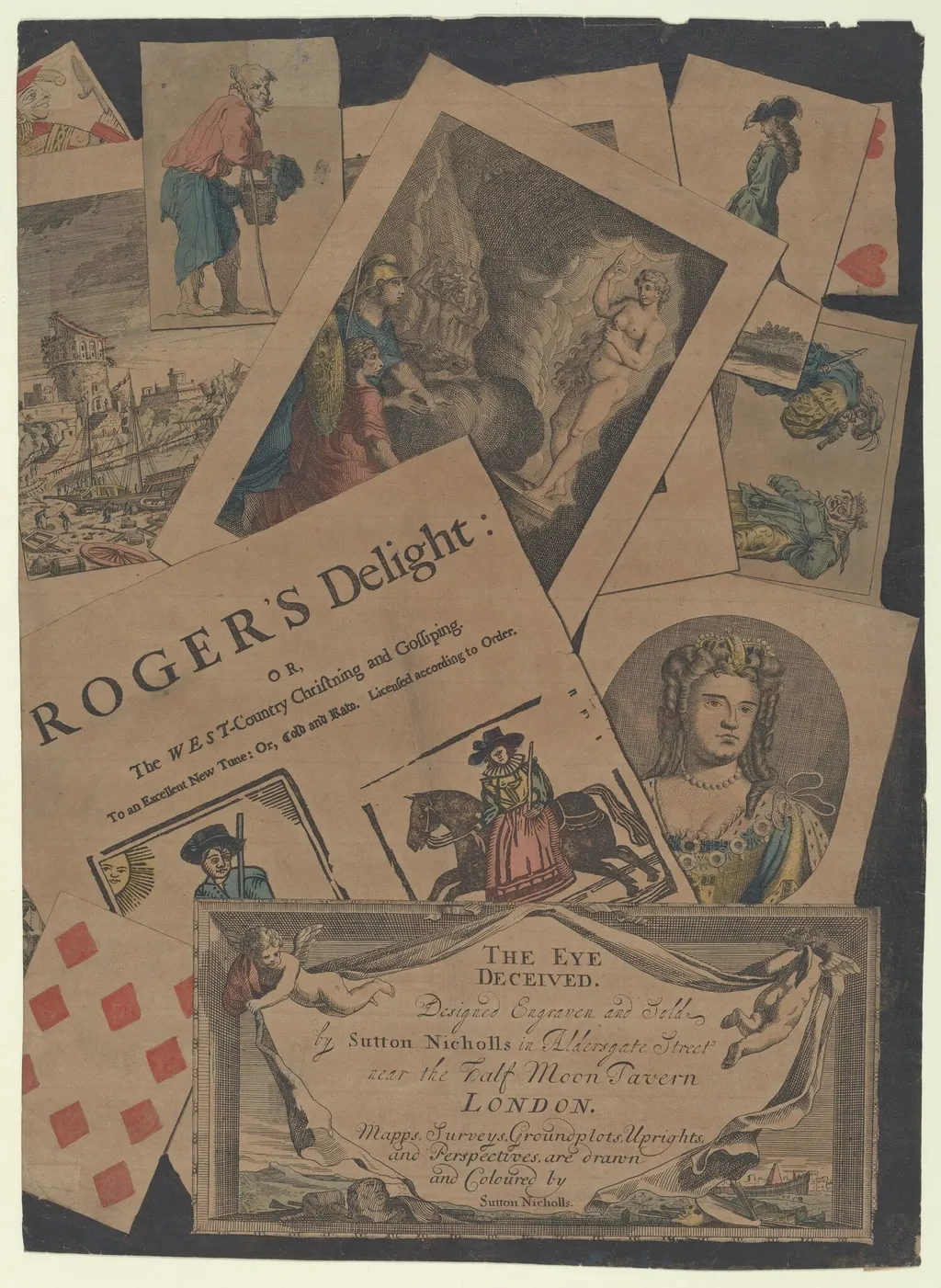
The Eye Deceived is an ink print by the Baroque artist Sutton Nicholls. It dates from 1705 and is held in the collection of the National Gallery of Art.
- Inscription
- Inscribed:center: ROGER'S Delight: / or / The WEST Country Christning and Gossiping. / To an Excellent New Tune; or, Cold and Raw Licensed according to order; THE EYE / DECEIVED ' Designed Engraven and sold / by Sutton Niccholls in Aldersgate Street / near th ehalf moon Tavern / LONDON. / Mapps. Surveys. Groundplots. Uprights / and Perspectives are drawn / and Coloured by / Sutton Nicholls
About this work
Overview
Created around 1705 by Sutton Nicholls, this print combines etching and engraving on laid paper, enhanced with hand coloring.
Created around 1705 by Sutton Nicholls, this print combines etching and engraving on laid paper, enhanced with hand coloring. It presents a composite image formed by assembling smaller printed vignettes onto a single sheet. The composition includes disparate scenes, equestrian figures, a floating female face, a shipwreck, and a nude form amid clouds, arranged to challenge visual perception.
The work bears inscriptions referencing 'Roger’s Delight' and 'The Eye Deceived,' along with a London publisher’s address, suggesting commercial distribution as a visual puzzle.
Subject & Meaning
The imagery juxtaposes realistic fragments with impossible spatial relationships, inviting viewers to question the reliability of sight. A man on horseback holds a staff that appears to bend unnaturally; celestial and terrestrial elements coexist without logical grounding. These contradictions reflect contemporary fascination with optical illusions and the limits of perception.
The title and subtitle frame the work as a playful deception, aligning it with popular entertainments of the time that tested the viewer’s ability to discern truth from trickery.
Technique & Style
Nicholls employed fine-line etching and engraving to achieve crisp, detailed forms, typical of early 18th-century printmaking. Each scene was likely printed separately and then meticulously cut and pasted onto a larger sheet, followed by hand-applied color to enhance realism. The integration of disparate elements into a unified surface demonstrates technical precision and an understanding of collage as a compositional tool.
The use of laid paper and water-based pigments reflects standard materials of the period, prioritizing clarity and durability for repeated handling.
History & Provenance
The print was produced in London during a period of growing public interest in visual curiosities and mechanical illusions. Nicholls, known for publishing prints and broadsides, likely distributed this work through urban print shops as a novelty item. Its survival in limited numbers suggests it was not intended as fine art but as an ephemeral object of amusement.
The inclusion of a commercial address implies direct sales to consumers, possibly as part of a series of similar visual puzzles.
Context
In early 1700s England, optical toys, magic lantern shows, and printed illusions were popular among the urban middle class. This print aligns with a broader cultural trend of experimenting with perception, influenced by scientific inquiries into vision and optics. Similar works appeared in pamphlets and broadsheets, often marketed as intellectual pastimes.
The blending of mythological, maritime, and domestic imagery reflects the eclectic visual language of popular print culture, where entertainment and education overlapped.
Legacy
Though not widely studied in art historical canon, 'The Eye Deceived' exemplifies the intersection of print technology, popular entertainment, and perceptual inquiry in the early modern era. It anticipates later developments in visual trickery, from 19th-century stereoscopes to 20th-century Op Art. Its existence underscores how printmakers like Nicholls contributed to public engagement with visual science, transforming the act of looking into an active, questioning experience rather than passive observation.
Own this work as a print
Artist & collection


- Fairy Connoisseurs Inspecting Mr. Frederick Locker's Collection of Drawings
 Tom Blanchard in Hamlet. For the Bassoon. Lady Coventry's Minuet
 Des Pfarrers Tochter von Taubenhein (The Parson's Daughter from Taubenhain)
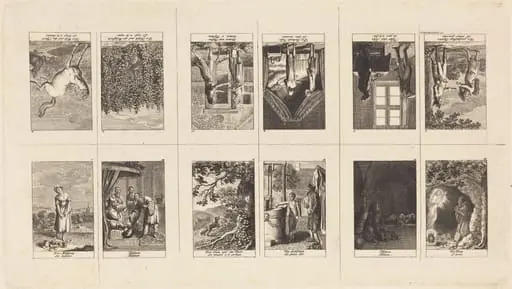 Illustrations to Fables & Tales by Gellert, Gleim, Hagedorn, Lichtwer and Pfeffel
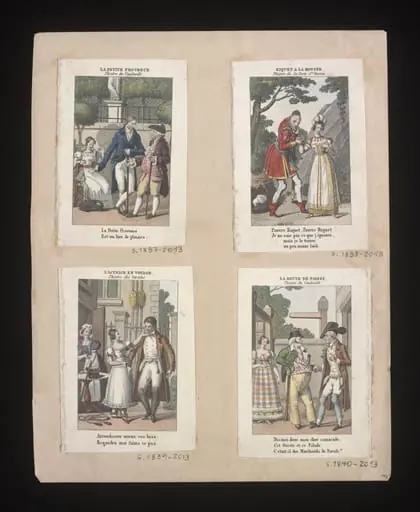 L'Actrice en Voyage, Théatre des Varietes
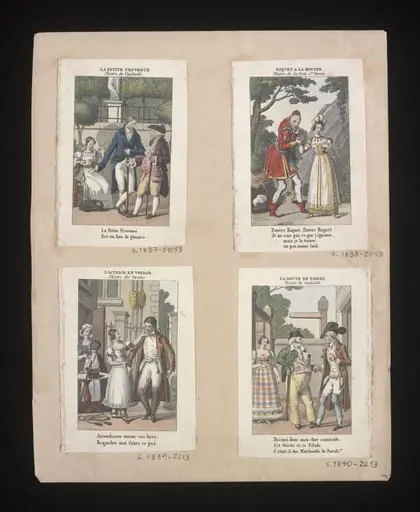 La Petite Provence, Théatre du Vaudeville,
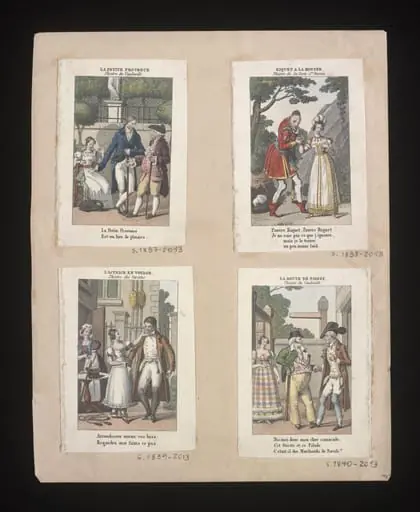 La Route de Poissy at Théatre du Vaudeville
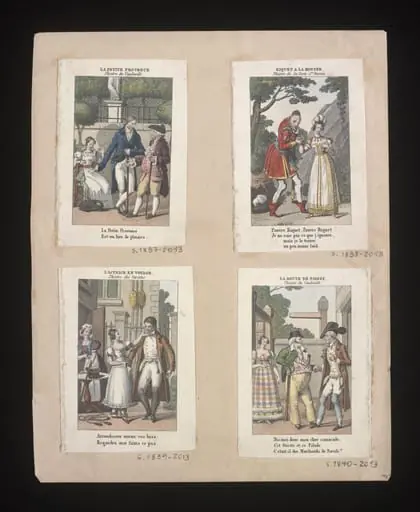 Riquet a la Houppe, Théatre de la Porte St Martin
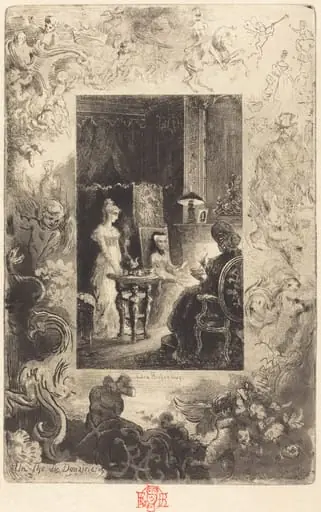 Un Thé de Douairières (The Dowagers' Tea Party)
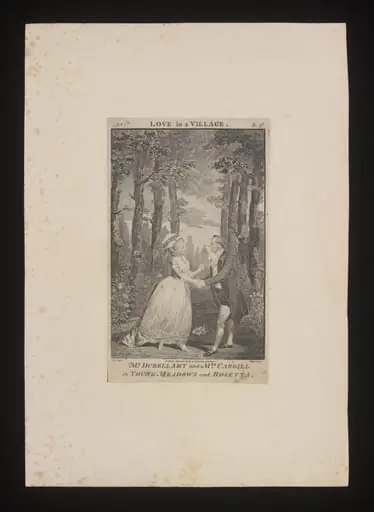 Love in a Village
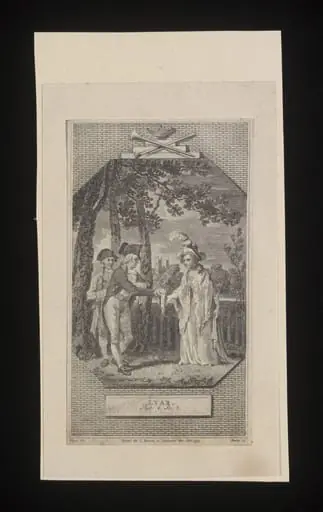 Lyar
Lyar H Beard Print Collection