Artwork
Resurrection of Lazarus
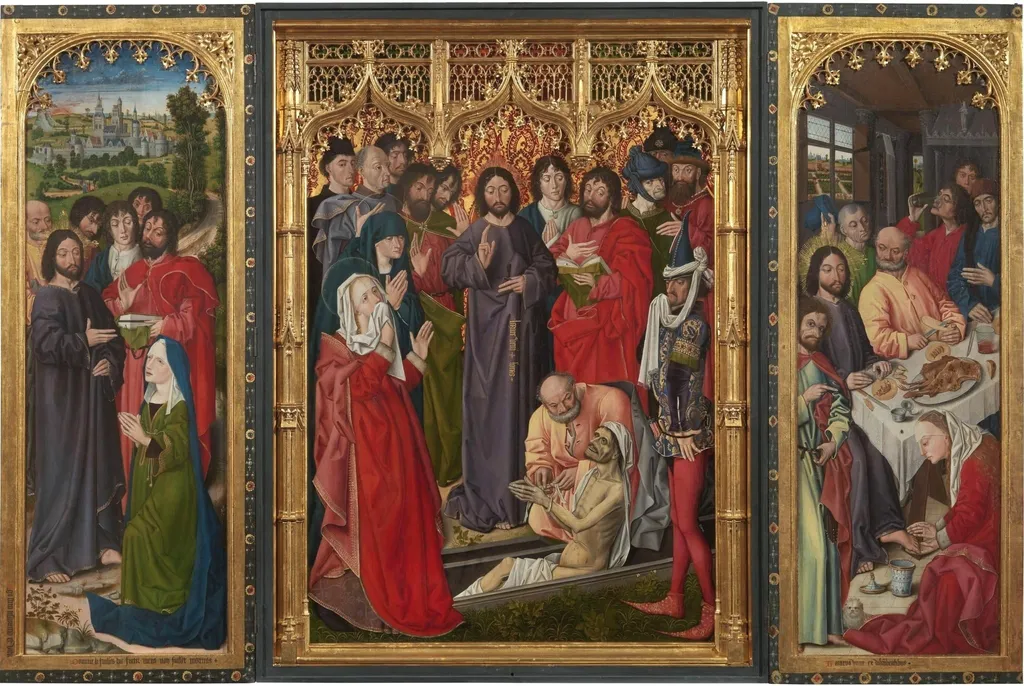
Resurrection of Lazarus is an oil painting by the Early Renaissance artist Nicolas Froment. It dates from 1461 and is held in the collection of the Uffizi Gallery.
About this work
Overview
It is Froment's earliest documented surviving work and one of the most important fifteenth-century paintings by a foreign artist in the Uffizi collection.
The Resurrection of Lazarus is a triptych altarpiece painted in 1461 by the French artist Nicolas Froment, active in Picardy and later Provence. Executed in oil on oak panel, it measures 175 by 200 cm according to museum records, though some sources cite dimensions of 134 by 350 cm. The work is currently held in the Uffizi Gallery, Florence, as inventory number 1065, where it underwent significant restoration in 2017. It is Froment's earliest documented surviving work and one of the most important fifteenth-century paintings by a foreign artist in the Uffizi collection. The triptych is signed and dated on the exterior: "Nicolaus Frumenti absolvit hoc opus XV HL. Junii MºCCCCºLXI."
Subject & Meaning
The triptych presents a continuous narrative drawn from the Gospel of John, unfolding across three panels. The left panel depicts Martha approaching Jesus to inform him of her brother Lazarus's death. The central panel shows the climactic miracle: Jesus, standing in a purple robe with raised right hand, commands Lazarus to rise from the stone tomb, while the skeletal figure emerges before numerous onlookers including the apostles, Mary, and Martha, one kneeling in red and another seated in peach. The right panel concludes the narrative with the feast in the house of Simon the Pharisee, where Mary anoints Jesus' feet, a scene that notably presents her as decorously dressed with head covering rather than conflated with Mary Magdalene. When closed, the exterior reveals the donor Francesco Coppini kneeling in prayer with two attendants before the Virgin and Child, his coat of arms displayed above. The iconography reflects traditional devotional structures while incorporating naturalistic detail, such as the fly on the banquet table, that transforms sacred narrative into immersive observation. The extensive gold leaf, deep reds, purples, greens, and blues, combined with varied gestures of prayer, pointing, and astonishment, create a complex emotional register appropriate to the miraculous subject.
Technique & Style
The triptych is executed in oil on oak panel, with the three panels set into a wooden support with fittings. Technical examination reveals a preparation of two primer layers: calcium carbonate followed by white lead. The oil-based binder permits refined layering and glazing characteristic of Netherlandish-influenced practice. Pigments identified include madder and rose madder for reds, copper resinate for greens, and indigo for delicate shading. Reflectography has disclosed largely freehand underdrawing with some compositional adjustments, indicating Froment's direct approach. The paint handling shows smooth, detailed modeling of faces and fabrics with soft shadows defining drapery and spatial depth. Light falls evenly across scenes, creating subtle tonal shifts. The original Flemish-style frame features gilded wooden Gothic tracery inspired by French cathedral arcades, with openwork and side motifs resembling jewels on a dark blue ground. The central panel's gilded fretwork was also restored in 2017. The figures display the characteristic angularity of International Gothic, with features pushed almost to caricature, while costumes, objects, and landscape details evoke the fairy-tale world of northern European courts. Fine craquelure patterns result from wood shrinkage and abundant binder in the paint film.
History & Provenance
The triptych was commissioned by Francesco Coppini, Bishop of Terni and papal legate to Pope Pius II, who traveled through Flanders, France, and England from 1459 to 1462 on diplomatic missions including efforts to collect Peter's pence and mediate the Wars of the Roses. Coppini presented the completed work to Cosimo de' Medici the Elder, who between 1461 and 1464 donated it to the Franciscan Observant convent of Bosco ai Frati in Mugello, today within the municipality of Scarperia e San Piero. The painting remained there until the Napoleonic suppressions of religious houses, entering the Uffizi in 1841. The exterior portraits of Coppini and his attendants, rendered with veristic naturalism, preserve the features of this ambitious prelate who fell from papal favor in 1463 for supporting the Yorkist cause, was stripped of his bishopric, and died a Benedictine monk in 1464. The triptych was exhibited in London in 1932, Florence in 1945, Bordeaux in 1952, and again in Florence in 1977. A dedicated exhibition, "Resurrezione di Lazzaro," was held at the Uffizi's Sala del Camino in 2017 following restoration by Lucia and Andrea Dori, supported by the Friends of the Uffizi Gallery. Earlier undocumented twentieth-century interventions had detached the panels from their frame, painted the structure black, and applied retouchings that obscured original colors and craquelure.
Context
Nicolas Froment, born circa 1435 in Picardy and active from at least 1465 in Provence in the service of King René d'Anjou, represents the diffusion of Flemish painting techniques into France and beyond. The triptych exemplifies the international circulation of artistic styles in the mid-fifteenth century, as a French painter working for an Italian prelate diplomat produced a work in the Flemish manner that would enter one of Florence's premier collections. The commission reflects the sustained Italian interest in Northern European art even during the Renaissance. Froment's subsequent reputation rests on a small corpus of surviving works, with The Burning Bush of 1475-76 for King René generally considered his most celebrated achievement. The Uffizi triptych has attracted scholarly attention from Bernard Berenson, who prefaced the 1945 exhibition catalogue, through to recent restoration science. Critical discussion has focused on Froment's distinctive combination of meticulous realism with near-caricatured figural types, and on the work's value as documentary evidence for the career of Francesco Coppini, whose portrait on the exterior constitutes an important early example of individualized donor imagery.
Legacy
The Resurrection of Lazarus occupies a significant position in art history as Froment's earliest dated work and a rare survival from his Picardy period before his Provencal association with King René. Its preservation in the Uffizi since 1841 has ensured its visibility as a key example of French International Gothic painting and of Flemish-influenced technique in fifteenth-century Europe. The 2017 restoration and exhibition, curated by Daniela Parenti with accompanying publication, brought renewed attention to the work's technical sophistication and narrative complexity. The triptych serves as important evidence for the patronage networks connecting Italian prelates, Flemish artistic traditions, and Florentine collecting practices in the mid-Quattrocento. Its donor portraits contribute to the history of realistic commemorative imagery, while the anoint_defaultsing scene offers a significant instance of iconographic clarification in the long tradition of conflating the various scriptural women named Mary. The work continues to be cited in scholarship on cross-cultural artistic exchange, Northern influence on Italian art, and the international Gothic style.
Own this work as a print
Artist & collection
Artist
Nicolas Froment (c. 1435 – c. 1486) was a French painter of the Early Renaissance. Froment is one of the most notable representatives of the Second School of Avignon (École d'Avignon), a group of artists at the court of…

- Drieluik met de kruisiging
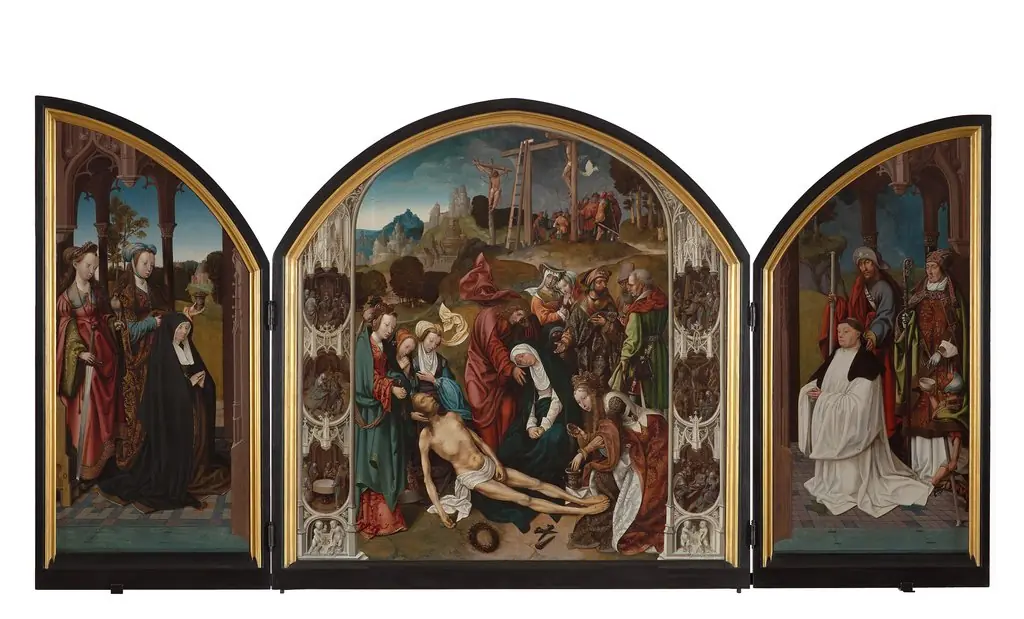 Ss Cecilia,Mary Magdalene with donatrix,lamentation flanked by other six Sorrows of Mary, Ss James Great,Martin of Tours an Augustine monk
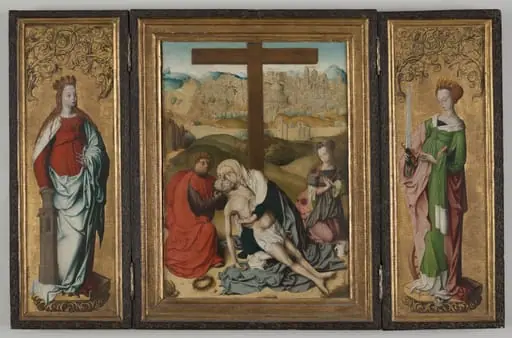 Triptych with The Lamentation of Christ (center), St. Barbara (left wing), St. Catherine of Alexandria (right wing), The Annunciation (reverse wings)
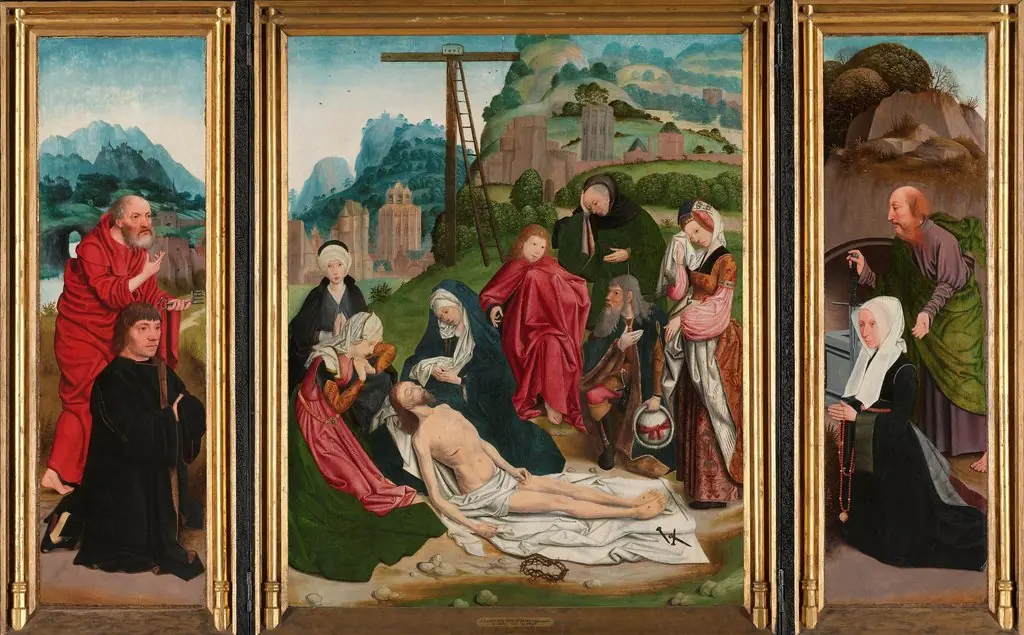 Triptych with the Lamentation (centre panel), the donor with St Peter (inner left wing), the donor’s wife with St Paul (inner right wing) and the donors’ coats of arms (outer wings)
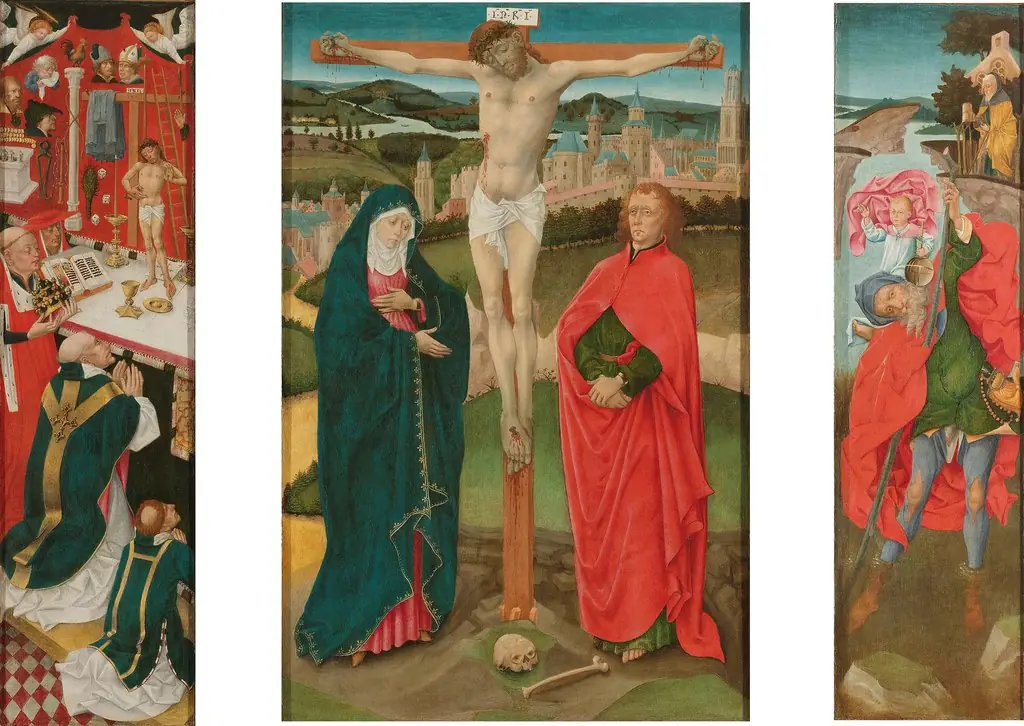 Triptych with the Crucifixion
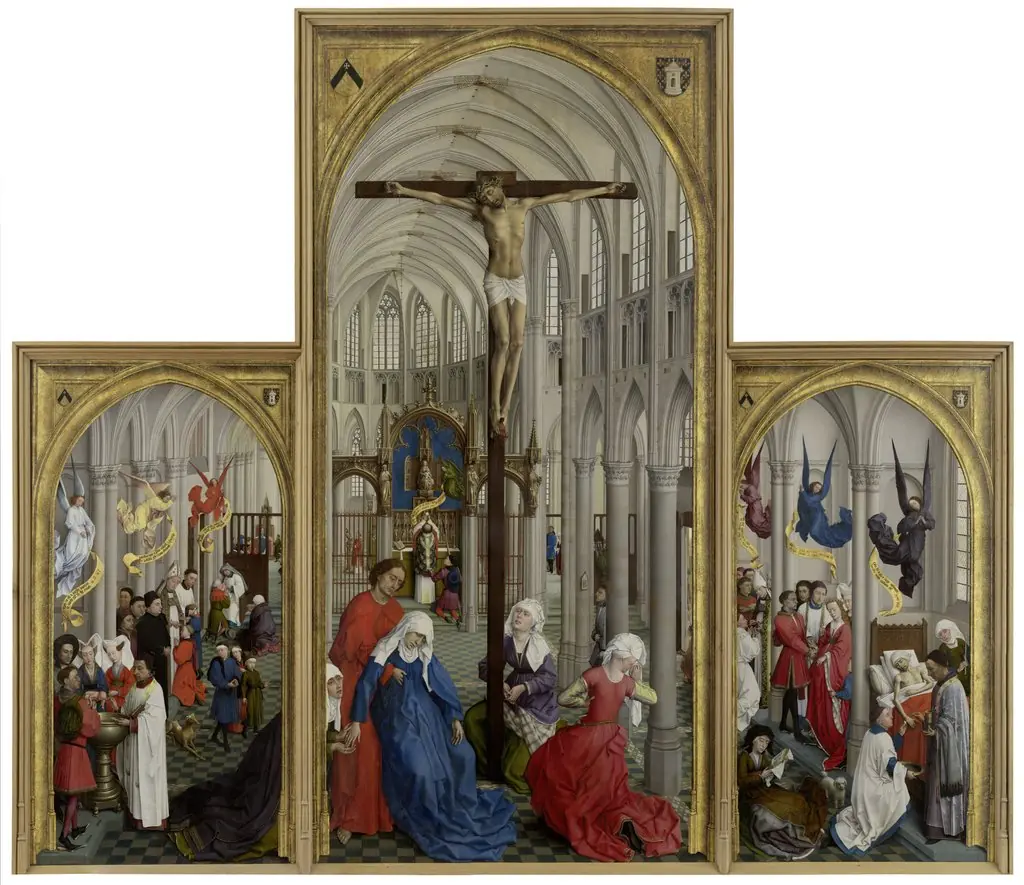 The Seven Sacraments
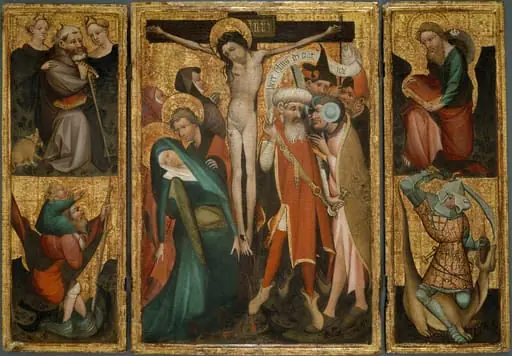 Triptych of the Crucifixion with Saints Anthony, Christopher, James and George
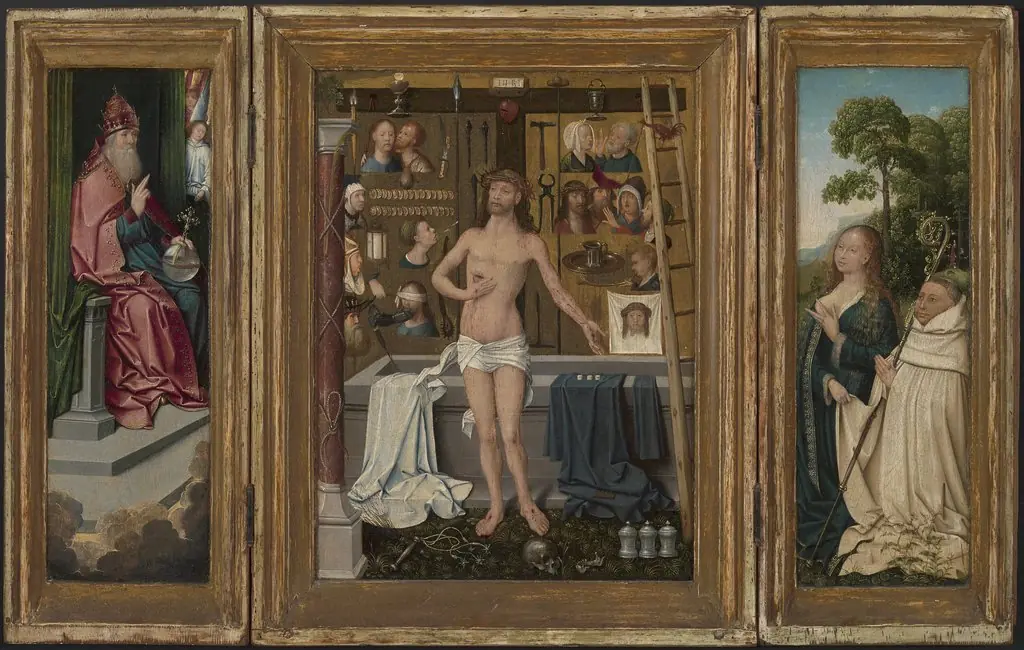 Triptych of Antonius Tsgrooten
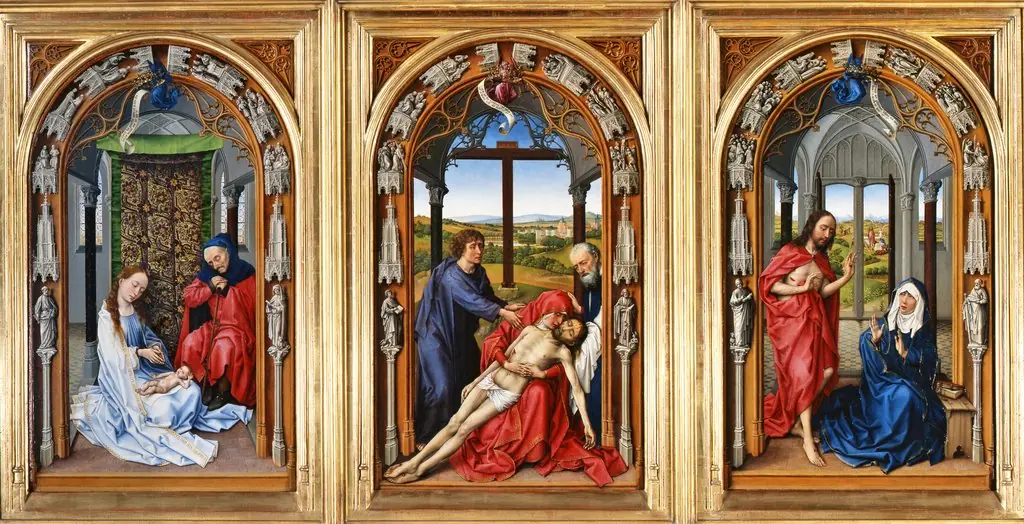 Miraflores Altarpiece
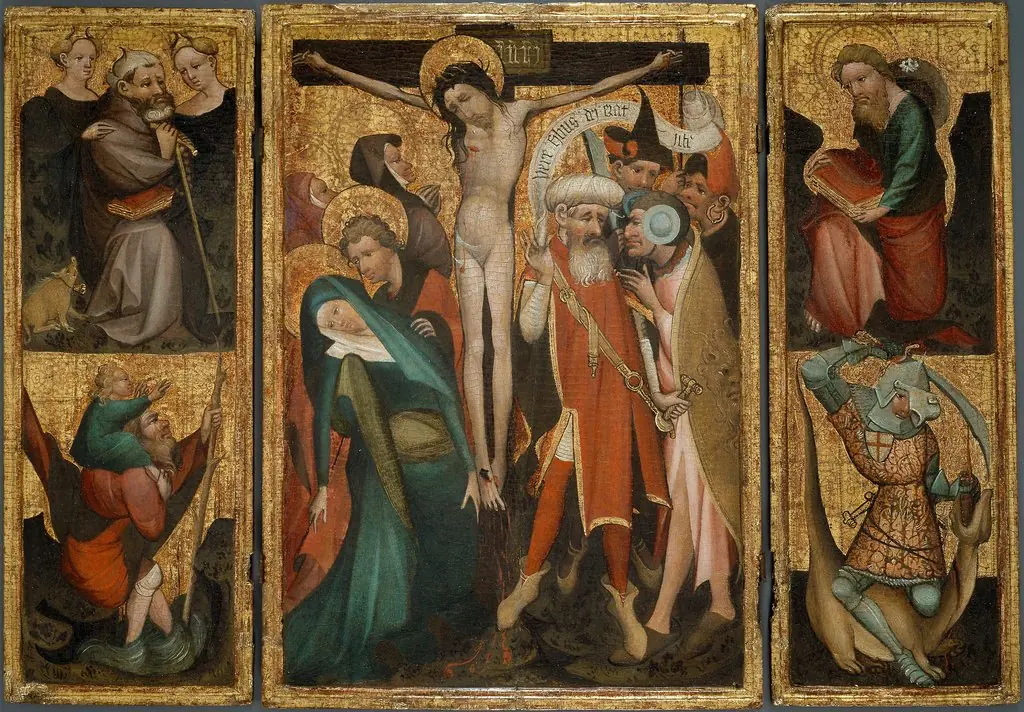 Triptych of the Crucifixion with Saints Anthony, Christopher, James and George
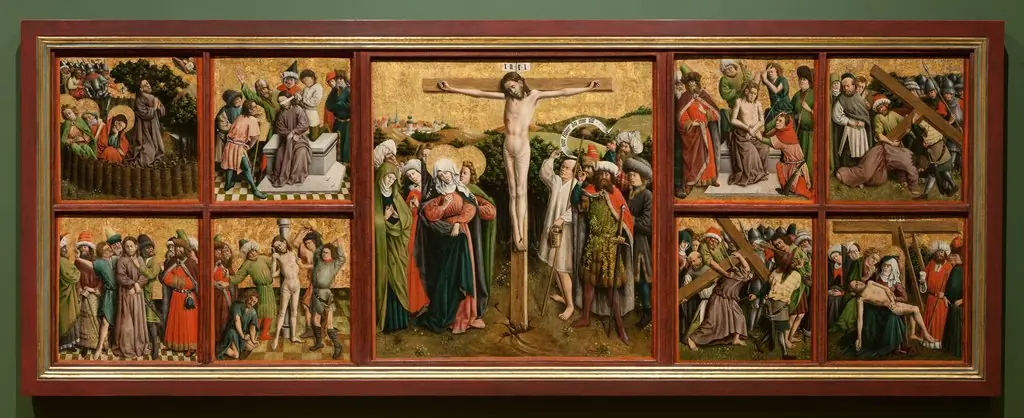 Altarpiece with The Passion of Christ
 Diptych with the Passion of Christ