Artwork
Miraflores Altarpiece
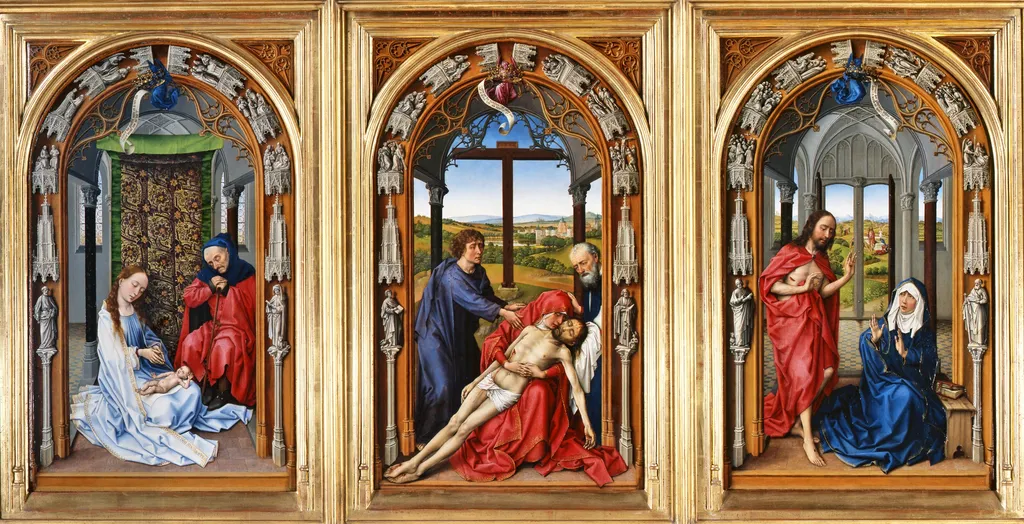
Miraflores Altarpiece is an oil painting by the Northern Renaissance artist Rogier van der Weyden. It dates from 1443 and is held in the collection of the Gemäldegalerie Berlin.
About this work
The work is one of the earliest examples of van der Weyden’s careful detail and rich color.
This altarpiece shows scenes from Christian tradition in oil paint. Rogier van der Weyden painted it for a monastery around the early 1440s. It was moved to Berlin in 1850.
The work is one of the earliest examples of van der Weyden’s careful detail and rich color. It was made for private prayer, not big public display. Only three of the original panels survive today.
Check out Rogier van der Weyden next.
Subject & Meaning
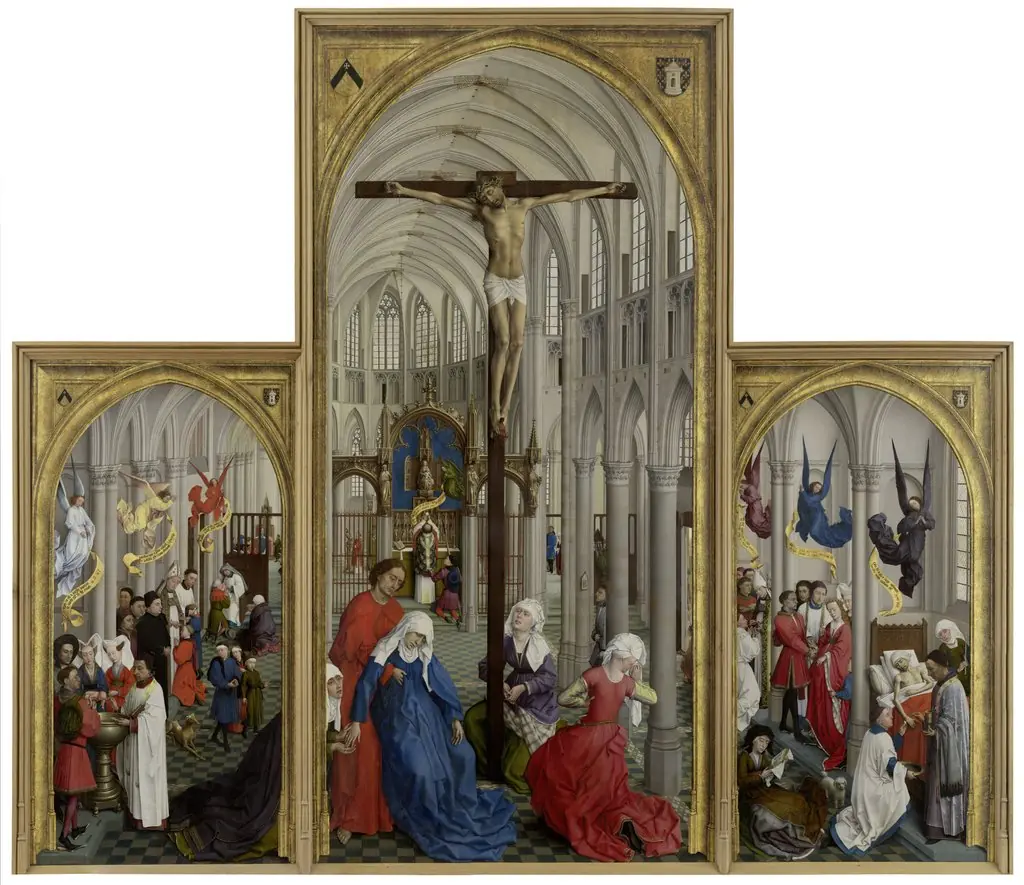
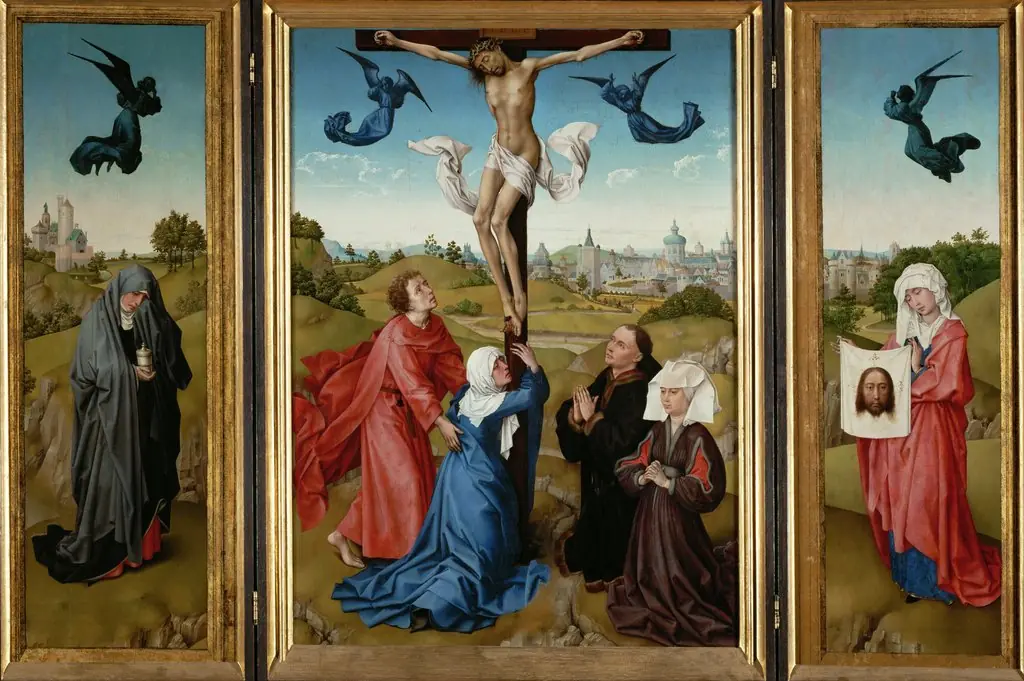
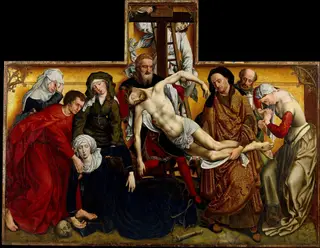
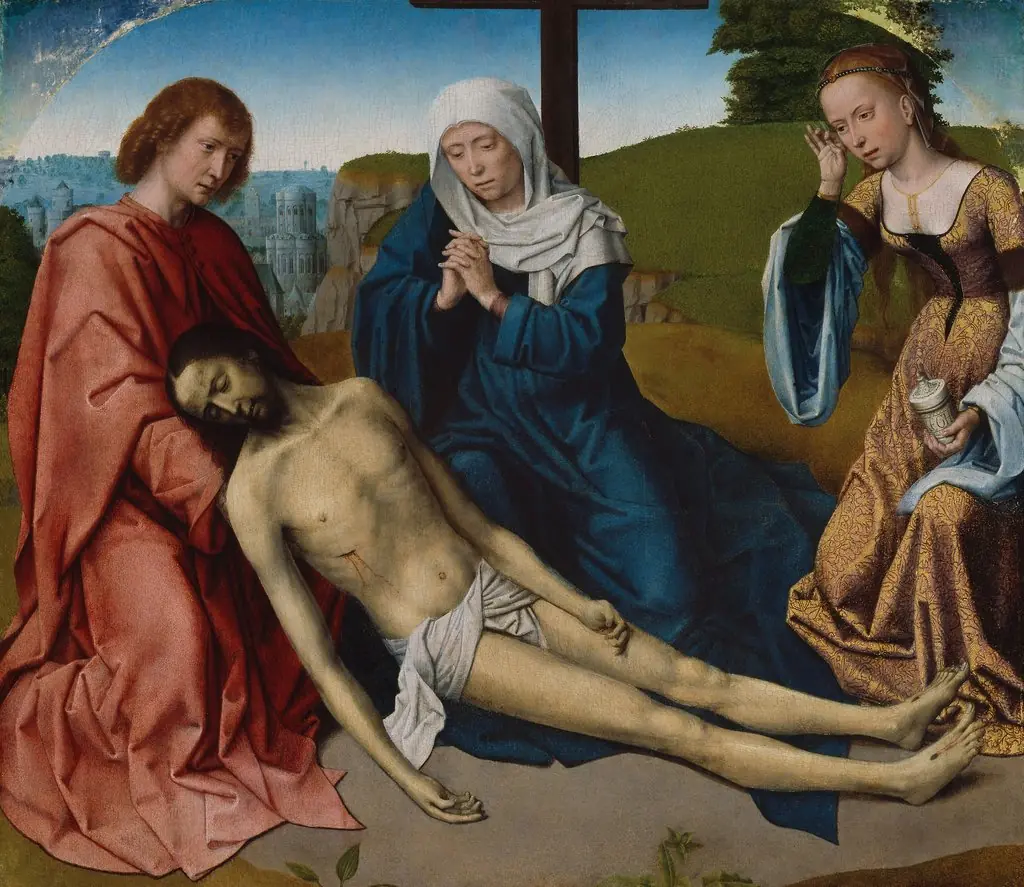
The Miraflores Altarpiece presents a triptych of Marian devotion, arranged chronologically from left to right: the Holy Family, the Lamentation, and Christ’s appearance to the Virgin after the Resurrection. Each panel centers Mary, whose robes carry symbolic color coding, white for purity, red for compassion and grief, and blue for perseverance and fidelity, while inscribed fragments of the Magnificat underscore her role in salvation history.
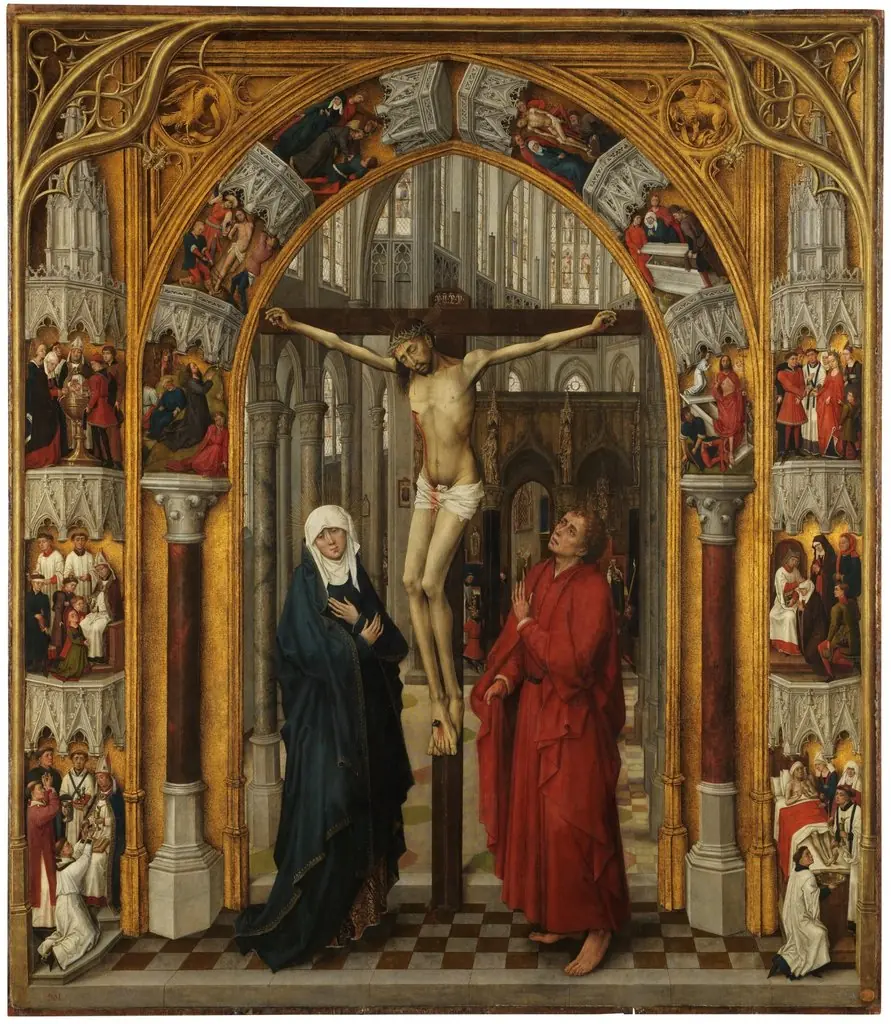
The outer arches frame historiated reliefs that expand the narrative: the left panel’s reliefs depict Christ’s infancy, the central panel’s show Passion antecedents such as the Binding of Isaac, and the right panel’s depict Old Testament prefigurations of resurrection. The winding path in the right panel, absent from biblical text, functions as a temporal device linking tomb to apparition, reinforcing the theological arc of Incarnation, Sacrifice, and Glory.
Technique & Style
The Miraflores Altarpiece is an oil painting executed on oak panels, a characteristic medium and support for Early Netherlandish art. Each of the three panels measures approximately 71 by 43 cm. The work is distinguished by a rich color palette dominated by whites, reds, and blues, which symbolically represent the Virgin Mary's virtues of purity, compassion, and perseverance. Stylistically, the altarpiece features simulated relief sculptures within painted Gothic arches that frame each scene, creating an illusion of depth where the figures appear to occupy a stage-like interior space.
Technical examination via infrared reflectography reveals significant changes in the underdrawing, indicating the artist sought different compositional solutions during creation. The panels, originally fixed rather than hinged, were later modified with hinges, though their backs remain unworked, suggesting the original intent was a stationary display. The work is in good condition following a 1981 cleaning that removed discolored varnishes.
History & Provenance
The Miraflores Altarpiece, a c. 1442-5 oil-on-oak wood panel triptych by Rogier van der Weyden, was created in Brussels and originally commissioned by John II of Castile for the Miraflores Charterhouse near Burgos. It was later owned by William II of the Netherlands before entering the Gemäldegalerie Berlin in 1850. The work depicts three scenes from the Virgin Mary's life: the Holy Family, the Pietà, and the Appearance of the Risen Christ to Mary, arranged chronologically from left to right.
The altarpiece features symbolic color coding for Mary's robes, white for purity, red for compassion, and blue for perseverance, and employs innovative iconographic framing with historiated arches containing relief sculptures that augment each panel's narrative. Technical analysis confirms it was painted around 1437, with pentimenti revealed through infrared reflectography, and it has remained in good condition after conservation in 1981. Two smaller copies exist in Granada and New York, but the Berlin version is recognized as the original based on dendrochronological evidence and stylistic analysis.
The Miraflores Altarpiece is held in the Gemäldegalerie in Berlin, where it carries the inventory number 534A. The museum acquired the work in 1850 through a purchase from the collection of the late King William II of the Netherlands. Prior to this acquisition, the altarpiece had been stolen in 1809 by General Darmagnac from its original location at the Miraflores Charterhouse near Burgos during the Peninsular War. King John II of Castile had originally donated the piece to the monastery in 1445.
Technical investigations conducted at the Berlin museum in 1981 confirmed the work's authenticity as the original by Rogier van der Weyden, overturning earlier beliefs that it was a later copy. The panels were cleaned during this period to remove discolored varnish. While the triptych was originally constructed with fixed panels, hinges were likely added in the sixteenth century.
The work has been presented in various frames throughout the twentieth century, with a new, simple frame installed for its display starting in 2025.
Context
The Miraflores Altarpiece is a c. 1443 oil-on-oak wood panel triptych by Rogier van der Weyden, housed in the Gemäldegalerie Berlin since 1850 and originally commissioned by John II of Castile for the Miraflores Charterhouse near Burgos. Its three panels depict the Holy Family, the Pietà, and the Appearance of the Risen Christ to Mary, arranged chronologically to trace Mary's relationship with Christ across his life. The work employs rich symbolic colour, white for Mary's purity, red for her mourning, and blue for her perseverance, and features Gothic architectural framing with historiated arches containing detailed reliefs that reference Old Testament antecedents to the Passion.
The altarpiece influenced contemporaries such as Petrus Christus, Dirk Bouts, and Hans Memling, particularly in its use of symbolically decorated portals. Technical analysis confirms it as the original Berlin version, distinct from smaller copies in Granada and New York, which lack pentimenti and were likely produced later in van der Weyden's workshop. Its composition reflects Early Netherlandish innovations in emotional depth, spatial complexity, and iconographic integration, situating it within the broader context of 15th-century devotional art and the devotional practices of the Castilian court.
Legacy
The Miraflores Altarpiece exerted a documented influence on contemporary Early Netherlandish painters, particularly in its use of symbolically decorated portals placed as imaginary reliefs in the framing arches. According to scholarship, the triptych informed works by Petrus Christus, Dirk Bouts, and Hans Memling.
Two near-identical but slightly smaller copies survive, in the Metropolitan Museum of Art, New York, and in the Royal Chapel of Granada. These were long considered the originals until a 1981 technical examination of the Berlin panels, combined with dendrochronological analysis and infrared reflectography, established the Berlin version as the autograph work. The copies were likely produced around 1496 by Juan de Flandes for Isabella I of Castile, daughter of the original patron, and were placed in her funerary chapel.
The altarpiece has been held by the Gemäldegalerie in Berlin since 1850, when it was acquired from the collection of the late King William II of the Netherlands. It was cleaned in 1981, and the panels remain in good condition without significant damage.
Overview
The Miraflores Altarpiece, a three‑panel oil work on oak dating from roughly 1442–1445, was created by the Early Netherlandish painter Rogier van der Weyden. Currently housed in Berlin’s Gemäldegalerie, it entered the collection in 1850 after having served a monastic setting in its original context.
Artist & collection
Artist
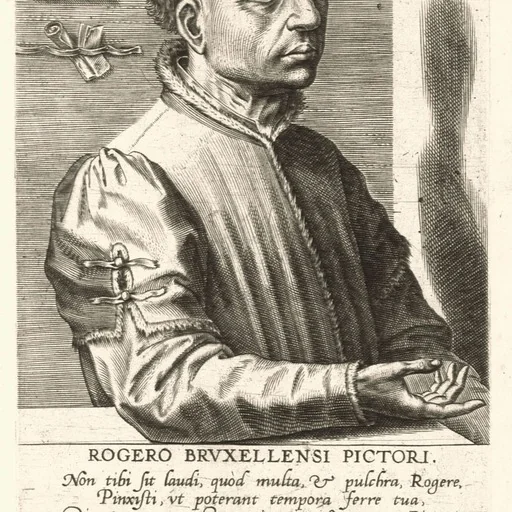
Rogier van der Weyden (Dutch:; 1399 or 1400 – 18 June 1464), initially known as Roger de la Pasture (French: ), was an early Netherlandish painter whose surviving works consist mainly of religious triptychs,…