Artwork
Daphnis
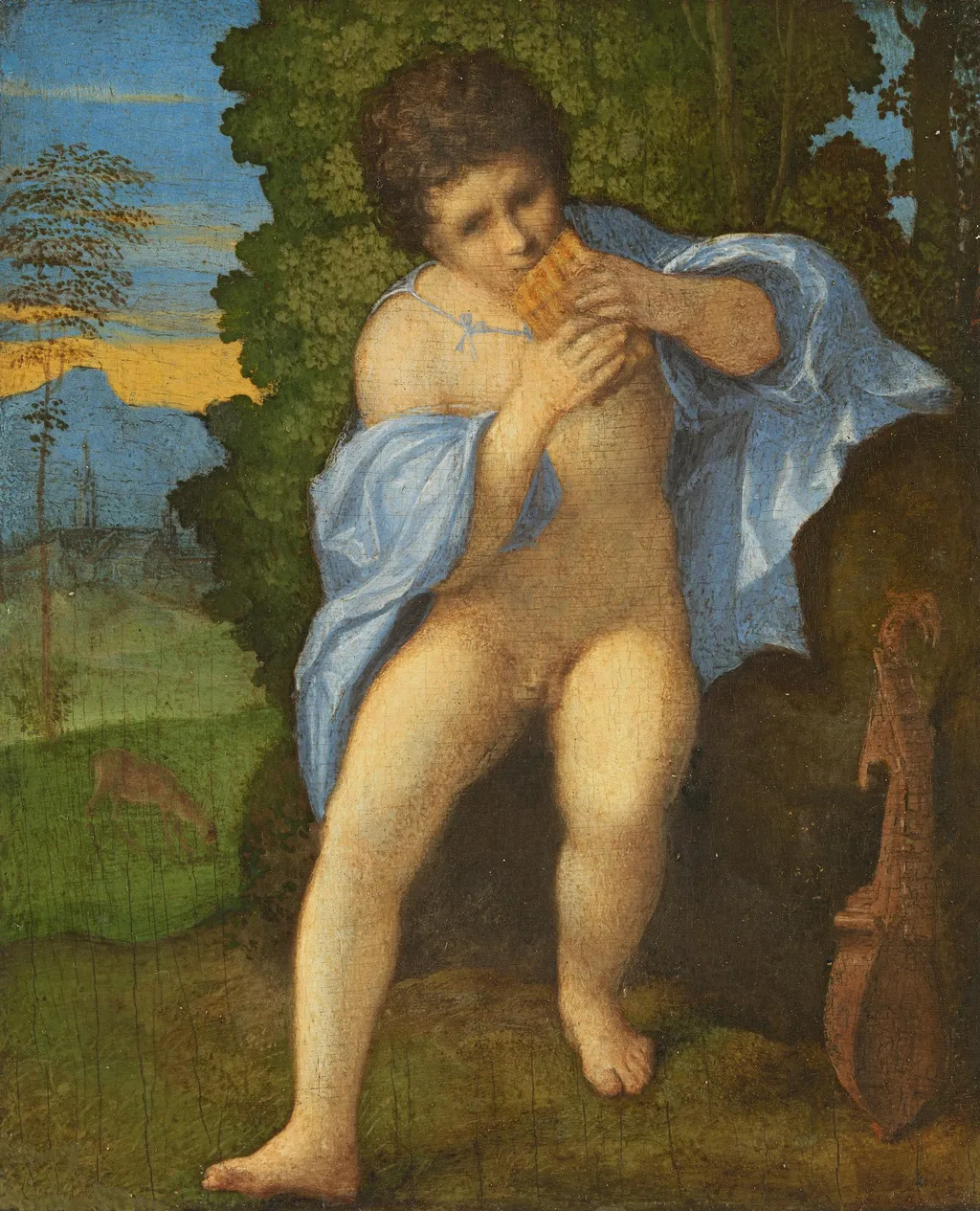
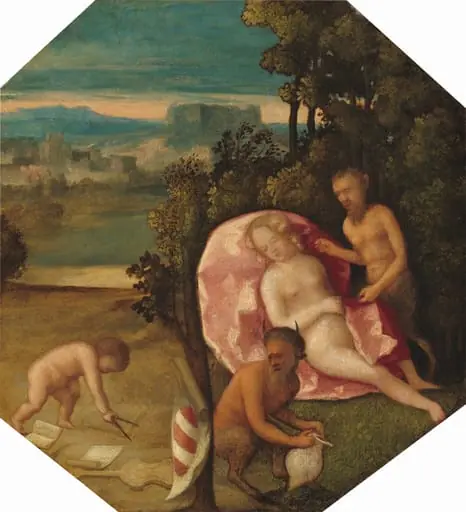
Daphnis is a paint painting by the High Renaissance artist Palma Vecchio. It dates from 1514 and is held in the collection of the Bavarian State Painting Collections.
About this work
Subject & Meaning
The composition centers on the mythological protagonist, with drapery and surrounding scenery establishing a pastoral setting.
The painting depicts Daphnis, a figure from classical pastoral mythology, rendered as a nude youth set within a landscape. The composition centers on the mythological protagonist, with drapery and surrounding scenery establishing a pastoral setting. Among the attributes included in the scene is a syrinx, the pan pipes associated with pastoral music and with the myth of Daphnis, and a cittern, a stringed instrument suited to the bucolic theme.
Together these elements frame the work as a mythological painting in the Venetian High Renaissance tradition, where the pastoral genre was used to evoke idealized rustic life and the lyrical associations of the Daphnis legend.
The nudity of the figure, combined with the musical instruments and landscape, underscores the painting's thematic focus on the shepherd-poet of antiquity and the sensual, musical world of pastoral mythology.
Technique & Style
The work is executed on a poplar wood panel using paint, as recorded in the catalog entry. Its execution belongs to the High Renaissance Venetian school and falls within the mythological genre, depicting the shepherd Daphnis in a state of nudity, draped in flowing fabric, set against an idealised landscape that includes a syrinx and a cittern. The composition combines graceful figure modeling with a lyrical, pastoral atmosphere typical of Palma Vecchio’s output in 1514.
The painting is housed in the Bavarian State Painting Collections at the Alte Pinakothek, displayed in the small gallery on the upper floor.
History & Provenance
Daphnis is a poplar panel painting attributed to Palma Vecchio, executed in 1514. The work belongs to the mythological genre and measures 19.6 cm in height by 16.4 cm in width. It depicts the pastoral deity Daphnis in a composition that combines nudity, drapery, a syrinx and a cittern within a landscape.
The painting has been part of the Bavarian State Painting Collections since its acquisition and is exhibited in the Alte Pinakothek’s small gallery 4 on the upper floor. Its creation is linked to the High Renaissance Venetian school, reflecting the stylistic traits of that period.
The painting Daphnis by Palma Vecchio is housed in the Bavarian State Painting Collections and is on view in the small gallery 4 of the Alte Pinakothek in Munich. It is executed on poplar wood and measures 19.6 cm by 16.4 cm, dating to 1514. The work belongs to the mythological genre and is classified as a High Renaissance piece within the Venetian school.
Its presence in the museum’s permanent display reflects its inclusion in the institution’s catalogue, though no specific accession number is recorded in the available documentation.
Legacy
The painting Daphnis by Palma Vecchio, executed in 1514 on poplar wood, is housed in the Bavarian State Painting Collections and displayed in the Alte Pinakothek's small gallery 4. As a mythological work within the High Renaissance Venetian school, it exemplifies the era’s interest in pastoral narratives and nudity, and has been referenced in scholarly discussions of Palma Vecchio’s oeuvre and the development of mythological painting in Italy. Its inclusion in a major public collection has contributed to ongoing assessments of the artist’s role in bridging High Renaissance technique with poetic subject matter.
Overview
Palma Vecchio, a Venetian artist of the Italian High Renaissance, completed Daphnis in 1514. This painting on poplar wood depicts the mythological figure Daphnis within a natural landscape, holding a musical instrument. The work exemplifies the artistic trends of its period, characterized by a focus on classical themes and a harmonious rendering of form and setting. It is currently housed in the collection of the Alte Pinakothek.
Context
The artist, Jacopo Negretti, adopted the name Palma Vecchio, or "Palma the Elder," to distinguish himself from his great-nephew, Palma il Giovane, who also became a notable painter. This naming convention helped clarify their individual contributions within the Venetian art scene. Palma Vecchio's work, including Daphnis, reflects the artistic environment of early 16th-century Venice, known for its rich color and attention to light.

Own this work as a print
Artist & collection

Artist
Palma Vecchio (c. 1480 – 30 July 1528), born Jacopo Palma, also known as Jacopo Negretti, was a Venetian painter of the Italian High Renaissance. He is called Palma Vecchio in English and Palma il Vecchio in Italian…




- The Infant Bacchus
 Allegorische weibliche Figur
 Venus with Cupid Stealing Honey
 Allegory
 Apollo and Diana
 Adam and Eve with Cain and Abel
 Venus with Cupid the Honey Thief
 Madonna and Child and the Infant Saint John in a Landscape
 Landscape with Satyr Family
 Allegory
 The Rest on the Flight into Egypt
 A Faun and His Family with a Slain Lion