Artwork
The Holy Family with St Catherine and the Infant St John
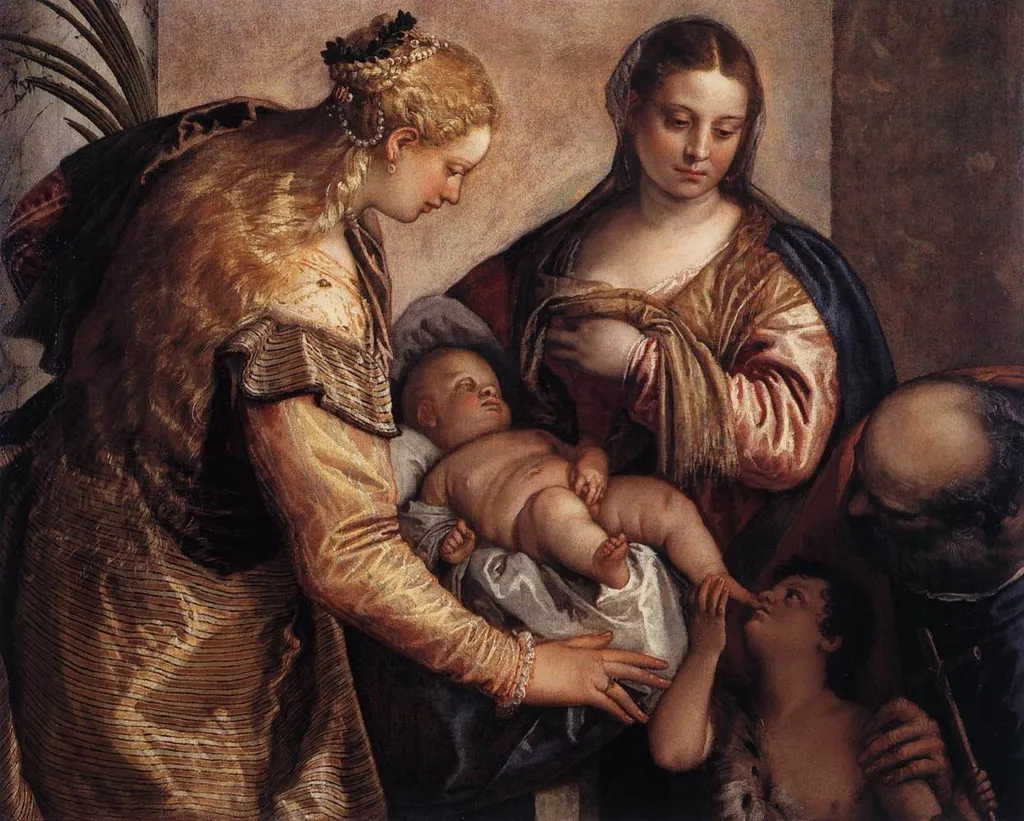
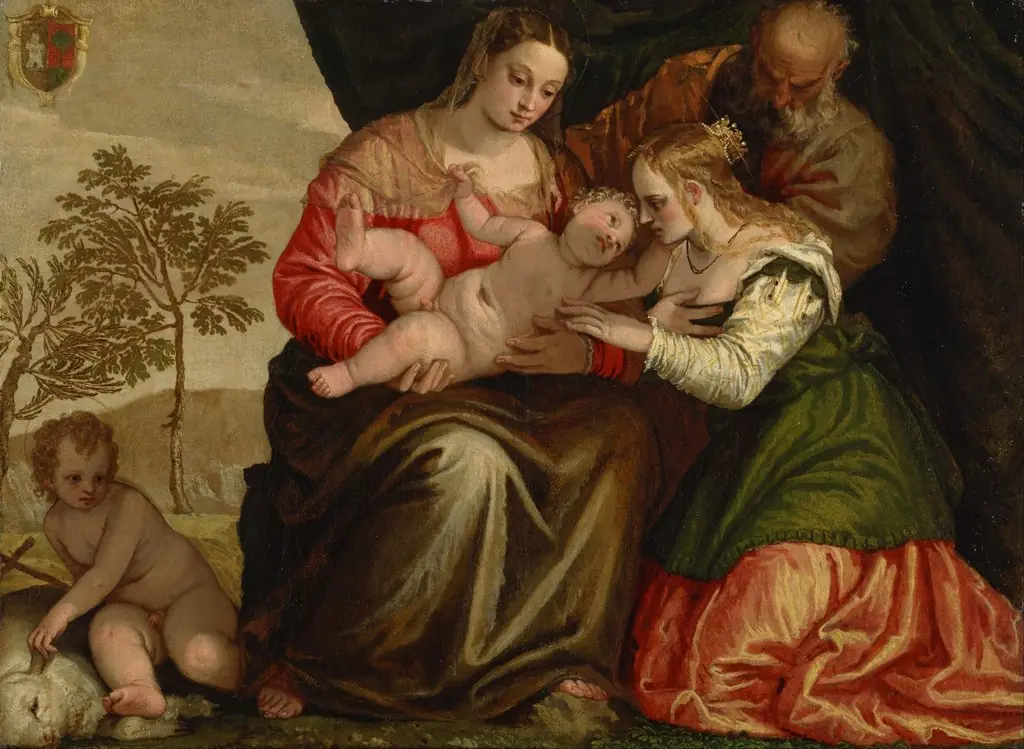
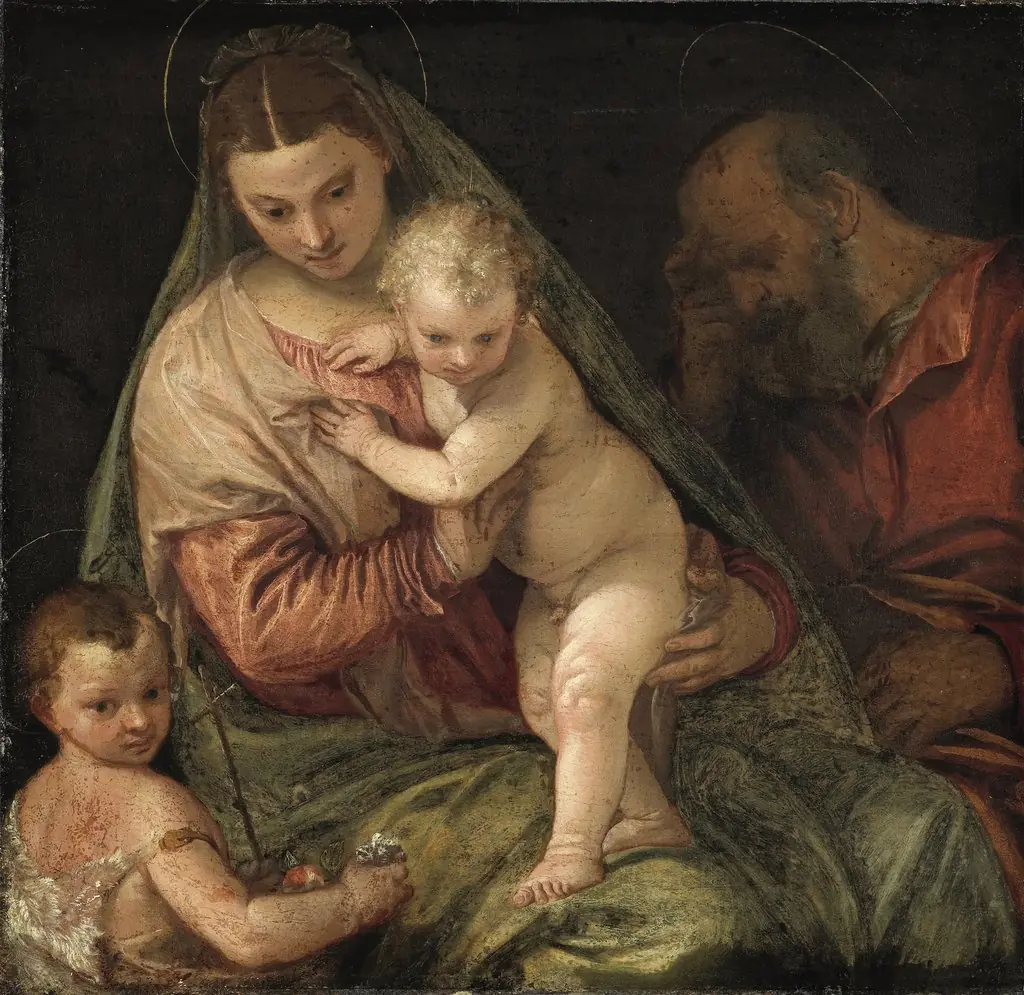
The Holy Family with St Catherine and the Infant St John is an oil painting by the Mannerist artist Paolo Veronese. It dates from 1570 and is held in the collection of the Uffizi Gallery.
About this work
Subject & Meaning
This attribution is supported by her gesture of offering a hand with a ring, symbolizing the mystical marriage central to her iconography.
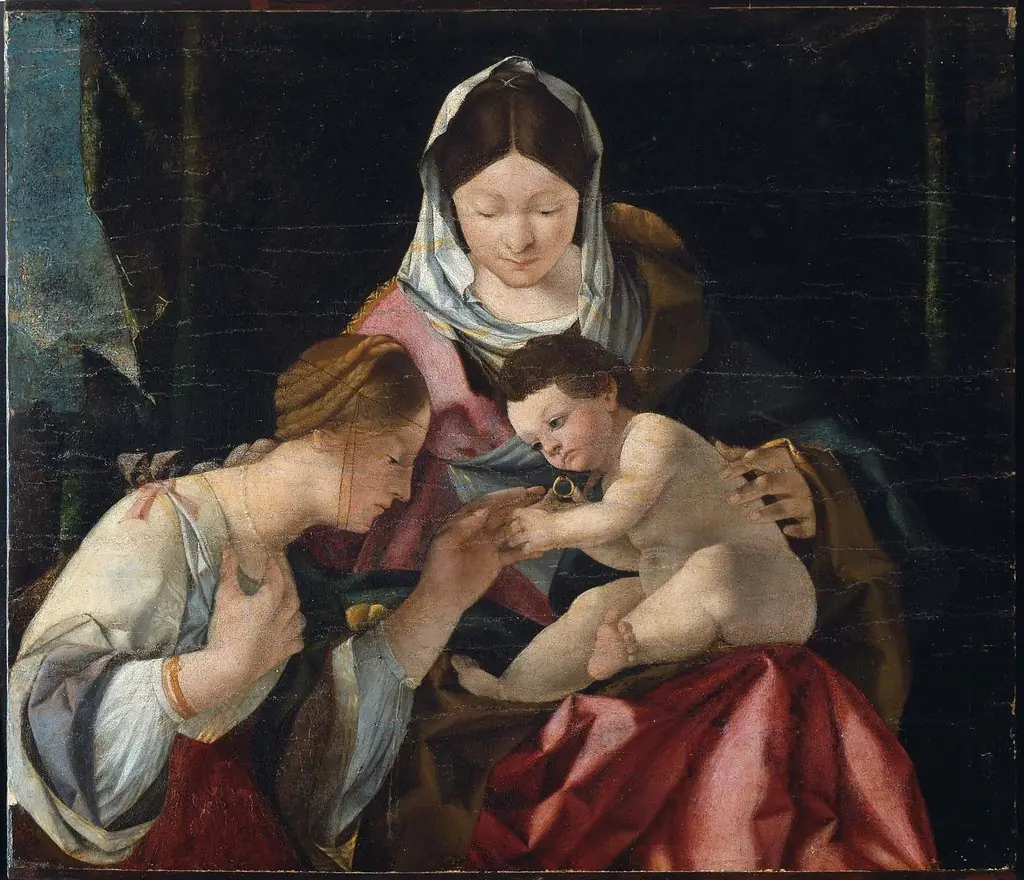
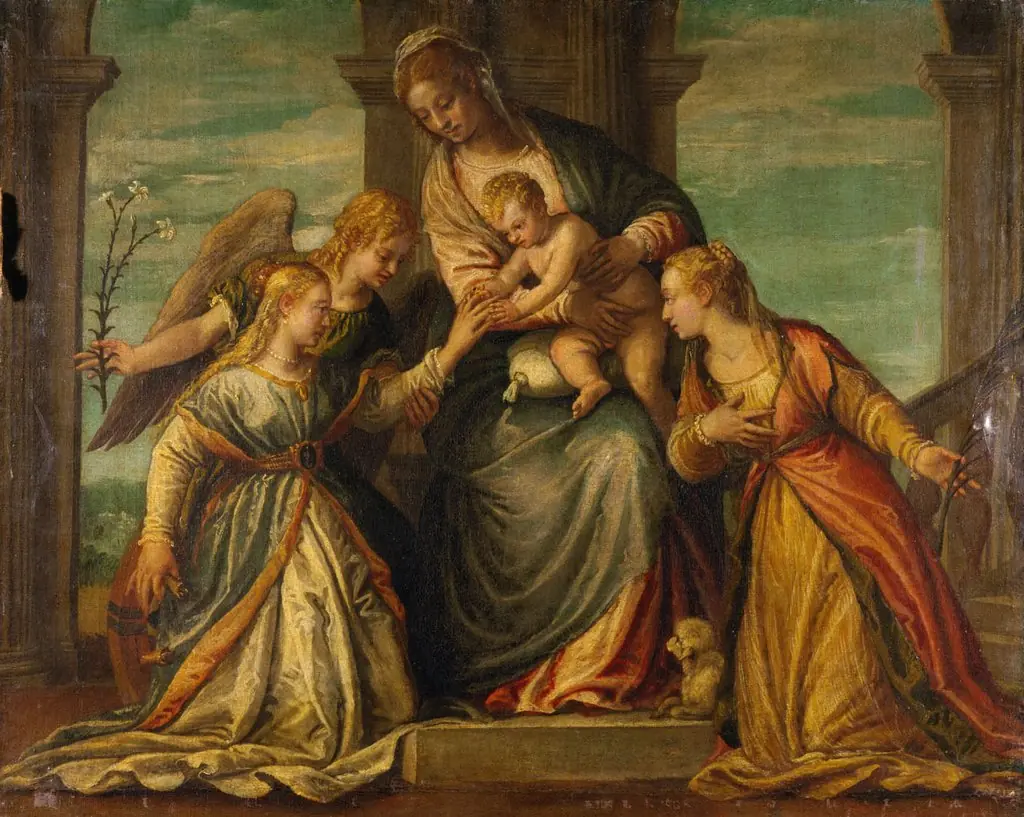
The painting depicts the Holy Family alongside the Infant St. John and a female saint, set against a neutral background interrupted only by a wall edge. Mary presents the sleeping Christ Child to the figures surrounding him: St. John kisses the infant's foot while St. Joseph leans over with a paternal hand on the child's shoulder. The female saint, dressed as a princess and holding a palm of martyrdom, is the subject of iconographic debate. While some modern studies suggested St. Barbara, the prevailing interpretation identifies her as St. Catherine of Alexandria. This attribution is supported by her gesture of offering a hand with a ring, symbolizing the mystical marriage central to her iconography. The composition, arranged along a diagonal, emphasizes the devotional homage paid to the Christ Child by the surrounding saints.
Technique & Style
Executed in oil on canvas, this work measures 86 by 122 cm. The composition features figures arranged along a diagonal against a neutral background interrupted only by a wall edge. Stylistically, the painting is distinguished by the refinement of its poses and the material rendering of fabrics, alongside specific lighting effects that highlight the saint's blond hair and intricate hairstyle. The interplay of light and shadow contributes to the work's overall quality. A conservation treatment undertaken in 1988 removed an old, yellowed layer of repaint, revealing the original chromatic values and allowing these formal qualities to be fully appreciated.
History & Provenance
No surviving records identify the original commissioner, though scholarship suggests the Barbaro family, who previously engaged the artist and held Saint Catherine as their patron saint. The painting is generally dated to the mid-1560s, specifically c.1562-1565, a period reflecting Tintoretto's influence, despite some debate regarding its placement in the artist's early or late career. By 1648, the work was documented in Venice at the residence of the Windmann family near the church of San Canciano. In 1654, Paolo del Sera, acting as agent for Cardinal Carlo de' Medici, sold the canvas to the cardinal. Following Carlo's death, and on del Sera's recommendation, Cardinal Leopoldo de' Medici acquired the piece from his own estate. The painting entered its current collection in Florence in 1798, having passed through the Medici collections. The work is held in the Uffizi Gallery in Florence. Its inventory number is Uffizi inv. 1890-813. It was sold in 1654 by Paolo del Sera to Cardinal Carlo de' Medici and later entered the collection of Cardinal Leopoldo, passing to the Uffizi in 1798. The painting was documented in Venice in 1648 in the residence of the Windmann family. It has been exhibited in The Art of Paolo Veronese, 1528-1588 (1988).
Context
The painting occupies a debated place within Paolo Veronese's chronology, with scholarship divided between an early dating and a later one around 1562-1565, the latter view prevailing and situating the work close to the Pala di San Zaccaria in the Accademia Galleries. The late dating reflects the influence of Tintoretto on Veronese's mature style. Authorship has never been seriously questioned, the picture having been praised for its high quality as early as Marco Boschini, though Fiocco once proposed that the canvas may originally have been larger, a hypothesis now largely rejected in light of an almost identically sized copy at the Baltimore Museum of Art. The work's place in art history is also tied to its early modern reception: lacking surviving commission records, Martinelli theorised a Barbaro family patronage, since Saint Catherine of Alexandria was their patron and the family had previously commissioned Veronese. Conservation in 1988, ahead of the exhibition The Art of Paolo Veronese, 1528-1588, removed an aged yellowed repaint and restored the refined diagonal poses, tactile fabrics, and luminous effects for which the painting is noted. The painting's iconographic identification of the female saint has likewise generated scholarly debate, with ancient sources naming Catherine of Alexandria and modern studies proposing Saint Barbara; the Catherine reading, supported by the ring-bearing gesture evoking the mystical marriage, is now generally preferred.
Artist & collection
Artist
Paolo Caliari (1528 – 19 April 1588), known as Paolo Veronese ( VERR-ə-NAY-zay, -zee, US also -see; Italian: ), was an Italian Renaissance painter based in Venice, known for extremely large history paintings of…