Artwork
Baptism of Christ
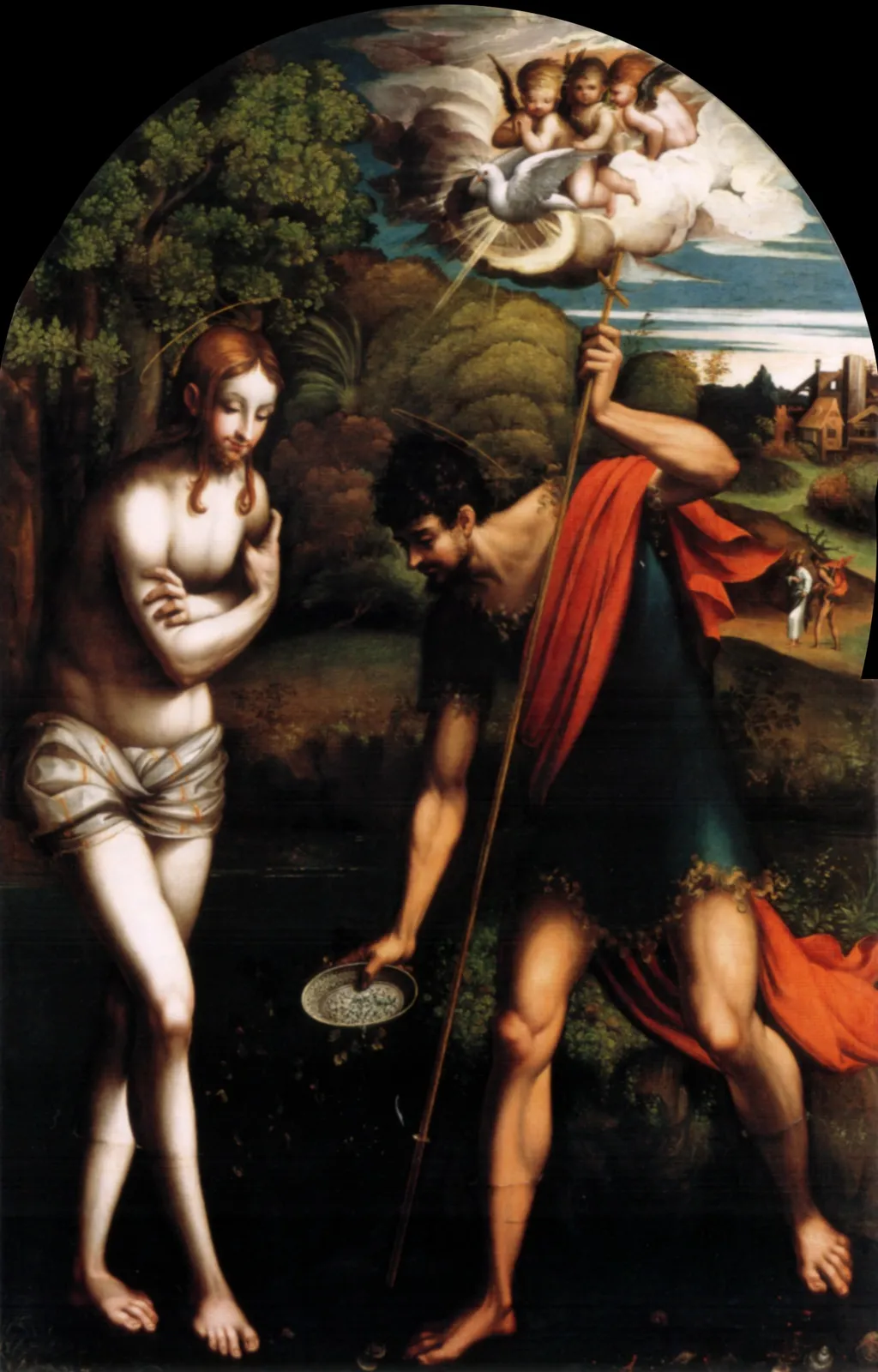
Baptism of Christ is an oil painting by the High Renaissance artist Parmigianino. It dates from 1519 and is held in the collection of the Gemäldegalerie Berlin.
About this work
Subject & Meaning
This religious narrative highlights the moment of divine revelation, underscored by the presence of the Holy Spirit and the attentive angels.
The painting depicts the biblical event of the Baptism of Jesus, featuring the central figures of Christ and John the Baptist. Christ stands with arms crossed to receive the sacrament in the Jordan River, while the Baptist bends to collect water in a basin. Above the scene, three putti appear on a small cloud, witnessing the descent of the dove representing the Holy Spirit. The composition is set within a landscape that includes a wooded area on the left and a road leading to a town on the right, where two additional figures are visible. This religious narrative highlights the moment of divine revelation, underscored by the presence of the Holy Spirit and the attentive angels.
Technique & Style
Executed circa 1519, this work is an oil painting on a poplar panel measuring 197 by 137 cm. It represents the earliest surviving piece by the artist, created when he was approximately sixteen years old. Stylistically, the composition emphasizes the monumentality of the two primary figures, Jesus and John the Baptist, set within a landscape featuring a wooded area and a distant town. While the panel displays certain archaic qualities, it reveals early indications of the elongated anatomies characteristic of the artist's later oeuvre. The treatment of forms suggests influences from Correggio and Francia, yet notably lacks Leonardesque sfumato. Despite its early date, the handling of the medium demonstrates a technical proficiency that historically prompted admiration for such a youthful creator.
History & Provenance
The *Baptism of Christ* is an oil-on-panel painting executed by Parmigianino around 1519, recognized as the earliest surviving work by the artist, who was approximately sixteen years old at the time. Giorgio Vasari recorded that this panel, depicting John the Baptist baptizing Christ, was originally placed in the Church of the Nunziata in Parma. The painting remained in the Garbazza chapel of the Church of Saint John the Evangelist until 1546, when the church was demolished; it was subsequently moved to a new location within the same church under the patronage of the Torelli family. Following the confiscation of Torelli assets in 1611, the work was documented in the sacristy of the Nunziata by 1671 before being acquired by Count Carlo Sanvitale in 1706. By 1857, the panel had left the Sanvitale collection and entered the possession of Edward Solly in England, who sold it to the Berlin museums in 1821.
The painting is held by the Gemäldegalerie in Berlin, where it remains today.
Its documented history begins in Parma, where it was originally placed in the Nunziata church run by the frati de' Zoccoli, as recorded by Vasari. After passing through the chapel of the Torelli family at San Giovanni Evangelista, it was confiscated in 1611 following the family's condemnation for a plot against the Farnese. The panel was subsequently acquired by Count Carlo Sanvitale in 1706 for 4,200 lire. By 1821 it had entered the collection of Edward Solly in England, from which it was purchased by the Berlin museum.
Catalogued as autograph by Waagen in 1837 and Nagler in 1838, the work was sent on deposit to the parish church of Rederitz in 1866, where it was effectively forgotten until Grey Voss identified it there in 1923 and restored it to Parmigianino scholarship.
Context
Executed circa 1519 when the artist was sixteen, this panel is widely recognized as Parmigianino's earliest surviving work. Its attribution relies heavily on Giorgio Vasari's account of a miraculous painting created by a child for the Nunziata church in Parma. While most scholars accept this provenance, Carlo Arturo Quintavalle controversially rejected the Italian attribution in 1948, suggesting a Flemish origin due to the work's rigid style, a view linked to earlier observations of its northern characteristics. Later studies, including Di Giampaolo's 1991 analysis of background architecture, have reinforced the traditional attribution. Stylistically, the composition displays archaic forms alongside emerging Mannerist traits, such as elongated anatomies, while reflecting influences from Correggio and Francia rather than Leonardo da Vinci. The painting's complex history, involving confiscation and eventual acquisition by the Gemäldegalerie in Berlin, underscores its significance in tracing the artist's developmental trajectory from precocious youth to mature innovator.
Legacy
The Baptism of Christ exerted a lasting influence on later artists through its innovative composition and emotional depth. Its depiction of Christ and John the Baptist in a dynamic, naturalistic setting helped shape High Renaissance approaches to religious narrative. The work was widely referenced in 16th- and 17th-century accounts, including Vasari's Lives, which highlighted its creation by the young Parmigianino and contributed to his early reputation. Subsequent movements and artists drew on its stylized figures and atmospheric landscape, particularly its use of elongated forms and symbolic elements like the dove. The painting's journey through private collections and institutional acquisitions, including its transfer to the Gemäldegalerie in Berlin, cemented its status as a key example of early Mannerist innovation in religious art.
Own this work as a print
Artist & collection

Artist
Girolamo Francesco Maria Mazzola (11 January 1503 – 24 August 1540), also known as Francesco Mazzola or, more commonly, as Parmigianino (UK: US: Italian:; "the little one from Parma"), was an Italian Mannerist painter…