Artwork
Portrait of Jacob Meyer de Haan
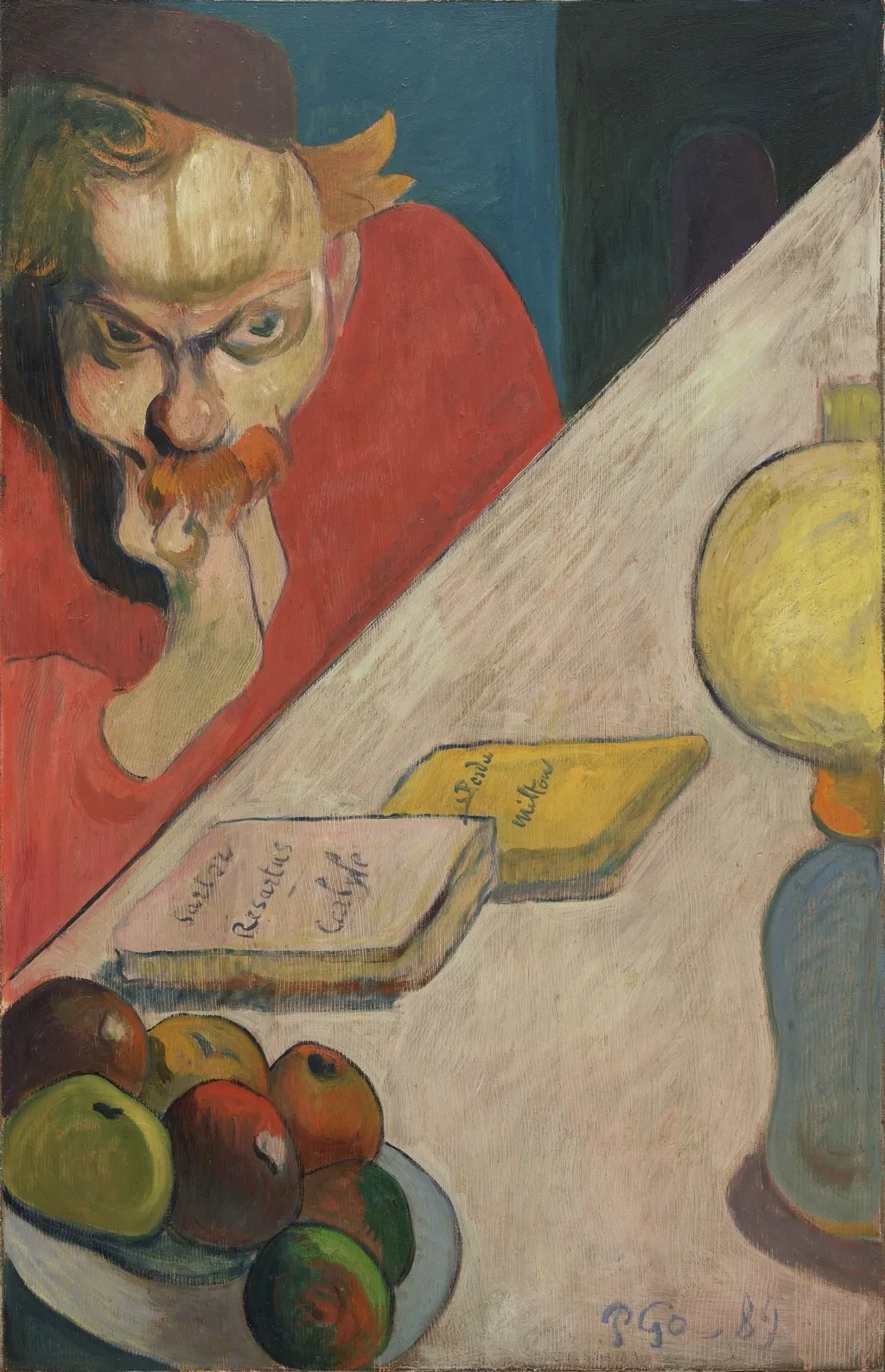
Portrait of Jacob Meyer de Haan is an oil painting by the Post-Impressionist artist Paul Gauguin. It dates from 1895 and is held in the collection of the Museum of Modern Art.
About this work
Overview
Painted in 1895, this oil portrait by Paul Gauguin captures Jacob Meyer de Haan, a Dutch artist and associate from his time in Brittany. The work reflects Gauguin’s move away from naturalism toward symbolic composition, using color and arrangement to convey inner states rather than literal representation. It is held in the collection of the Museum of Modern Art in New York.
Subject & Meaning
These elements frame the sitter not merely as a person but as a thinker engaged with existential ideas.
Meyer de Haan is depicted in a pensive pose, chin resting on his hand, suggesting deep reflection. Surrounding him are objects tied to intellectual and spiritual themes: a book likely referencing Milton’s Paradise Lost and Carlyle’s Sartor Resartus, an oil lamp symbolizing enlightenment, and fruit evoking biblical or mythological abundance. These elements frame the sitter not merely as a person but as a thinker engaged with existential ideas.
Technique & Style
Gauguin employs flat planes of unmodulated color and bold outlines, characteristic of Synthetism. The dark blue background isolates the figure, while the red of his shirt and beard intensifies visual focus. Objects on the table are rendered with simplified forms, their placement deliberate rather than naturalistic. Light is not modeled realistically but used symbolically, enhancing the painting’s meditative tone.
History & Provenance
Created during Gauguin’s stay in Brittany, the portrait was made shortly before his departure to Tahiti. Meyer de Haan, a fellow artist and disciple, had been part of Gauguin’s artistic circle in Pont-Aven. The painting remained in private hands until acquired by the Museum of Modern Art, where it entered its permanent collection in the 20th century.
Context
This work emerged from Gauguin’s broader rejection of Impressionist naturalism. Influenced by religious symbolism, literature, and non-Western art, he sought to express spiritual and emotional truths through simplified forms and symbolic content. Meyer de Haan’s inclusion reflects Gauguin’s interest in intellectual companionship during a period of artistic reinvention.
Legacy
The portrait stands as an early example of Gauguin’s mature symbolic style, influencing later Expressionist and Symbolist movements. Its integration of literary references and psychological depth expanded the possibilities of portraiture beyond likeness, paving the way for modern artists to treat the human figure as a vessel for abstract ideas.
Own this work as a print
Artist & collection
Artist
Eugène Henri Paul Gauguin (; French:; 7 June 1848 – 8 May 1903) was a French painter, sculptor, printmaker, ceramist, and writer, whose work has been primarily associated with the Post-Impressionist and Symbolist movements.