Artwork
Nude
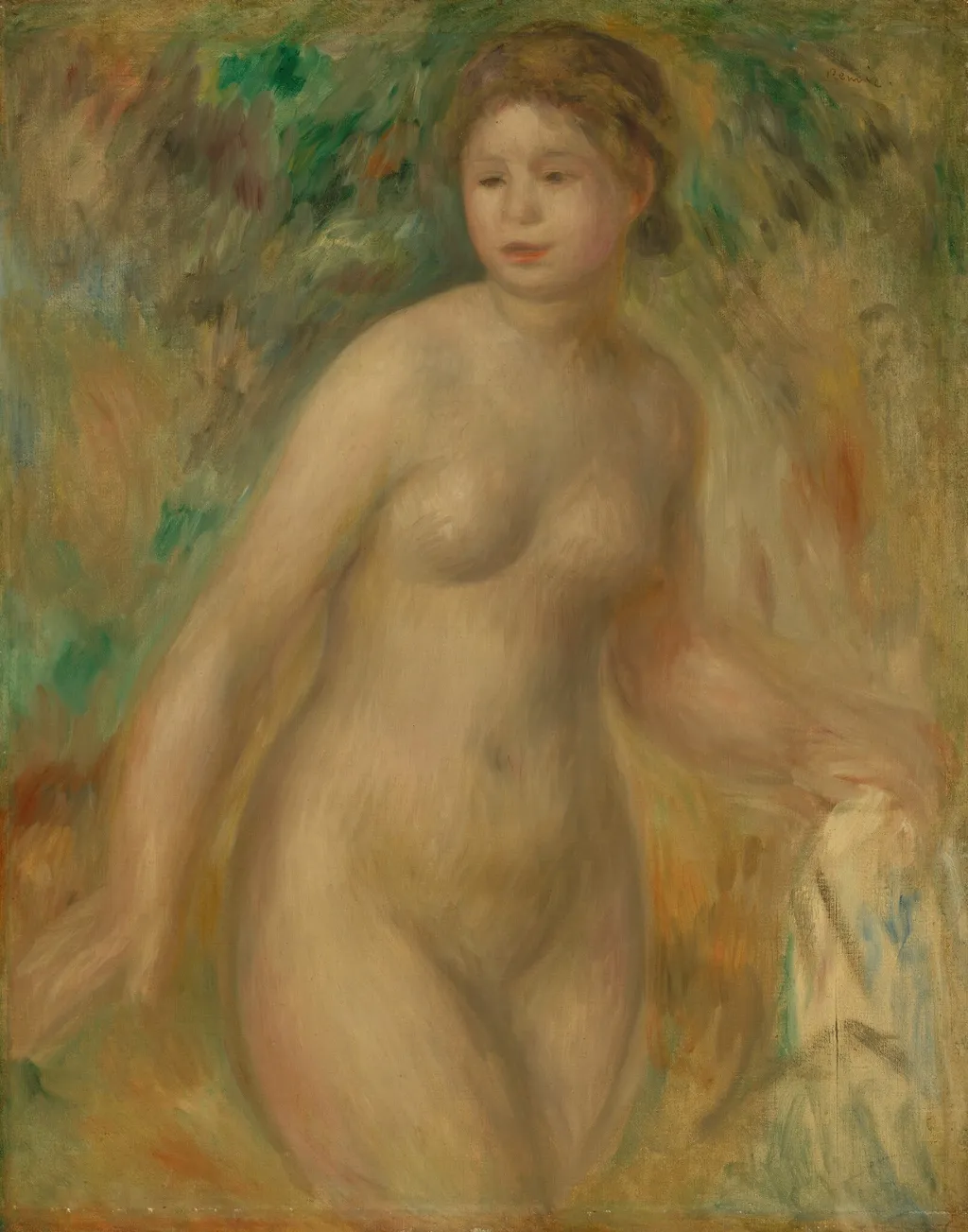
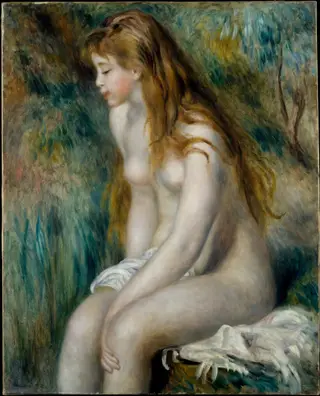
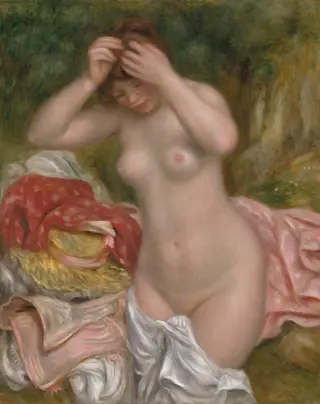
Nude is an oil painting by the Impressionist artist Pierre-Auguste Renoir. It dates from 1895 and is held in the collection of the National Gallery of Art.
- Inscription
- Inscribed:upper right: Renoir.
About this work
A nude woman stands in a natural setting, a cloth in her left hand, her body the center of the scene. The background blends green, orange, and brown in soft, loose strokes. An Impressionist oil by Auguste Renoir, painted in 1895.
Subject & Meaning
The work's iconography is limited to the anatomical form, suggesting an emphasis on sensuality and formal composition rather than symbolic narrative.
The painting titled Nude, executed by Auguste Renoir in 1895, portrays a solitary female figure rendered in oil on canvas. It belongs to the genre of nude painting, a category that emphasizes the study of the human body without narrative or allegorical accessories. The work's iconography is limited to the anatomical form, suggesting an emphasis on sensuality and formal composition rather than symbolic narrative.
Documentation from the National Gallery of Art records its provenance from the artist to successive dealers and collectors before its donation in 1967, confirming its status as an example of Renoir's late-period nudes.
Technique & Style
Auguste Renoir's Nude is executed in oil paint on canvas, a medium consistent with his late-career practice. The painting is relatively modest in scale, measuring 84.3 cm in height by 67.1 cm in width, an upright format suited to a single standing figure. The support is a standard canvas prepared for oil work, and the handling reflects Renoir's characteristic late style, with soft, blended brushwork and warm, luminous flesh tones built up through layered paint.
The composition is restricted to the nude genre, focusing on the figure without narrative setting or elaborate background detail. The work is held by the National Gallery of Art in Washington, D.C., where it has been held since its 1967 gift from Eugene and Agnes Ernst Meyer.
History & Provenance
Auguste Renoir completed this oil on canvas in 1895. The work remained with the artist until approximately that year, when it passed to Roux de Billancourt in Paris. Following Roux de Billancourt's death, the painting was sold at Hôtel Drouot on November 25, 1898, where it was acquired by the dealership Durand-Ruel et Cie.
In 1916, the firm sold the piece through dealer Jos Hessel to the collector Dikran Khan Kélékian. Upon Kélékian's estate sale at the American Art Association in New York on January 30, 1922, the artist Charles Sheeler purchased the work. It subsequently entered the collection of Eugene and Agnes Ernst Meyer, who held it in Mount Kisco and Washington, D.C., before donating it to the National Gallery of Art in 1967, where it was accessioned. Specific exhibition history details beyond its institutional location are not provided in the available records.
Legacy
The painting changed hands several times after leaving Renoir's studio, passing from Durand-Ruel to Jos Hessel in 1916 and then to Dikran Khan Kélékian, whose 1922 sale brought it to Charles Sheeler. Sheeler and his wife later gifted the work to the National Gallery of Art in 1967, where it remains. Its inclusion in a premier public collection has allowed scholars to study the piece as an example of Renoir's late nudes, shaping interpretations of his treatment of the female form. The work is catalogued in the Gallery's records as an oil on canvas nude.
Overview
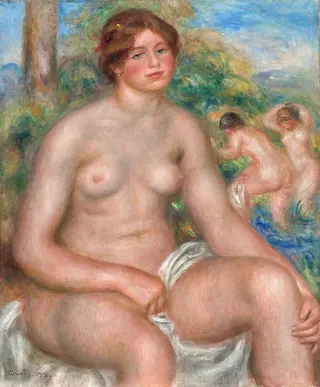
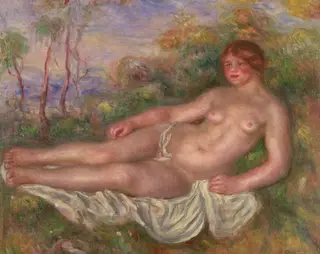
This oil on canvas painting, titled Nude, was created by Auguste Renoir around 1895. It features a female figure depicted in a natural outdoor environment. The artwork exemplifies Renoir's ongoing exploration of the human form, particularly the female nude, a recurring motif throughout his career. The composition emphasizes the figure's presence within a softly rendered landscape.
Context
Nude aligns with the principles of Impressionism, the artistic movement with which Renoir is closely associated. While the painting dates to a later period in his career, it retains the Impressionist emphasis on capturing fleeting moments and the effects of light. Renoir's focus on the female figure, rendered with a soft palette and fluid brushwork, reflects a common theme within the movement, often depicting everyday life or intimate scenes.
Own this work as a print
Artist & collection
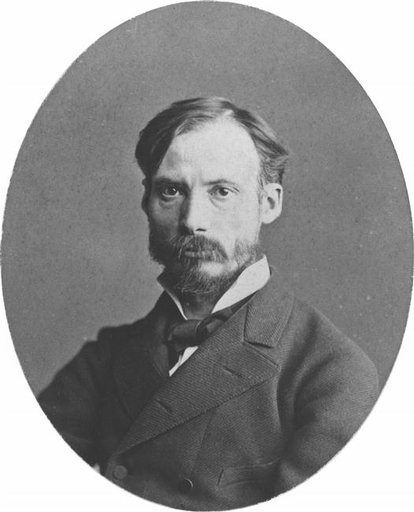
Artist
Pierre-Auguste Renoir was a French artist who was a leading painter in the development of the Impressionist style.