Artwork
The Old Shambles, Manchester, Lancashire
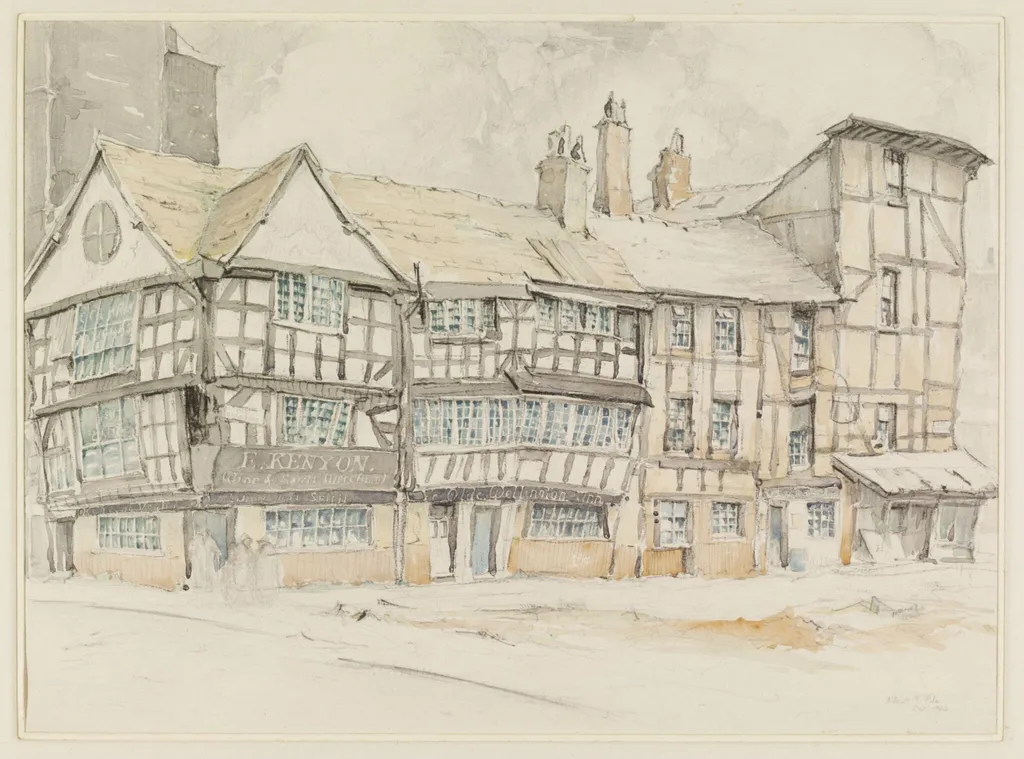
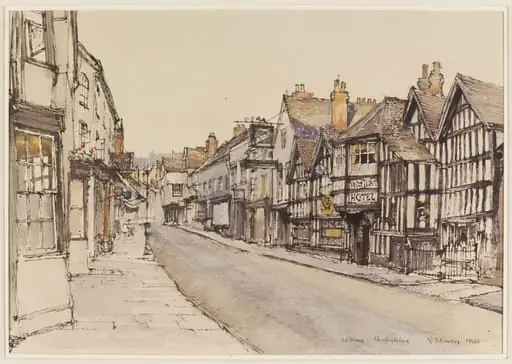
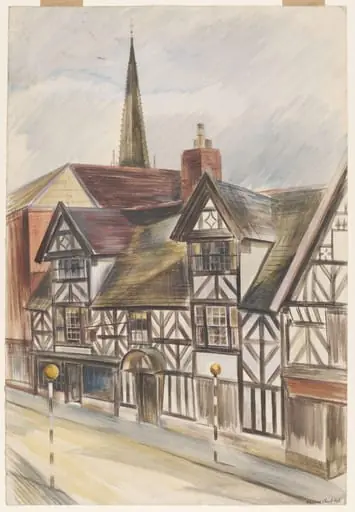
The Old Shambles, Manchester, Lancashire is a watercolor work on paper by the Social Realist artist Albert Pile. It dates from 1942 and is held in the collection of the Victoria and Albert Museum. Created in 1942, this watercolour captures the final surviving stretch of medieval timber-framed buildings in Manchester.
About this work
Overview
The work reflects a deliberate effort to document everyday historic structures before they vanished, emphasizing their fragile presence amid urban change.
Created in 1942, this watercolour captures the final surviving stretch of medieval timber-framed buildings in Manchester. Painted during World War II, it was part of the Recording Britain project, which sought to preserve visual records of at-risk architecture. The work reflects a deliberate effort to document everyday historic structures before they vanished, emphasizing their fragile presence amid urban change.
Subject & Meaning
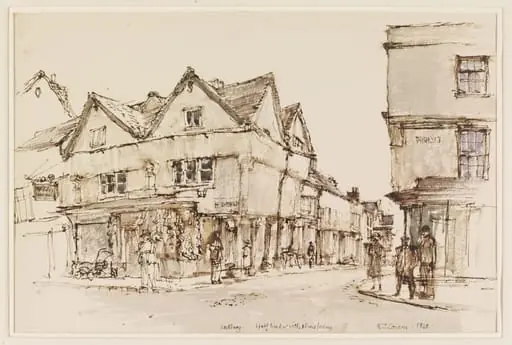
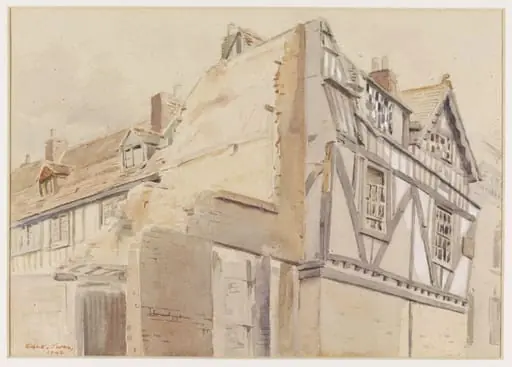
The scene portrays a row of decaying half-timbered houses along a narrow street, once part of Manchester’s commercial heart. The presence of a wine and spirit merchant’s sign hints at the site’s former function as a trading space. The buildings’ uneven forms and worn surfaces suggest decades of use and neglect, transforming the architecture into a quiet testament to the passage of time and the erosion of urban memory.
Technique & Style
Rendered in watercolour, the painting uses delicate washes to convey texture and light. Dark timber beams contrast with pale plaster infill, while small square windows, some with faint blue glazing, add subtle detail. The artist employed loose, observational brushwork to capture the irregularity of the structures, avoiding idealization in favor of a candid, almost documentary approach to form and decay.
History & Provenance
Commissioned by the Pilgrim Trust under the direction of Sir Kenneth Clark, this piece was produced as part of the Recording Britain initiative. The project enlisted artists to travel across the country, recording vernacular architecture threatened by war or modernization. The watercolour entered the Victoria and Albert Museum’s collection as part of this national archive, preserving it for future study.
Context
During the early 1940s, British cities faced increasing risk from aerial bombing and postwar redevelopment. The Recording Britain project emerged as a cultural safeguard, responding to fears that historic sites might disappear without record. This watercolour, like others in the series, reflects a broader anxiety about loss, not only of buildings, but of the tangible links to local identity and history.
Legacy
The painting remains a key document in the archive of British topographical art. It contributes to ongoing efforts to understand pre-war urban landscapes and the role of art in heritage preservation. Though the physical structures it depicts are now gone, the watercolour endures as a quiet record of a vanished streetscape, valued for its historical fidelity rather than aesthetic flourish.
Artist & collection
Artist
Albert Pile painted British cityscapes in watercolour during the 1940s. In The Old Shambles, Manchester, Lancashire you can see terraced buildings with narrow gables and a wet street reflecting gas-lamp glow in October…